The Shanghai accent in Mandarin, and where it comes from
The Shanghai accent in Mandarin is Shanghainese showing through: people who grew up speaking Shanghainese carry its sounds into the Mandarin they learned at school. The best-documented signs are an s where standard Mandarin has sh, -n and -ng said alike after some vowels, and h and w blurred in names such as 黄 and 王, with a few Shanghainese words on top. This page goes through each one, says what research has found about it, and shows the feature of Shanghainese behind it.
Tap 🔊 to hear an example. Shanghainese examples play the recordings from Verbavia’s course, made with a Shanghainese voice; Mandarin examples play a Mandarin voice.
On this page
- What is Shanghai Mandarin?
- s for sh: the missing retroflex sounds
- One nasal for two: -n and -ng
- h and w: why 黄 and 王 sound alike
- The accent in three pairs
- Two southern habits: fuller tones, and no -r
- Shanghainese words in Shanghai Mandarin
- Is the Shanghai accent the same as other southern accents?
- Do younger Shanghai people still have the accent?
- What this means for a Mandarin learner
- Quick questions
What is Shanghai Mandarin?
Shanghai Mandarin is not a separate language. It is Standard Chinese, the Mandarin of school, work and television, as spoken by people whose first language, or whose parents’ language, is Shanghainese. In their description of Shanghainese for the International Phonetic Association, Chen and Gussenhoven write that today virtually all its speakers also speak Standard Chinese, with a Shanghainese accent. In Chinese it is often called 沪普 hùpǔ ‘Shanghai Putonghua’, from 沪, the short name for Shanghai, and 普 for 普通话, Putonghua.
That makes it different from Shanghainese itself, which is a language of its own with its own words and grammar; Shanghainese vs Mandarin sets out how far apart the two are. An accent is what is left when a speaker of one switches to the other: the sounds the first language does not have, and a handful of its words.
Describing an accent is not judging it. This page describes the Shanghai one because it has been studied, and because each feature can be traced to something in Shanghainese: what sounds like a slip in Mandarin is usually Shanghainese speaking through.
s for sh: the missing retroflex sounds
Standard Mandarin has two sets of hissing sounds: s, c, z, made with the tongue behind the teeth, and sh, ch, zh, made with the tongue curled back, the sounds linguists call retroflex. Shanghainese has only the first set. Chen and Gussenhoven count 28 consonants in Shanghainese, and none of them is retroflex.
So one of the clearest signs of a Shanghai accent is sh, ch, zh said as s, c, z. A 2005 study of the spontaneous Mandarin of 100 Shanghai speakers, by Zheng, Sproat and colleagues, describes it as a property of the accent and uses the share of s against sh as a measure of how strong a speaker’s accent is. In Shanghainese, 山 sae ‘mountain’ and 三 sae ‘three’ are said alike; in Mandarin they are 山 shān and 三 sān, and a speaker who carries the Shanghainese habit across makes them sound alike in Mandarin too. The same habit leaves Mandarin 十 shí ‘ten’ and 四 sì ‘four’ apart only in their tones: Shanghainese says them 十 zeh and 四 sy, both with the tongue behind the teeth.
One nasal for two: -n and -ng
Mandarin ends syllables in two nasals, -n and -ng, and keeps them apart: 陈 Chén and 程 Chéng are two different surnames. Shanghainese has only one nasal at the end of a syllable, and Chen and Gussenhoven describe how its exact position varies with the vowel before it, closer to an n after some vowels. In Shanghainese, 陈 zen and 程 zen are said alike.
Three studies have measured what happens in Shanghai speakers’ Mandarin:
- Zheng, Sproat and colleagues (2005) found speakers putting eng for en and ing for in, and the other way round.
- Guan (2019) recorded 25 people aged 22 to 28 who grew up in Shanghai. The change ran mainly from -ng to -n; it was commonest after i, less common after e, and rarest after a; and it happened more in casual conversation than in reading a word list.
- Faytak, Liu and Sundara (2020) filmed the tongue with ultrasound. After i, Shanghai speakers consistently said -in and -ing with the same nasal; after e they sometimes did, ending in n; after a the two stayed apart. Speakers of standard Mandarin kept all three pairs apart.
The last study holds a surprise for learners. When the researchers played the sounds back, listeners from Shanghai could not tell -in from -ing, which is expected, but listeners who speak standard Mandarin also struggled. The authors read it as a near merger in standard Mandarin itself. If you find xīn and xīng hard to hear apart, you are in good company.
h and w: why 黄 and 王 sound alike
In Shanghainese the surnames 黄 waon and 王 waon are said alike. In Mandarin they are 黄 Huáng and 王 Wáng, and a Shanghai accent can blur them. An essay on Shanghai Mandarin published on The Paper in 2022 gives the example of the names 王勃 Wáng Bó and 黄渤 Huáng Bó being heard as one, and adds that 吴 Wú and 胡 Hú are easily confused in the same way. This one comes straight from Shanghainese, where the two surnames are a single word.
The accent in three pairs
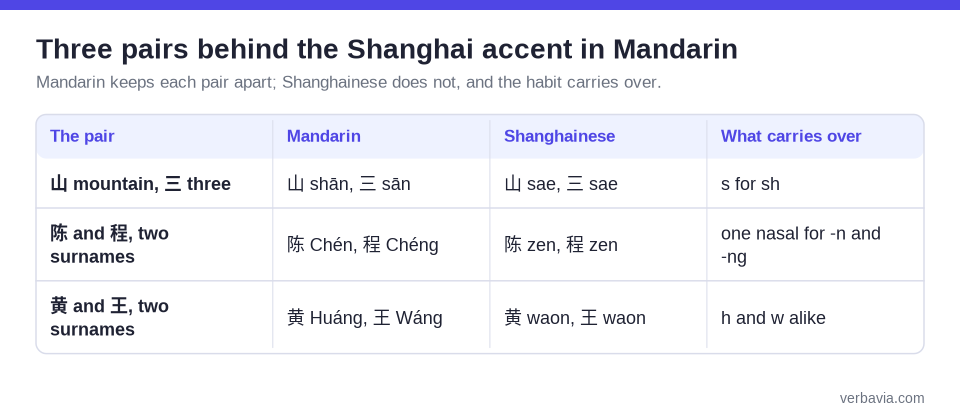
Each of the three sound features above comes from a pair of characters that Mandarin keeps apart and Shanghainese says alike:
| Pair | Mandarin | Shanghainese | What carries over |
|---|---|---|---|
| 山 mountain, 三 three | 山 shān, 三 sān | 山 sae, 三 sae | s for sh |
| 陈 and 程, two surnames | 陈 Chén, 程 Chéng | 陈 zen, 程 zen | one nasal for -n and -ng |
| 黄 and 王, two surnames | 黄 Huáng, 王 Wáng | 黄 waon, 王 waon | h and w alike |
Two southern habits: fuller tones, and no -r
Two more features are described for Mandarin speakers across southern China as a whole rather than for Shanghai in particular, and a Shanghai accent shares them.
Standard Mandarin, following Beijing, says many second syllables without a tone of their own: the second half of 谢谢 xièxie ‘thanks’ is short and light. Many Mandarin speakers in southern China give such syllables their full tone instead. A 2018 study by Zhao of how listeners judge this found that saying few toneless syllables is heard as southern and non-Mandarin, and that listeners attach more negative meanings to it, while saying many is heard as Beijing. Shanghainese tone works on a different principle altogether: in a word, the first syllable sets the melody of the whole, as the tones page explains.
The -r ending, erhua, is a northern habit too. It is common in Beijing speech and standard recordings use some of it, as in 哪儿 nǎr ‘where’. Many southern speakers avoid such words in Mandarin and use the plain form, 哪里 nǎlǐ. Wu has a suffix of its own written with the same character, 儿, but it is a nasal, ng, not an r.
How the Mandarin tones and the toneless syllable work is on Mandarin tones.
Shanghainese words in Shanghai Mandarin
Accents are not only sounds. A 2008 paper by Guan Yunjue, quoted in The Paper, summed up Shanghai Mandarin as Putonghua in its sounds and Shanghainese in its words. The examples The Paper collects include:
- 交关 ciau kuae ‘very, a lot’, the Shanghainese word for very, used in place of Mandarin 很 or 非常;
- 对伐 te va ‘right?’ as a tag at the end of a sentence, where Mandarin says 对吧 duì ba or 对吗 duì ma;
- and phrases translated word for word from Shanghainese, which is how The Paper defines 沪普 in the first place.
伐 va is the Shanghainese question particle, in place of Mandarin 吗, and 交关 ciau kuae is one of the words on Shanghainese vs Mandarin words. The Paper’s examples are words and phrases rather than grammar, and we found no study of Shanghainese grammar carried into Shanghai Mandarin, so this page says nothing about it.
Is the Shanghai accent the same as other southern accents?
Partly. The missing -r and the fuller tones are shared across much of the south. The -n and -ng merger runs the same way in Taiwan Mandarin, where studies cited by Guan found the same direction, -ng to -n, and the same order of vowels. Speakers whose first language is Cantonese start from a different place: Cantonese keeps three nasal endings, -m, -n and -ng, so the Shanghai reason for merging two of them is not there. Shanghainese vs Cantonese compares the two languages.
What marks the accent as Shanghai’s is the part that comes from Shanghainese itself: 黄 and 王 said alike, and Shanghainese words such as 交关 ciau kuae and the tag 伐 va.
Do younger Shanghai people still have the accent?
Less of it. In a study cited by Zheng, Sproat and colleagues, Starr and Jurafsky found that younger speakers, women and the more educated used more of the standard sh sounds, and argued that economic development was the main force behind the shift. The Paper says the same in plainer terms: people born from the 1980s on, after a second national push for Putonghua, generally speak more standard Mandarin.
Less is not none. Guan’s speakers were in their twenties and still merged -in and -ing, especially in casual talk. And the influence now runs the other way as well: Chen and Gussenhoven note changes in younger people’s Shanghainese that come from Standard Chinese. Old and new Shanghainese shows how much the city’s own language has moved.
What this means for a Mandarin learner
- If you live in Shanghai, expect the accent. Hear s and think s or sh; hear -n after i and think -n or -ng, and let the context decide.
- Do not copy it for a test. Spoken Putonghua is graded on a six-step scale from 1A, the most standard, to 3B. In Zheng and colleagues’ study, every one of the 100 Shanghai speakers fell between 2A and 3B.
- Do not lose sleep over in and ing. Standard Mandarin listeners struggled with the same pair.
- Notice the words. 交关 and 伐 in someone’s Mandarin are the first Shanghainese you will hear, and the guide for Mandarin speakers is the place to start if you want more.
An accent is not the language. Shanghainese itself is a different matter, with different everyday words and a different grammar, and can Mandarin speakers understand Shanghainese? answers how much a Mandarin speaker follows. Verbavia teaches both languages, each as a free course: Mandarin and Shanghainese online, with the most common Shanghainese words to browse first.
Learn Shanghainese with Verbavia
Start the free Shanghainese course
Verbavia’s free Shanghainese course teaches the everyday words that make a sentence Shanghainese rather than Mandarin, shows the characters and the pronunciation side by side, and plays its examples in a Shanghainese voice. One lesson a day.
Quick questions
Why do Shanghai people say s instead of sh?
Because Shanghainese has no retroflex sounds: 山 sae and 三 sae are said alike, so the sh of Mandarin shān is a sound speakers have to learn for Mandarin.
What is 沪普?
沪普 hùpǔ is Shanghai Putonghua: Mandarin spoken with a Shanghainese accent, and with some Shanghainese words.
Is Shanghai Mandarin the same as Shanghainese?
No. Shanghai Mandarin is Mandarin with an accent. Shanghainese is a separate Wu language that a Mandarin speaker cannot follow without learning it.
Do young people in Shanghai have a Shanghai accent?
Less than their parents, according to the studies, but features such as merging -in and -ing are still found in speakers in their twenties.
Sources
- Zheng, Y., Sproat, R., Gu, L., Shafran, I., Zhou, H., Su, Y., Jurafsky, D., Starr, R. and Yoon, S.-Y. (2005). Accent detection and speech recognition for Shanghai-accented Mandarin. Interspeech 2005 — sh/ch/zh replaced by s/c/z; eng for en and ing for in; 100 speakers rated 2A–3B on the 1A–3B scale; Starr and Jurafsky on age, gender and education.
- Faytak, M., Liu, S. and Sundara, M. (2020). Nasal coda neutralization in Shanghai Mandarin: Articulatory and perceptual evidence. Laboratory Phonology 11(1).
- Guan, Y. (2019). Nasal coda realisation in speech production of Shanghai Mandarin. Proceedings of the 19th International Congress of Phonetic Sciences, Melbourne.
- Chen, Y. and Gussenhoven, C. (2015). Shanghai Chinese. Journal of the International Phonetic Association 45(3) — the 28 consonants; one nasal coda; virtually all speakers also speak Shanghainese-accented Standard Chinese.
- Zhao, H. (2018). Social meaning in the perception of neutral tone variation in Putonghua. Asia-Pacific Language Variation 4(2).
- Wikipedia: Standard Chinese phonology — unstressed syllables; many speakers in southern China keep the inherent tone.
- Wikipedia: Erhua — northern Mandarin; avoided by many southern speakers; in Wu a nasal coda.
- Wikipedia: Cantonese phonology — the nasal codas /m, n, ŋ/.
- Jiang Tianya, The Paper (8 August 2022). 上海人“沪普”考古 — 王勃 and 黄渤, 吴 and 胡; 交关 and 对伐; Guan Yunjue (2008) on Shanghai Putonghua; the 1950s and 1980s Putonghua campaigns and speakers born from the 1980s.