The three baskets of knowledge (ngā kete e toru)
The three baskets of knowledge, ngā kete e toru ‘the three baskets’, are te kete tuauri, te kete tuatea and te kete aronui, the baskets that the atua Tāne, in most published accounts, brought down to people from the uppermost heaven. Te Aka Māori Dictionary names them together as ngā kete o te wānanga ‘the baskets of knowledge’. What follows is the story source by source, the second tradition that gives the climb to Tāwhaki, a table of what each published account puts in each basket (they do not agree), the spellings, and where the baskets’ names are used today.
Tap 🔊 to hear an example. Māori examples play Papa Reo, the te reo Māori voice made by Te Hiku Media from recordings of native speakers. Every sentence in the free course is spoken like this.
On this page
- What are the three baskets of knowledge?
- Who brought the baskets of knowledge: Tāne or Tāwhaki?
- The story of Tāne’s climb to the twelfth heaven
- What is in each basket? The sources disagree
- How do you spell the baskets’ names?
- What does kete mean today?
- Where are the three baskets named today?
- Using the three baskets in school work
- Quick questions
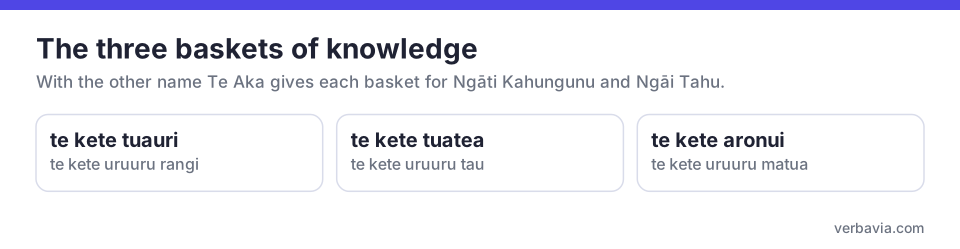
| Basket | Other name (Ngāti Kahungunu and Ngāi Tahu, per Te Aka) | In a few words |
|---|---|---|
| te kete tuauri | te kete uruuru rangi | Te Aka: sacred knowledge and karakia. Others read it differently (see the table below). |
| te kete tuatea | te kete uruuru tau | Te Aka: ancestral knowledge of harmful arts and war, with farming and stone, wood and earth work. Te Ara’s Ranginui story calls it the basket of light. |
| te kete aronui | te kete uruuru matua | Te Aka: peace, love and the arts; learning by observing the world; “the humanities”. |
What are the three baskets of knowledge?
They are a way of dividing all knowledge into three. Ross Calman, writing on Māori education for Te Ara, the Encyclopedia of New Zealand, describes the three kete as the curriculum areas of traditional learning: what was taught was sorted according to the baskets Tāne brought from the heavens. Tīmoti Kāretu, the first Māori Language Commissioner, makes the same comparison in a 2008 essay: to anyone with a teaching background, he writes, the baskets look like a syllabus, each one a distinct field to master.
Kete on its own is Te Aka’s basket, kit. Wānanga, in the sense that matters here, is tribal knowledge, lore, learning, the kind that is cultural, religious, historical, genealogical and philosophical. The name ngā kete e toru, the three baskets, is not a dictionary headword, but it is old: one of Te Aka’s examples, from a Māori-language newspaper of 1923, speaks of ngā kete e toru o te wānanga ‘the three baskets of knowledge’, which the elders said the people of the Tākitumu canoe held on to strongly. Te Ara titles an artwork Ngā kete e toru o te mātauranga, using mātauranga, knowledge, wisdom, understanding.
Who brought the baskets of knowledge: Tāne or Tāwhaki?
Most published accounts give the climb to Tāne, the atua who separated earth and sky; his part in that story, the forests and the first woman is told in the Māori gods. Te Aka, Te Ara, Elsdon Best and Kāretu all name Tāne. Te Ara records several of his names tied to this deed: Charles Royal gives Tāne-te-wānanga as Tāne the bringer of knowledge, and a Te Ara caption explains Tānenuiarangi as Tāne who ascended the heavens. Te Aka spells that name Tāne-nui-a-Rangi, and its entry for the woven poutama pattern uses a third, Tāne-o-te-wānanga.
A second tradition gives the climb to Tāwhaki, a figure from Hawaiki. Te Ara says that “according to Tainui tradition” Tāwhaki ascended the heavens and received the three baskets, and that this is what the carving Te Puna Wai Mātauranga, by Bob Koko, represents outside the University of Waikato library in Hamilton. Te Ara’s story on kites adds a version in which Tāwhaki rose on a kite of aute bark, was brought down twice by his enemy Tamaiwaho’s helper, and finally climbed a mountain instead. No source reached for this page names Tāwhaki outside these Tainui and “some traditions” attributions, so it is fair to say: Tāne in most accounts, Tāwhaki in Tainui tradition.
The story of Tāne’s climb to the twelfth heaven
The accounts share a shape: Tāne climbs through the heavens, is opposed by his brother Whiro, reaches the top, and comes back with the baskets. The details are each source’s own.
The heavens and Io
Te Aka has Toi-o-ngā-rangi and Tikitiki-o-rangi as two names for the uppermost of the twelve heavens. Te Aka’s entry for the baskets says Tāne had to get past eleven heavens before the twelfth, and there was brought before the supreme being, Io, to ask for them; its example sentence puts it in a line: Ko ngā kete o te wānanga i tīkina e Tāne i a Io-matua ‘These are the kits of knowledge that Tāne fetched from Io the-parent’. Kāretu adds that every heaven held rituals and tests, of the mind and the body. Rāwiri Taonui’s Ranginui story on Te Ara names the place at the top Te Tihi-o-Manono, a citadel in Te Toi-o-ngā-rangi, and notes that the heavens are counted as ten or twelve.
Io is not in every tradition. Te Aka says some tribes have a tradition of a supreme being that “may be a response to Christianity”, though Io also appears in Hawai‘i, the Society Islands and the Cook Islands. Te Ara (Charles Royal) explains the debate: Io is missing from early manuscripts, and became widely known through S. Percy Smith’s The Lore of the Whare-wananga (1913), drawn from Wairarapa informants. Tellings without Io still have Tāne fetch the baskets.
Whiro and the war parties of insects
Whiro is Te Aka’s atua of “things associated with evil, darkness and death”. Kāretu calls him Tāne’s older brother, who believed that being the elder gave him the prior right to the baskets. Bradford Haami’s Te Ara story on insects tells the Wairarapa version: Whiro sent war parties of sandflies, midges, stick insects, centipedes, butterflies, birds and bats to strike Tāne’s head, and Tāne called on the winds, which spun them in circles. On the way down, in the heaven Rangi-te-wanawana, Whiro met him again with an army of beetles; Tāne won, and brought the insects to earth as prisoners, to live in his forests. Elsdon Best (1934) has the same attack by birds and insects, driven off by the children of the wind atua Tāwhirimātea.
The two stones and Wharekura
Te Ara’s education story gives a Ngāti Kahungunu tradition in which Tāne came back from Te Toi-o-ngā-rangi with three baskets and two whatukura ‘sacred stones’: the baskets from a house called Matangireia, the stones from one called Rangiātea. He hung them all in Wharekura, a house in Rangitāmaku, the second heaven. The first earthly whare wānanga ‘house of learning’, built by Ruatepupuke, was given the same name. Te Aka gives whatukura two senses, an order of male supernatural beings whose house is Rangiātea, and stones of knowledge in the whare wānanga. Haami’s Wairarapa telling uses the word differently again, calling the prize itself “the three baskets of whatukura (sacred knowledge)”.
How wharekura went on to mean a school, and now a Māori-medium secondary school, is in kōhanga reo, kura kaupapa and wharekura. Te Ara’s Māori education story says the last traditional whare wānanga were held in the second half of the nineteenth century.
What is in each basket? The sources disagree
This is where the published accounts part company, and none of them says the others are wrong. Two Te Ara stories, written by different authors, give the baskets almost opposite characters. The table puts each source in its own words, shortened; it does not choose between them.
| Source | te kete tuauri | te kete tuatea | te kete aronui |
|---|---|---|---|
| Te Aka Māori Dictionary | Sacred knowledge: the creation of the natural world, the energies behind what the senses perceive, the realm of the tohunga; includes karakia | Ancestral knowledge of mākutu, whaiwhaiā and evil, including war; also agriculture, woodwork, stonework, earthworks | Aroha, peace, arts and crafts that benefit the Earth; knowledge from careful observation; also ritual, literature, philosophy, “the humanities” |
| Tīmoti Kāretu, Te Kaharoa (2008) | Peace, love and all things good | Warfare, black magic, agriculture, wood, stone and earth works | Incantations, literature, philosophy, every form of ritual |
| Ross Calman, Te Ara (Māori education) | Benign ritual; the history and practices of human lineages | “The repository of evil knowledge” | Religious, ceremonial and other advanced knowledge, for enlightenment and welfare |
| Rāwiri Taonui, Te Ara (Ranginui) | Basket of darkness; for Māori Marsden, things unknown | Basket of light; for Marsden, present knowledge | Basket of pursuit; for Marsden, the knowledge people now seek |
| Te Aka’s Ngāti Kahungunu and Ngāi Tahu names | Uruuru rangi: sacred knowledge, karakia and ritual (its 1926 example says warfare) | Uruuru tau: war, agriculture, wood, stone and earth work | Uruuru matua: peace, goodness and love; its example lists carving, gardening and the marae |
Three things are worth noticing. War and harmful arts sit in te kete tuatea for Te Aka, Kāretu and Calman, but Taonui’s Te Ara story calls that basket the basket of light and gives darkness to te kete tuauri. Ritual moves around: Te Aka puts karakia in tuauri and ritual in aronui as well, Kāretu puts all ritual in aronui, and Calman puts benign ritual in tuauri. And Te Aka itself shows the seams: its kete uruuru rangi is defined as ritual knowledge while the 1926 example it quotes says the basket’s treasures are warfare, and it notes that uruuru tau is “defined a little differently” from the basket it parallels.
Elsdon Best, in The Maori As He Was (1934), does not name the baskets. He gives their contents in order: first, high priestly lore and ritual; second, evil, black magic and war; third, human affection and sympathy, peace and the arts of peace. Read against Te Aka’s order (tuauri, tuatea, aronui), that matches Te Aka closely, but Best never says which name goes with which, so the table leaves him out. For school work, the safest course is to name your source, as the table does.
Te Aka glosses the word tuauri on its own as ancient (and also indigo), and aronui as to take notice of or inclination. That fits Te Aka’s description of the aronui basket as knowledge gained by observing, but no source reached explains the basket names word by word, so this page does not either.
How do you spell the baskets’ names?
The spellings differ by publisher, and all of these are in print:
- te kete tuauri, te kete tuatea, te kete aronui: Te Aka, Kāretu and Calman, as separate words, lower case.
- te kete-tuatea, te kete-tuauri, te kete-aronui: Taonui’s Te Ara story, hyphenated.
- Kete Aronui: capitalised, as a title, for the television series below.
- ngā kete o te wānanga (Te Aka’s headword), kete wānanga (Calman), ngā kete e toru o te wānanga (Te Aka’s 1923 example): names for all three together.
The order varies too. Te Aka’s definition lists tuauri, tuatea, aronui, while its 1923 example runs aronui, tuatea, tuauri; Taonui lists tuatea first. The spelling tua-uri, which turns up online, is not in Te Aka and was not found in any source used here. On the vowels: every source here writes tuauri without macrons, though Te Aka notes that the colour word is sometimes said with long vowels, tūāuri. The Māori pronunciation guide uses kete itself to show the pure e.
What does kete mean today?
In everyday Māori a kete is simply a basket or kit; Te Aka’s example is He hangere tēnei kete ‘This kit is half full’. Kete were also used in cooking, as what is a hāngī shows, and weaving them is part of the craft described in korowai, Māori cloaks. The idea of a basket that holds knowledge has carried into modern words: Te Aka lists kete kōrero, a repertoire of language, and kete puoro, a musical repertoire. The proverb Whaowhia te kete mātauranga, fill the basket of knowledge, is explained with its two spellings in Māori proverbs.
Where are the three baskets named today?
Only uses that a source ties to the baskets are listed here.
- Auckland University of Technology. Its Māori name, Te Wānanga Aronui o Tāmaki Makau Rau, refers to te kete aronui, by AUT’s own explanation; the full name is taken apart in Māori names of universities.
- The University of Waikato. Bob Koko’s carving of Tāwhaki, Te Puna Wai Mātauranga, outside the library, for the Tainui telling (Te Ara).
- Te Papa. Jim Wiki (Te Aupouri) carved Ngā kete o te wānanga in Ōamaru stone, showing Tāne’s ascent to the twelfth heaven; Te Ara reproduces it from Te Papa’s collection. Te Papa’s own education resource Ko au te taiao reads the stepped poutama pattern as Tāne’s climb to fetch the baskets, and Te Aka records the same reading, introduced with “some say”.
- Kete Aronui, the television series. NZ On Screen lists it on Māori Television from 2002 to 2010, profiling contemporary Māori artists in dance, film, music, weaving, tā moko and more, and says the title translates as “basket of knowledge”. It does not say more about the name, but an arts series fits Te Aka’s description of the aronui basket.
The Ministry of Education’s long-running site Te Kete Ipurangi is often assumed to belong here. Its name is built from kete and ipurangi, which Te Aka glosses as Internet (and, first, the source of a stream), but no source reached for this page links the name to the three baskets of knowledge, so it is not counted. For classroom te reo, see te reo for teachers.
A fourth basket
Kāretu’s 2008 essay in Te Kaharoa proposes adding a basket of his own, te kete tuawhā ‘the fourth basket’, which he calls te kete aroiti: a basket for things usually given little regard, among them tolerance, compromise, mutual respect and the acceptance of cultural, social and linguistic difference. Aroiti is his coinage and has no Te Aka entry; tuawhā is Te Aka’s fourth. It is one scholar’s proposal, not part of the tradition, and he presents it that way.
Using the three baskets in school work
The baskets are a framework, like Te Whare Tapa Whā is for health, and they are often used to organise a unit, a library or a course. Three things keep it accurate. Say whose account you are using, because the contents differ (the table above gives five). Say Tāne, and mention Tāwhaki as the Tainui telling. And treat the ritual chants about the climb as what they are: they belong to the occasions they are used on, which is why this page quotes none; how karakia are used today is covered in karakia for meetings, and what tikanga means in what does tikanga mean?. Other stories of the atua and heroes are in Māui legends and Māori mythical creatures, and Whiro also names a night of the moon in the maramataka.
To read words like kete, wānanga and mātauranga in sentences of your own, the free te reo Māori course starts from the first sounds and builds up a lesson a day.
Learn te reo Māori with Verbavia
Verbavia’s free te reo Māori course starts with the most common words, explains the grammar properly, and plays every example in Papa Reo’s native te reo voice. One lesson a day, from your first word to B1.
Quick questions
What are the 3 baskets of knowledge in Maori?
Te kete tuauri, te kete tuatea and te kete aronui, together ngā kete o te wānanga. Sources disagree on what each holds; Te Aka gives sacred knowledge, harmful arts and war, and peace and the arts.
Who brought the three baskets of knowledge?
Tāne, in most published accounts, after climbing to the twelfth heaven, Toi-o-ngā-rangi. Te Ara records a Tainui tradition that gives the climb to Tāwhaki.
What is the kete aronui?
Te Aka calls it the basket of aroha, peace and the arts, of knowledge gained by observing the world, and sometimes of the humanities. Te Ara’s Ranginui story calls it the basket of pursuit.
Who tried to stop Tāne?
His brother Whiro, who in Te Ara’s Wairarapa version sent war parties of insects, birds and bats; Tāne had the winds scatter them.
Sources
- Te Aka Māori Dictionary: kete
- Te Aka Māori Dictionary: kete o te wānanga
- Te Aka Māori Dictionary: kete tuauri
- Te Aka Māori Dictionary: kete tuatea
- Te Aka Māori Dictionary: kete aronui
- Te Aka Māori Dictionary: kete uruuru rangi
- Te Aka Māori Dictionary: kete uruuru matua
- Te Aka Māori Dictionary: kete uruuru tau
- Te Aka Māori Dictionary: tuauri
- Te Aka Māori Dictionary: aronui
- Te Aka Māori Dictionary: wānanga
- Te Aka Māori Dictionary: whare wānanga
- Te Aka Māori Dictionary: wharekura
- Te Aka Māori Dictionary: whatukura
- Te Aka Māori Dictionary: Toi-o-ngā-rangi
- Te Aka Māori Dictionary: Tikitiki-o-rangi
- Te Aka Māori Dictionary: Tāne-nui-a-Rangi
- Te Aka Māori Dictionary: Whiro
- Te Aka Māori Dictionary: Io
- Te Aka Māori Dictionary: poutama
- Te Aka Māori Dictionary: mātauranga
- Te Aka Māori Dictionary: ipurangi
- Te Aka Māori Dictionary: mākutu
- Te Aka Māori Dictionary: whaiwhaiā
- Te Aka Māori Dictionary: tuawhā
- Te Aka Māori Dictionary: kete puoro
- Te Aka Māori Dictionary: whao (to put into)
- Te Aka Māori Dictionary: Rangiātea
- Te Aka Māori Dictionary: Te Wānanga Aronui o Tāmaki Makau Rau
- Ross Calman, ‘Māori education – mātauranga’, page 1, Te Ara – the Encyclopedia of New Zealand
- Te Ara: ‘Baskets of knowledge – ngā kete e toru’ (artwork caption)
- Rāwiri Taonui, ‘Ranginui – the sky’, page 2, Te Ara
- Te Ara: ‘Ngā kete o te wānanga’, carving by Jim Wiki (Te Papa ME 15027)
- Te Ahukaramū Charles Royal, ‘Te Waonui a Tāne – forest mythology’, page 1, Te Ara
- Te Ahukaramū Charles Royal, ‘Māori creation traditions’, page 2, Te Ara
- Bradford Haami, ‘Te aitanga pepeke – the insect world’, page 1, Te Ara
- Te Ara: ‘Tāne battles the insects’, artwork by Robert Jahnke
- Te Ara: ‘Tāwhaki’, Te Puna Wai Mātauranga carving by Bob Koko
- Te Ara: ‘Manu tukutuku – Māori kites’, page 1
- Tīmoti Kāretu, ‘Te Kete Tuawhā, Te Kete Aroiti – The Fourth Basket’, Te Kaharoa 1 (2008)
- Elsdon Best, The Maori As He Was (1934): ‘Tane as the Origin of Occult Knowledge’, NZETC
- Te Papa: Ko au te taiao, education resource (PDF)
- NZ On Screen: Kete Aronui (series, 2002–2010)