How to introduce yourself in Shanghainese
To introduce yourself in Shanghainese, give your surname, then your name, then where you are from: 我姓王,叫王明,是北京人。 ngu sin waon, ciau waon min, zy poh cin nyin. ‘My surname is Wang, I’m Wang Ming, from Beijing.’ This page takes the questions people ask when they meet you one at a time: your name, where you are from, where you live, what you do, your family, and the one you will be asked most, about the language itself. Each comes with the way to ask it back, and the page ends with a short introduction built only from lines it has taught.
Tap 🔊 to hear an example. Shanghainese examples play the recordings from Verbavia’s course, made with a Shanghainese voice; Mandarin examples play a Mandarin voice.
On this page
- Start with hello
- How do you say my name is in Shanghainese?
- How do you say where you are from in Shanghainese?
- Where you live, and how long you have been here
- How do you say what you do in Shanghainese?
- Family: what your partner’s parents may ask
- How do you say I’m learning Shanghainese?
- Asking the same questions back
- What gives an introduction away as Mandarin
- A short self-introduction in Shanghainese
- Where to go next
- Quick questions
Start with hello
An introduction starts where a greeting ends. To one person, say 侬好。 non hau. ‘hello’; to a room, such as a family gathered to meet you, 㑚好。 na hau. ‘hello, all of you’, with the plural you, 㑚 na. When you are introduced to someone, the formal reply is 幸会。 yin we. ‘pleased to meet you’. Greetings, thanks and goodbyes are on hello and thank you in Shanghainese, and both words for you on the pronouns page.
How do you say my name is in Shanghainese?
There are two verbs, one for each half of a Chinese name. 姓 sin ‘to be surnamed’ gives the family name, and 叫 ciau ‘to be called’ gives the whole name:
- 我姓王。 ngu sin waon. ‘My surname is Wang.’
- 我姓李。 ngu sin li. ‘My surname is Li.’
- 我叫王明,是北京人。 ngu ciau waon min, zy poh cin nyin. ‘My name is Wang Ming; I’m from Beijing.’
Said together, surname first, they make the opening line of the page: 我姓王,叫王明,是北京人。 ngu sin waon, ciau waon min, zy poh cin nyin. The characters are the ones a Mandarin speaker would write, but every syllable is said the Shanghainese way, names included: 王 waon is not Mandarin Wáng, and 我 ngu ‘I’ begins with the ng of sing. The pronunciation guide takes the sounds one by one.
To ask someone else, there are three questions, from most to least formal:
| Shanghainese | Meaning | When to use it |
|---|---|---|
| 侬贵姓? non kue sin? | What is your surname? | Polite: 贵 is honorific. The one to use with anyone you would address formally. |
| 侬姓啥? non sin sa? | What’s your surname? | Plainer. |
| 侬叫啥名字? non ciau sa min zy? | What’s your name? | Asks for the whole name. Mandarin says 你叫什么名字, nǐ jiào shénme míngzi. |
The answer to the first two is the surname alone: 我姓李。 ngu sin li. In the third, 啥 sa ‘what’ does the work of Mandarin 什么; it is one of the Shanghainese question words, and like them it needs no question particle on the end.
How do you say where you are from in Shanghainese?
侬是啥地方人? non zy sa di faon nyin? ‘Where are you from?’ is literally you are what-place person? 啥地方 sa di faon ‘where’ is the Shanghainese word for where, and the Mandarin question it replaces is 你是哪里人? nǐ shì nǎlǐ rén? The answer follows the same pattern, with the place in front of 人 nyin ‘person’:
- 我是英国人。 ngu zy in koh nyin. ‘I’m British.’
- 我是美国人。 ngu zy 'me koh nyin. ‘I’m American.’
- 阿拉是上海人。 a la zy zaon he nyin. ‘We’re from Shanghai.’
To turn the question round, add 侬呢? non 'ne? ‘and you?’ Notice that 人 nyin begins with the ny of canyon, where Mandarin has rén; why Shanghainese sounds like Japanese explains where that sound comes from.
Where you live, and how long you have been here
Ask with 侬住勒啥地方? non zyu leh sa di faon? ‘where do you live?’, and answer with the place after 住勒 zyu leh ‘to live at’: 我住勒浦东。 ngu zyu leh phu ton. ‘I live in Pudong.’ 勒 leh is the short word for at that follows a verb.
A question that goes with it is how long you have been in the city:
- 侬勒上海几年哉? non leh zaon he ci nyie tse? ‘How long have you been in Shanghai?’
- 我来仔三年哉。 ngu le tsy sae nyie tse. ‘I’ve been here three years.’
- 我垃拉上海住仔三年哉。 ngu laeh la zaon he zyu tsy sae nyie tse. ‘I’ve been living in Shanghai for three years.’
Two small words carry the time. 仔 tsy after the verb says the three years have been completed, and 哉 tse at the end says that is how things stand now: you are still here. Both are on the aspect page, and the numbers you need for the years are on Shanghainese numbers.
How do you say what you do in Shanghainese?
The question is 侬做啥工作? non tsu sa kon tsoh? ‘what work do you do?’, where Mandarin asks 你做什么工作? nǐ zuò shénme gōngzuò? For a job title, use 是 zy ‘to be’, with no word for a:
- 我是老师。 ngu zy lau sy. ‘I’m a teacher.’
- 我是学生。 ngu zy ghoh san. ‘I’m a student.’
- 我是医生。 ngu zy i san. ‘I’m a doctor.’
For where you work, use 上班 zaon pae ‘to go to work’, with the place in front of it after 勒 leh ‘at’:
- 我勒银行上班。 ngu leh nyin ghaon zaon pae. ‘I work at a bank.’
- 我勒一家公司上班,工作蛮忙。 ngu leh ih ka kon sy zaon pae, kon tsoh mae maon. ‘I work at a company, and the work’s pretty busy.’
Its opposite is 下班 gho pae ‘to finish work’. 蛮 mae ‘quite’ in the second line is the everyday Shanghainese word for quite or pretty.
Family: what your partner’s parents may ask
If you are meeting a partner’s family, these are the family questions, and the answers are short:
- 㑚屋里几个人? na oh li ci gheh nyin? ‘How many are there in your family?’ — 阿拉屋里四个人。 a la oh li sy gheh nyin. ‘There are four of us.’
- 有小囡伐? yeu siau noe va? ‘Have you got children?’ — 我有一个小囡。 ngu yeu ih gheh siau noe. ‘I have one child.’
小囡 siau noe ‘child’ is the Wu word for a child, where Mandarin says 孩子 háizi, and 屋里 oh li ‘home’ does the work of Mandarin 家里. To explain how you came to be at the table:
- 我是英国人,勿过我老婆是上海人。 ngu zy in koh nyin, veh ku ngu lau bu zy zaon he nyin. ‘I’m from England, but my wife is from Shanghai.’
- 搿位是我朋友小王。 geh we zy ngu ban yeu siau waon. ‘This is my friend Xiao Wang.’
勿过 veh ku ‘but’ joins the two halves, and 搿位 geh we ‘this person’ is the polite way to introduce someone else. A husband is 老公 lau kon and a wife 老婆 lau bu; the words for parents, grandparents, brothers, sisters, uncles and aunts are on the family words page.
How do you say I’m learning Shanghainese?
This is the sentence worth practising until it comes out whole, with two that go with it:
- 我勒海学上海闲话。 ngu leh he ghoh zaon he ghae gho. ‘I’m learning Shanghainese.’
- 我只会讲一眼眼。 ngu tsah we kaon ih ngae ngae. ‘I can only speak a very little.’
- 请侬讲慢一眼。 tshin non kaon mae ih ngae. ‘Please speak a bit more slowly.’
勒海 leh he before the verb means in the middle of, where Mandarin uses 在: Mandarin says 我在学上海话。 wǒ zài xué Shànghǎihuà. 上海闲话 zaon he ghae gho is what the language calls itself, Shanghai speech. 一眼眼 ih ngae ngae ‘a tiny bit’ is the Wu word for a little, in place of Mandarin 一点点 yìdiǎndiǎn, and 讲 kaon ‘to speak’ replaces Mandarin 说.
Two replies you may hear are 侬会讲上海闲话?! non we kaon zaon he ghae gho?! ‘you can speak Shanghainese?!’ and, if the sentence went well, 侬上海闲话讲得老好! non zaon he ghae gho kaon teh lau hau! ‘your Shanghainese is really good!’ The modest answer is 还差得远。 wae tsha teh yoe. ‘far from it’, and someone impressed may say 老结棍! lau cih kuen! ‘amazing!’ To ask someone whether they speak it, say 侬上海闲话讲得来伐? non zaon he ghae gho kaon teh le va? ‘do you speak Shanghainese?’
Asking the same questions back
Every question on this page can be turned round with 侬呢? non 'ne? ‘and you?’, and agreeing is just as short: 是伐?我也是。 zy va? ngu gha zy. ‘Really? Me too.’ Both work after any answer, and both are Shanghainese where a Mandarin speaker would say 你呢? nǐ ne? and 是吗? shì ma?.
What gives an introduction away as Mandarin
| Shanghainese | Mandarin | |
|---|---|---|
| What’s your name? | 侬叫啥名字? non ciau sa min zy? | 你叫什么名字? nǐ jiào shénme míngzi? |
| Where are you from? | 侬是啥地方人? non zy sa di faon nyin? | 你是哪里人? nǐ shì nǎlǐ rén? |
| What work do you do? | 侬做啥工作? non tsu sa kon tsoh? | 你做什么工作? nǐ zuò shénme gōngzuò? |
| I’m learning Shanghainese. | 我勒海学上海闲话。 ngu leh he ghoh zaon he ghae gho. | 我在学上海话。 wǒ zài xué Shànghǎihuà. |
| I can only speak a very little. | 我只会讲一眼眼。 ngu tsah we kaon ih ngae ngae. | 我只会说一点点。 wǒ zhǐ huì shuō yìdiǎndiǎn. |
A handful of words decide the rows: 侬 non for 你, 啥 sa for 什么, 勒海 leh he for 在, 讲 kaon for 说 and 一眼眼 ih ngae ngae for 一点点. Swap one of them back and the sentence is Mandarin, however it is pronounced. The rest of the everyday words that differ are on Shanghainese vs Mandarin words.
A short self-introduction in Shanghainese
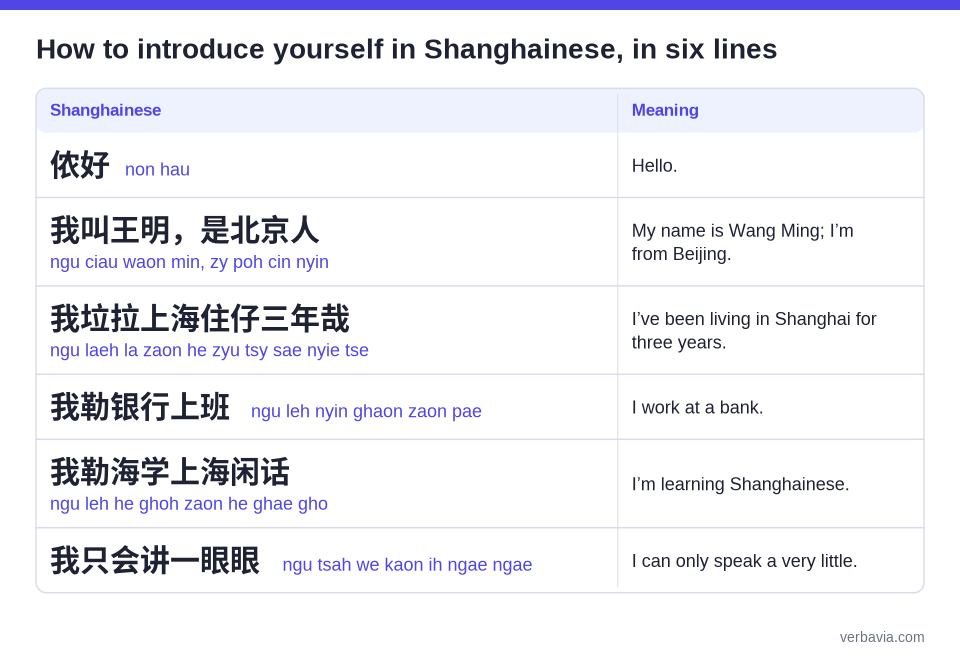
Put together from lines already on this page, here is a whole introduction, in the order this page asked the questions:
| Shanghainese | Meaning |
|---|---|
| 侬好。 non hau. | Hello. |
| 我叫王明,是北京人。 ngu ciau waon min, zy poh cin nyin. | My name is Wang Ming; I’m from Beijing. |
| 我垃拉上海住仔三年哉。 ngu laeh la zaon he zyu tsy sae nyie tse. | I’ve been living in Shanghai for three years. |
| 我勒银行上班。 ngu leh nyin ghaon zaon pae. | I work at a bank. |
| 我勒海学上海闲话。 ngu leh he ghoh zaon he ghae gho. | I’m learning Shanghainese. |
| 我只会讲一眼眼。 ngu tsah we kaon ih ngae ngae. | I can only speak a very little. |
For a partner’s family, swap the second line for 我是英国人,勿过我老婆是上海人。 ngu zy in koh nyin, veh ku ngu lau bu zy zaon he nyin. and end with 请侬讲慢一眼。 tshin non kaon mae ih ngae. Every line has a recording: listen to each, then say the six in a row until they run together.
Where to go next
For a trip rather than a family, the phrases for visitors cover asking the way, prices and saying you don’t understand. The Mandarin versions of the family words are on family members in Chinese, and the Mandarin greetings on greetings in Chinese. Every Shanghainese line on this page is from Verbavia’s free course, which teaches them with the grammar behind them, one lesson a day: learn Shanghainese online, or browse the most common Shanghainese words first.
Learn Shanghainese with Verbavia
Start the free Shanghainese course
Verbavia’s free Shanghainese course teaches the everyday words that make a sentence Shanghainese rather than Mandarin, shows the characters and the pronunciation side by side, and plays its examples in a Shanghainese voice. One lesson a day.
Quick questions
How do you say my name is in Shanghainese?
我叫 ngu ciau and your name, or 我姓 ngu sin and your surname: 我姓王。 ngu sin waon. means my surname is Wang.
How do you ask someone’s name in Shanghainese?
Politely, 侬贵姓? non kue sin?, which asks for the surname; for the whole name, 侬叫啥名字? non ciau sa min zy?
How do you say where are you from in Shanghainese?
侬是啥地方人? non zy sa di faon nyin?, answered with the place and 人 nyin: 我是英国人。 ngu zy in koh nyin.
How do you say I’m learning Shanghainese?
我勒海学上海闲话。 ngu leh he ghoh zaon he ghae gho. To add that you only speak a little, 我只会讲一眼眼。 ngu tsah we kaon ih ngae ngae.
Sources
- Omniglot: Useful phrases in Shanghainese — 侬叫啥名子 (sic) ‘what’s your name?’ and 侬是啥地方人 ‘where are you from?’.
- Wiktionary: 啥地方 — Wu ‘where’, with the Shanghainese example 儂住辣啥地方 ‘where do you live?’.
- Wiktionary: 上海閒話 — Wu ‘the Shanghainese language’, with the example 儂上海閒話講得來𠲎 ‘do you speak Shanghainese?’.
- Wiktionary: 貴姓 — honorific, ‘surname of a person’, as in 您貴姓.
- Wiktionary: 幸會 — formal, ‘pleased to meet you’.
- Wiktionary: 小囡 — Wu ‘child; kid’.
- Wiktionary: 一眼眼 — Northern Wu ‘a little’.
- Wiktionary: 結棍 — Wu ‘strong; powerful, awesome’.
- Wiktionary: 上班 — ‘to go to work; to begin one’s work day’.