Hail Mary in Māori, Sign of the Cross and Glory Be
The Hail Mary in Māori opens, in a Catholic prayer book printed at Ōtaki in about 1910, Ave Maria, e ki ana i te keratia, Hail Mary, full of grace; today’s Catholic wording opens Awe, e Maria, e kī ana koe i te karatia. This guide gives the sign of the cross in Māori first, then the Hail Mary and the Glory Be, each as that prayer book prints it, with the traditional Catholic English, where today’s wording differs, every word explained from Te Aka Māori Dictionary, help saying them, and where the three are said: at Mass, in the Rosary and in the Angelus. It is a companion to the Lord’s Prayer in Māori, which comes from the same prayer book.
Tap 🔊 to hear an example. Māori examples play Papa Reo, the te reo Māori voice made by Te Hiku Media from recordings of native speakers. Every sentence in the free course is spoken like this.
On this page
The sign of the cross in Māori
This is the sign of the cross as it is said at a Catholic Mass in te reo Māori today. The priest says the first line and everyone answers Amen:
Ki te ingoa o te Matua, o te Tamaiti, o te Wairua Tapu.
Āmene.
In the traditional Catholic English: In the name of the Father and of the Son and of the Holy Spirit. Amen.
Source. Catholic Diocese of Palmerston North, Parts of the Mass in Te Reo, page 1, where the line is marked Pirihi (priest) and the answer Iwi (people). The booklet Prayers in Common Use in Aotearoa – New Zealand, published for the National Liturgy Commission, has the same words under the title Ko te Tohu o te Rīpeka.
The Ōtaki prayer book of about 1910 opens its morning prayer with it, and has one small difference, me (and) before the last name instead of a third o:
Ki te ingoa o te Matua, o te Tamaiti, me te Wairua Tapu. Amene—
| Words | Te Aka’s meanings | In the English |
|---|---|---|
| Ki te ingoa | ki: to, towards; also at, in. ingoa: name | In the name |
| o te Matua | o: of. matua: father, parent | of the Father |
| o te Tamaiti | tamaiti: child, boy, used only in the singular | and of the Son |
| o te Wairua Tapu | Wairua Tapu: Holy Ghost. On its own, wairua is spirit, soul, and tapu sacred | and of the Holy Spirit |
| Āmene | amen; a loanword, one of the English words in Māori | Amen |
Tamaiti, not Tama. Te Aka’s word for son is tama, son, boy, nephew, and the Son of the prayer might be expected to be Tama. But every Catholic text this guide draws on, from 1910 to today’s Mass booklet, says Tamaiti, the word Te Aka gives as child, boy. Say the words as the Church prints them.
The title Ko te Tohu o te Rīpeka is the sign of the cross word for word: tohu is sign, mark, symbol and rīpeka is cross, crucifix, both Te Aka’s meanings.
Other Catholic spellings you will see
| Source | As it prints the sign of the cross |
|---|---|
| Prayer book, Ōtaki, about 1910 | Ki te ingoa o te Matua, o te Tamaiti, me te Wairua Tapu. Amene— |
| Parts of the Mass in Te Reo, Palmerston North, page 1 | Ki te ingoa o te Matua, o te Tamaiti, o te Wairua Tapu. Āmene. |
| The same booklet, page 23, after the Mass | Ki te ingoa o te Matua o te Tamaiti o te Wairua Tapu. Āmene |
| Rosary booklet, Te Kahurangi Whetu o te Moana, Tūranganui-a-Kiwa | Ki te ingoa o te Matua, o te Tamaiti, ko te Wairua Tapu. Amene. |
The words are the same in all four apart from the small word before Wairua Tapu, and whether the long vowel of Āmene is marked.
The Hail Mary in Māori and English
This is the Hail Mary exactly as page 2 of Ko etahi karakia mo nga turoro o te Hahi Katorika prints it, in its two paragraphs, with the printer’s spelling, which marks no long vowels. From here on the page calls it the Ōtaki text:
Ave Maria, e ki ana i te keratia, kei a koe te Ariki, ko koe e whakapaingia ana i nga wahine katoa, a ka whakapaingia hoki a Hehu, te hua o tou kopu.
E Hata Maria te Whaea o te Atua, inoi koe mo matou he hunga hara, aianei, a i te haora o to matou matenga rawa. Amene.
And the traditional Catholic English, as the Compendium of the Catechism of the Catholic Church prints it:
Hail, Mary, full of grace, the Lord is with thee. Blessed art thou among women and blessed is the fruit of thy womb, Jesus. Holy Mary, Mother of God, pray for us sinners, now and at the hour of our death. Amen.
Source of the Māori text. Ko etahi karakia mo nga turoro o te Hahi Katorika (Ōtaki: printed by Frank Penn at the Otaki Mail office, circa 1910), page 2; the prayer is printed in full again on pages 6 and 8. Massey University Library, Tāmiro, tamiro.massey.ac.nz/nodes/view/24541, licensed under Creative Commons Attribution 3.0 New Zealand.
The prayer opens with two Latin words, Ave Maria, the opening of the Latin prayer, which the Compendium prints as Ave, María, grátia plena. The rest is Māori.
Today’s Catholic wording
The Hail Mary in the booklet Prayers in Common Use in Aotearoa – New Zealand, which the National Liturgy Commission published so that Catholics would pray from one translation, is headed Awe e Maria and opens Awe, e Maria, e kī ana koe i te karatia, kei a koe te Ariki. It follows the Ōtaki text closely, with three differences worth knowing:
- The opening. Awe where the Ōtaki text keeps the Latin Ave, and karatia for keratia, the word that stands for grace. A rosary booklet from Tūranganui-a-Kiwa has e ki ana koe i te keratia, so both spellings are in Catholic use.
- Mother of God. The Ōtaki text calls Mary te Whaea o te Atua; today’s booklet has e te matua wahine o te Atua, built from matua ‘parent’ and wahine ‘female, woman’.
- Macrons. Today’s booklet marks long vowels, as in kī, Hāta and Āmene.
The booklet is the New Zealand Catholic bishops’ text and is not reprinted here. It is on the website of Te Rūnanga o Te Hāhi Katorika ki Aotearoa, the National Catholic Māori Council, at Prayers in Common Use, to which the bishops’ own prayer page links; it is published there as a Flash document, which current web browsers no longer open. If you are learning the prayer to say it with a parish, ask for the wording that parish uses.
The Hail Mary line by line
The left column is the Ōtaki text as printed. The middle column re-spells each line as Te Aka Māori Dictionary spells each word; words Te Aka has no entry for are left as printed. The right column is a literal reading built from Te Aka’s meanings, with the traditional English it matches.
| As printed, about 1910 | Spelt as Te Aka spells it | Literally, and the English |
|---|---|---|
| Ave Maria, | Ave Maria, | Latin. Hail, Mary, |
| e ki ana i te keratia, | e kī ana i te keratia, | being full of grace. full of grace, |
| kei a koe te Ariki, | kei a koe te Ariki, | the Lord is with you. the Lord is with thee. |
| ko koe e whakapaingia ana i nga wahine katoa, | ko koe e whakapaingia ana i ngā wāhine katoa, | it is you who are being blessed among all the women, Blessed art thou among women |
| a ka whakapaingia hoki a Hehu, te hua o tou kopu. | ā ka whakapaingia hoki a Hehu, te hua o tōu kōpū. | and Jesus too is blessed, the fruit of your womb. and blessed is the fruit of thy womb, Jesus. |
| E Hata Maria te Whaea o te Atua, | E Hata Maria te Whaea o te Atua, | O holy Mary, the Mother of God, Holy Mary, Mother of God, |
| inoi koe mo matou he hunga hara, | inoi koe mō mātou he hunga hara, | pray for us, a sinful people, pray for us sinners, |
| aianei, a i te haora o to matou matenga rawa. | āianei, ā i te hāora o tō mātou matenga rawa. | now, and at the hour of our death itself. now and at the hour of our death. |
| Amene. | Āmene. | Amen. Amen. |
Two things in the Māori are not in the English. Ko koe puts Mary first, it is you who. And he hunga hara is a people of sin: hunga is a group of people and hara sin, so us sinners becomes us, a sinful people. The particle rawa after matenga ‘death’ is one Te Aka glosses indeed, really, exactly; it adds weight, and the English has nothing for it.
The Glory Be in Māori
The Ōtaki prayer book prints the Glory Be on page 19, at the end of a psalm, like this:
Kororia ki te Matua, ki te Tamaiti, me te Wairua Tapu.
Me i te timatanga ano, kia pera hoki aianei, a kia pera ake ake, a i nga tau mutunga kore. Amene.
In the traditional Catholic English, from the same Compendium: Glory be to the Father and to the Son and to the Holy Spirit, as it was in the beginning is now, and ever shall be world without end. Amen.
Source. Ko etahi karakia mo nga turoro o te Hahi Katorika, page 19, after the psalm the booklet heads Waiata 66. On pages 14 and 18, in the prayers for the sick, the same words are split between a line marked v. and an answering line marked r., the call-and-response layout the booklet uses throughout. Massey University Library, Tāmiro, CC BY 3.0 NZ.
| As printed, about 1910 | Spelt as Te Aka spells it | Literally, and the English |
|---|---|---|
| Kororia ki te Matua, | Korōria ki te Matua, | Glory to the Father, Glory be to the Father |
| ki te Tamaiti, me te Wairua Tapu. | ki te Tamaiti, me te Wairua Tapu. | to the Son, and the Holy Spirit. and to the Son and to the Holy Spirit, |
| Me i te timatanga ano, | Me i te tīmatanga anō, | As at the beginning, as it was in the beginning |
| kia pera hoki aianei, | kia pērā hoki āianei, | may it be so now as well, is now, |
| a kia pera ake ake, | ā kia pērā ake ake, | and may it be so for ever, and ever shall be |
| a i nga tau mutunga kore. | ā i ngā tau mutunga kore. | and in the endless years. world without end. |
| Amene. | Āmene. | Amen. Amen. |
The comparison works the way Te Aka describes for pērā ‘like that’: me here is Te Aka’s as if, like, so Me i te tīmatanga anō, kia pērā hoki āianei is as it was at the beginning, so may it be now. Te Aka spells for ever as the headword āke, ake, ake, with the first vowel long; the Ōtaki text prints ake ake, and it is left as printed above.
Today’s Catholic wording
In Prayers in Common Use the Glory Be is headed Korōria ki te Tokotorutanga and opens Korōria ki a Matua, ki te Tamaiti, ki te Wairua Tapu: ki before all three names, where the Ōtaki text has me before the last. Its English beside it is the modern ecumenical wording, Glory to the Father, and to the Son, and to the Holy Spirit. Its last words are ā āke, āke. Āmene. It has no line for the Ōtaki text’s endless years. The Tūranganui-a-Kiwa rosary booklet, headed simply Kororia, opens Kororia ki te Matua, ki te Tamaiti, Ki te Wairua Tapu.
Word by word
Every meaning below is Te Aka Māori Dictionary’s, with the spelling Te Aka uses. Words already explained in the Lord’s Prayer in Māori, such as mātou ‘we, us’, tō ‘your’, hara ‘sin’ and āianei ‘now’, are only listed here.
| Word in the prayers | Te Aka’s meaning |
|---|---|
| kī (as printed: ki) | be full; with ana, e kī ana, being full |
| keratia (today: karatia) | not in Te Aka; it is the word that stands for grace in the prayer |
| kei | at, in; also has, have, with: kei a koe ‘with you’ |
| ariki | paramount chief, lord; and, as its fourth sense, Lord, a name for God |
| whakapaingia | passive of whakapai, whose senses include to make better, improve, bless |
| wāhine (as printed: wahine) | women: the plural of wahine, woman |
| katoa | all, every |
| ā (as printed: a) | and, and then |
| hoki | also, too, as well |
| Hehu | Jesus, as Catholic texts write the name; not in Te Aka, whose entry for Jesus is Ihu |
| hua | among its senses as a noun: product, fruit, progeny |
| tōu (as printed: tou) | your, of one person |
| kōpū (as printed: kopu) | belly, abdomen; womb, uterus |
| Hata | not in Te Aka. The Ōtaki booklet writes Hata before Mary’s name and Hato before the names of men saints, such as Hato Petera; Te Aka has Hato, Saint |
| whaea | mother, aunt, aunty |
| atua | god; and, as its second sense, God. The atua of Māori tradition are in Māori gods |
| inoi | to beg, pray, request, appeal; as a noun, prayer |
| mō (as printed: mo) | for, about, for the benefit of |
| he | a, an, some |
| hunga | group, people, company of people |
| hāora (as printed: haora) | hour, time; Te Aka notes it is sometimes written haora |
| matenga | death, time of death |
| rawa | a particle: indeed, really, exceedingly, exactly |
| korōria (as printed: kororia) | glory, majesty; a loanword |
| tīmatanga (as printed: timatanga) | beginning, start |
| anō (as printed: ano) | again, more, same |
| pērā (as printed: pera) | like that; Te Aka notes that when the comparison is completed, the second part is introduced by me |
| āke, ake, ake | forever, evermore |
| tau | year, age; also season, period of time |
| mutunga kore | endless, eternal, perpetual, infinite |
One possessive is worth a second look: tōu kōpū, your womb, and tō mātou matenga, our death, both take the o form, the one the body always takes. When each form is used is explained in Māori possessives: a and o.
How to say them
Every letter keeps its sound, so the prayers can be read aloud as written. The Māori pronunciation guide covers every sound; these are the ones these three prayers test:
- wh, in whakapaingia and whaea: in most dialects today closer to an English f, as Te Herenga Waka Victoria University of Wellington’s pronunciation guide puts it.
- ng, in ingoa, ngā, hunga, matenga and whakapaingia: the ng of singer, one sound.
- r, in Ariki, rīpeka, korōria and Maria: a soft rolled r, in Victoria’s words.
- Every vowel is said, even where two stand together, as in Tamaiti, Wairua and whakapaingia; Victoria’s guide notes that pairs of vowels such as au, ao, ea, oi and ua are common.
- Long vowels. The Ōtaki text marks none, but kī, kōpū, hāora, korōria, tīmatanga and Āmene each have at least one, and the macron marks a vowel that is lengthened as you say it. To write them yourself, see how to type Māori macrons.
For the Mass in te reo, the National Liturgy Office of the New Zealand Catholic Bishops Conference publishes audio pronunciation recordings for priests, part by part through the Mass from the introduction on, on its Te Miha page.
When the three prayers are said
- At Mass. In Palmerston North’s Parts of the Mass in Te Reo the Mass opens with the sign of the cross, under Ngā Ritenga Tīmatanga, the introductory rites. On page 23 it gives a prayer to Mary, E oma ana mātou, which it says “is commonly prayed straight after the Miha Māori finishes”, followed by the sign of the cross once more.
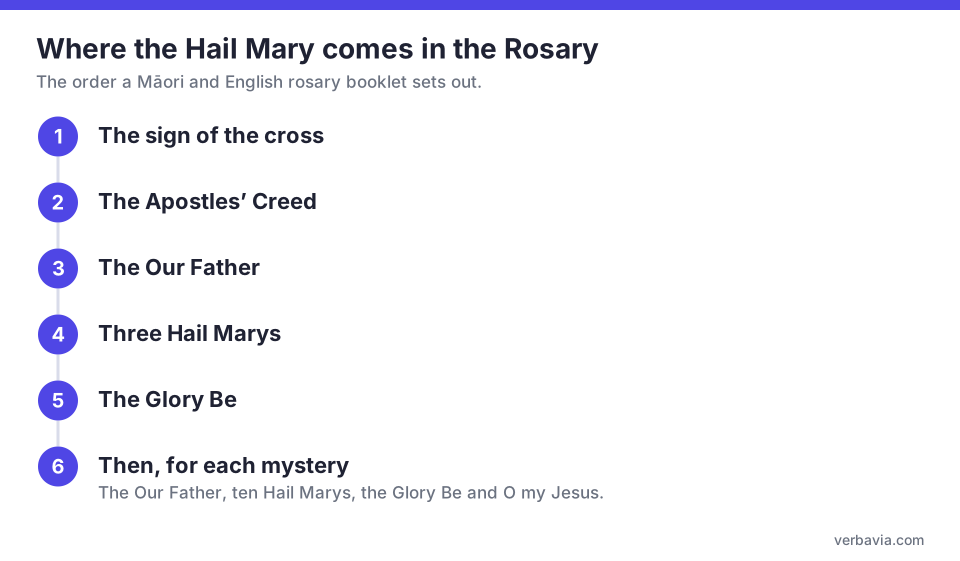
- The Rosary. A rosary booklet from Te Kahurangi Whetu o te Moana in Tūranganui-a-Kiwa, on Te Rūnanga o Te Hāhi Katorika’s website, sets out the order: after making the sign of the cross, the Apostles’ Creed, the Our Father, three Hail Marys and the Glory Be; then for each mystery the Our Father, ten Hail Marys, the Glory Be and O my Jesus. It gives each prayer in Māori and English.
- The Angelus. The Hail Mary is said three times in the Angelus, as the New Zealand Catholic Bishops Conference’s prayer page sets it out in English. The Ōtaki book has the Angelus in Māori on page 6, with the Hail Mary printed in full the first time and then given by its opening words, Ave Maria…
- Morning, evening and meals. In the Ōtaki book the sign of the cross opens the morning prayer, the evening prayer and the grace before meals, and the Hail Mary follows the Lord’s Prayer in the morning and the evening. Where the booklet asks for prayers for the sick of the village, it gives the Lord’s Prayer and the Hail Mary by their opening words only.
Going further
The Lord’s Prayer from the same Ōtaki prayer book is set out word by word in the Lord’s Prayer in Māori, with a short history of Catholic prayer in Māori. Not every karakia is a Christian prayer: the traditional ones used to open and close meetings are explained in karakia for meetings, and the waiata sung from 1 Corinthians 13 is in E Toru Ngā Mea. Many of the words in these prayers, ingoa, matua, tamaiti, whaea, wāhine and katoa among them, come early in our own free te reo Māori course, and the words for parents and relatives are gathered in Māori family words.
Te Aranga, the Māori name for Easter, and the days of Easter are explained in happy Easter in Māori.
Learn te reo Māori with Verbavia
Verbavia’s free te reo Māori course starts with the most common words, explains the grammar properly, and plays every example in Papa Reo’s native te reo voice. One lesson a day, from your first word to B1.
Quick questions
How do you say the Hail Mary in Māori?
In the Ōtaki prayer book of about 1910 it opens Ave Maria, e ki ana i te keratia, Hail Mary, full of grace. Today’s Catholic wording opens Awe, e Maria, e kī ana koe i te karatia.
What is the sign of the cross in Māori?
Ki te ingoa o te Matua, o te Tamaiti, o te Wairua Tapu. Āmene. The priest says the first line at Mass and everyone answers Āmene.
What is the Glory Be in Māori?
The 1910 prayer book prints it as Kororia ki te Matua, ki te Tamaiti, me te Wairua Tapu. Today’s booklet heads it Korōria ki te Tokotorutanga.
Why is the Son Tamaiti and not Tama?
Te Aka’s word for son is tama, but every Catholic text this guide draws on, from 1910 to today’s Mass booklet, says Tamaiti, Te Aka’s child, boy.
Sources
- Ko etahi karakia mo nga turoro o te Hahi Katorika (Otaki: Frank Penn, circa 1910), Massey University Library, Tāmiro, CC BY 3.0 NZ
- Catholic Diocese of Palmerston North: Parts of the Mass in Te Reo
- Prayers in Common Use in Aotearoa – New Zealand (National Liturgy Commission), on Te Rūnanga o Te Hāhi Katorika ki Aotearoa’s website
- Rohario, Te Kahurangi Whetu o te Moana, Tūranganui-a-Kiwa, on Te Rūnanga o Te Hāhi Katorika ki Aotearoa’s website
- Te Ara: Hirini Kaa, Ngā hāhi – Māori and Christian denominations, page 3: Catholic Church
- New Zealand Catholic Bishops Conference: Prayer
- National Liturgy Office (NZ Catholic Bishops Conference): Te Miha
- New Zealand Catholic Bishops Conference: Terms of Use
- Compendium of the Catechism of the Catholic Church, appendix: common prayers (Vatican)
- Te Herenga Waka Victoria University of Wellington: Te reo Māori pronunciation guide
- Te Aka Māori Dictionary: ki
- Te Aka Māori Dictionary: ingoa
- Te Aka Māori Dictionary: matua
- Te Aka Māori Dictionary: tamaiti
- Te Aka Māori Dictionary: tama
- Te Aka Māori Dictionary: Wairua Tapu
- Te Aka Māori Dictionary: wairua
- Te Aka Māori Dictionary: tapu
- Te Aka Māori Dictionary: āmene
- Te Aka Māori Dictionary: tohu
- Te Aka Māori Dictionary: rīpeka
- Te Aka Māori Dictionary: kī (be full)
- Te Aka Māori Dictionary: kei
- Te Aka Māori Dictionary: ariki
- Te Aka Māori Dictionary: whakapai
- Te Aka Māori Dictionary: wāhine
- Te Aka Māori Dictionary: wahine
- Te Aka Māori Dictionary: katoa
- Te Aka Māori Dictionary: ā (and)
- Te Aka Māori Dictionary: hoki
- Te Aka Māori Dictionary: Ihu
- Te Aka Māori Dictionary: hua
- Te Aka Māori Dictionary: kōpū
- Te Aka Māori Dictionary: Hato
- Te Aka Māori Dictionary: whaea
- Te Aka Māori Dictionary: atua
- Te Aka Māori Dictionary: inoi
- Te Aka Māori Dictionary: mō
- Te Aka Māori Dictionary: he
- Te Aka Māori Dictionary: hunga
- Te Aka Māori Dictionary: hara
- Te Aka Māori Dictionary: āianei
- Te Aka Māori Dictionary: hāora
- Te Aka Māori Dictionary: matenga
- Te Aka Māori Dictionary: rawa
- Te Aka Māori Dictionary: korōria
- Te Aka Māori Dictionary: tīmatanga
- Te Aka Māori Dictionary: anō
- Te Aka Māori Dictionary: me (as if, like)
- Te Aka Māori Dictionary: pērā
- Te Aka Māori Dictionary: āke, ake, ake
- Te Aka Māori Dictionary: tau (year)
- Te Aka Māori Dictionary: mutunga kore