Happy Easter in Māori: Ngā mihi o Te Aranga, with meaning
To say happy Easter in Māori, write Ngā mihi o Te Aranga! ‘Easter greetings!’, the form Massey University’s te reo guide gives for letters and emails, or wish someone a good break as Te Taura Whiri i te Reo Māori, the Māori Language Commission, does: Kia pai tō whakatā Aranga! ‘Hope you have a good Easter break!’ Te Aranga is Easter, and it comes from aranga, rising up, resurrection. Below: what each word means, where the sources differ, the days of Easter that have Māori names and the ones that do not, Easter words from eggs to hot cross buns, and card lines to copy.
Tap 🔊 to hear an example. Māori examples play Papa Reo, the te reo Māori voice made by Te Hiku Media from recordings of native speakers. Every sentence in the free course is spoken like this.
On this page
| Māori | English | When to use it |
|---|---|---|
| Ngā mihi o Te Aranga! | Easter greetings! | A card, an email sign-off, a message to anyone. Massey University. |
| Kia pai tō whakatā Aranga! | Hope you have a good Easter break! | To one person before the long weekend. Te Taura Whiri. |
| Kia hari, kia koa i tēnei Aranga | Be happy, be glad this Easter | A warmer wish; the opening of the Anglican archbishops’ 2025 Easter message. |
| Kia rapu hēki Aranga tātou! | Let’s do an Easter egg hunt! | With children on Easter morning. Te Taura Whiri. |
What does Te Aranga mean?
Te Aranga is Easter. Te Aka Māori Dictionary lists it as a name, Aranga, Te, with the one-word meaning Easter, no example sentence and no borrowed spelling: unlike Kirihimete for Christmas, there is no loan word for Easter in Te Aka. (Te Aka’s Īta is a nineteenth-century loan for East, not Easter.) Say it ah-rah-ngah, with ng as in singer and every vowel short.
The name is a Māori word, not a borrowing. As a verb, aranga means to arise, emerge, come about, and also to rise to the surface: Te Aka’s example is Ka aranga te taniwha ‘The taniwha rose to the surface’. As a noun it means rising up, arising, setting out, resurrection, and it is the only entry Te Aka returns for the English word resurrection. So Te Aranga is, word for word, the Rising: the festival is named after the resurrection itself, where English kept an older name for the season.
Te Aranga or Aranga?
Both appear, and the difference is grammar. On its own, Easter is Te Aranga, with te, and Massey writes the greeting Ngā mihi o Te Aranga with a capital Te, as part of the name. After another noun, Te Taura Whiri drops te and uses Aranga to describe it: hēki Aranga ‘Easter egg’, mutunga wiki Aranga ‘Easter weekend’, whakatā Aranga ‘Easter break’. NZ History’s word list gives plain Aranga, and glosses it Easter Sunday rather than Easter; more on that below.
How to say happy Easter in Māori
There is no Māori phrase that dictionaries give as a word-for-word happy Easter. What official and published sources print are greetings and wishes, and each of these is quoted from one:
| Māori | English | Who prints it |
|---|---|---|
| Ngā mihi o Te Aranga | Easter greetings | Massey University’s guide to te reo in letters and emails, with its other seasonal sign-offs. |
| Kia pai tō whakatā Aranga! | Hope you have a good Easter break! | Te Taura Whiri’s Easter social tiles, 2025. |
| Kia hari, kia koa i tēnei Aranga | Be happy, be glad this Easter (glossed here from Te Aka) | The Anglican archbishops’ Easter message, 2025, followed by the year in words; they give no English. |
| Nga mihi nui o te ra Aranga | Warm greetings of Easter day | Spoken straight after “Happy Easter” in RNZ’s 2023 Easter service from Holy Trinity Cathedral, Auckland, and printed there without macrons. |
Ngā mihi is greetings, acknowledgements, and o is of, so ngā mihi o Te Aranga is the greetings of Easter. It is built exactly like the Christmas and new-year sign-offs in the same Massey list, which Merry Christmas in Māori explains. In kia pai tō whakatā Aranga, kia pai is may it be good, tō is your (one person) and whakatā is Te Aka’s to take a breath, rest, relax, have a break: a wish for a good rest more than a religious greeting. In kia hari, kia koa, Te Aka gives hari as to be happy, glad; joy and koa as to be glad, joyful, happy; i tēnei Aranga is at this Easter.
What about “Hari Aranga”?
Hari Aranga turns up online as a word-for-word happy Easter, and a 2016 newspaper column glosses it that way. Hari really is joy, to be happy, yet the pair appears in neither Te Aka nor any official Easter material found for this guide, so it is left out of the card lines below. The same goes for Kia pai tō Aranga: the kia pai pattern is real, but the source that uses it for Easter says kia pai tō whakatā Aranga, a good Easter break.
Where the sources differ
| Question | Te Aka Māori Dictionary | Te Taura Whiri / Massey | NZ History word list |
|---|---|---|---|
| The word for Easter | Te Aranga, Easter | Aranga after a noun (Te Taura Whiri); Te Aranga in the greeting (Massey) | Aranga, glossed Easter Sunday |
| Good Friday | Parairei Pai, in an example of 1841 | Not covered | Parairei Pai, “also Paraire” |
| A happy Easter greeting | No entry | Ngā mihi o Te Aranga (Massey); Kia pai tō whakatā Aranga! (Te Taura Whiri) | Not covered |
| Egg | hēki (loan); hua heihei, hen’s egg | hēki Aranga, Easter egg | hua manu, “also hēki” |
None of these sources calls another wrong. The one real disagreement is what Aranga covers: Te Aka says Easter, NZ History says Easter Sunday. Both are used: RNZ’s Easter service speaks of te ra Aranga, the day of Easter, and Te Taura Whiri uses Aranga for the whole long weekend. Read it as the season unless the context makes it the Sunday.
Writing an Easter card or message in Māori
An Easter card has three parts: the wish, the person it goes to and the signature. Nā before a name is from, as in every Māori email sign-off, and Te Aka gives aroha nui, much love, as a sign-off for letters to friends. Ki a is to before a pronoun: koe for one person, koutou for three or more, the split set out in Māori pronouns. Lines marked built put a source’s greeting into that pattern; every other line is quoted. Swap the names for your own.
To a friend:
Ngā mihi o Te Aranga ki a koe! ‘Easter greetings to you!’ (built)
Kia pai tō whakatā Aranga! ‘Hope you have a good Easter break!’
Aroha nui, nā Mere ‘Much love, from Mere’
To a family or a group:
Kia hari, kia koa i tēnei Aranga. ‘Be happy, be glad this Easter.’
Ngā mihi o Te Aranga ki a koutou! ‘Easter greetings to you all!’ (built)
Nā Hone ‘From Hone’
To the team, in the last email before the long weekend:
He mutunga wiki roa – nau mai te whakatā! ‘A long weekend – welcome, rest!’
Kia pai tō koutou whakatā Aranga! ‘Hope you all have a good Easter break!’ (built: Te Taura Whiri’s line with tō koutou ‘your’ for three or more)
Ngā mihi o Te Aranga ‘Easter greetings’
Nā Mere ‘From Mere’
Te Taura Whiri translates its long-weekend line freely as “Long weekend vibes – can’t wait to relax!”: nau mai is the word of welcome, so the rest itself is being welcomed in. The same three-part card for a birthday is in Happy birthday in Māori, and for Mother’s Day, which follows in May, in Happy Mother’s Day in Māori.
The days of Easter in Māori
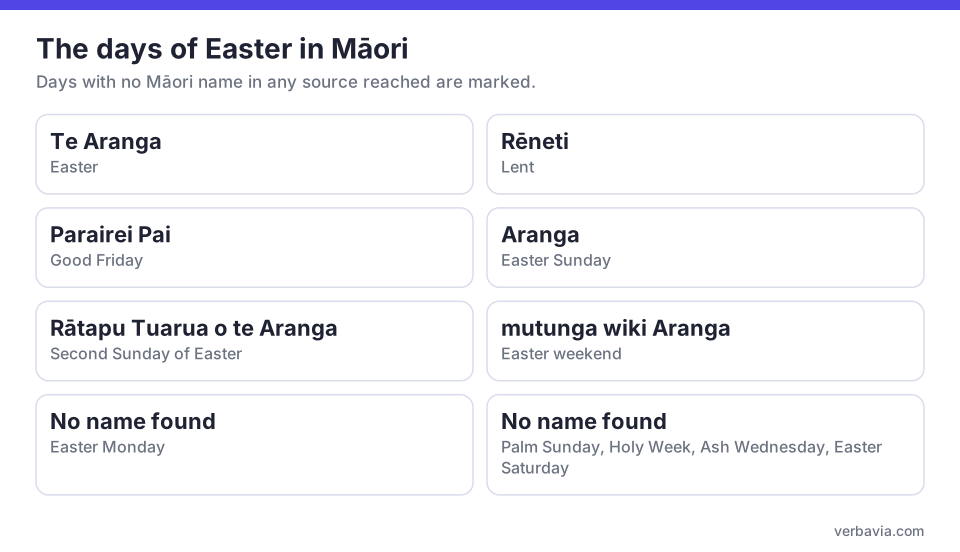
Only some of the days have a name in the sources, and two of those come from the 1840s. This is everything found, and what was looked for and not found:
| English | Māori | Source and note |
|---|---|---|
| Easter | Te Aranga | Te Aka. Also Aranga after a noun. |
| Lent | Rēneti | Te Aka, a loan: “the Christian period of fasting and penitence from Ash Wednesday to Holy Saturday”. |
| Good Friday | Parairei Pai | Te Aka’s example under Parairei, a source of 1841, and NZ History. Pai is good. |
| Easter Sunday | Aranga | NZ History’s gloss. Te Aka has no separate entry. |
| Second Sunday of Easter | Rātapu Tuarua o te Aranga | The heading of the Catholic Diocese of Auckland’s bilingual readings for that Sunday. |
| Easter weekend | mutunga wiki Aranga | Te Taura Whiri. Mutunga wiki is Te Aka’s weekend. |
| Easter Monday | No name found | Not in Te Aka, Massey, NZ History or Te Taura Whiri. Monday itself is Rāhina or Mane. |
| Palm Sunday, Holy Week, Ash Wednesday, Easter Saturday | No name found | No entry in Te Aka for any of them. |
Parairei is an older spelling of the loan for Friday; today’s is Paraire, with Rāmere as the Māori name. Te Aka’s example for Rēneti comes from the same 1841 source as Good Friday: Ko te Rātapu tuatoru i mua mai o Rēneti ‘the third Sunday before Lent’. No source reached puts Pai after the modern spelling, so Parairei Pai is the attested form. Both sets of weekday names, and the months, are in Māori numbers, days and months; Easter falls in March or April, Poutūterangi or Paengawhāwhā, which Massey’s list writes with hyphens.
Easter words in Māori
Most Easter things arrived from England in the nineteenth century, so most of their names are loans, reshaped by the sound rules explained in English words in Māori. Tiakarete is chocolate with the ch as ti and a vowel after every consonant.
| Māori | English | Note |
|---|---|---|
| hēki | egg | Loan, Te Aka. NZ History also gives hua manu. |
| hēki Aranga | Easter egg | Te Taura Whiri. |
| rapu hēki Aranga | Easter egg hunt | Te Taura Whiri. Rapu is to look for, hunt; rapurapu to search here and there. |
| tiakarete | chocolate | Loan, Te Aka. |
| rāpeti | rabbit | Loan, Te Aka. No separate word for bunny. |
| rohi rīpeka | hot cross bun | Te Taura Whiri. Rohi is a loaf, rīpeka a cross. |
| rīpeka | cross, crucifix | Also a verb in Te Aka: to crucify, to mark with a cross. |
| aranga | resurrection, rising up | The word Easter is named from. |
| hāhi | church (the body), religion | Loan, Te Aka. |
| whare karakia | church (the building) | Te Aka: a house of prayer. |
| hararei | holiday | Loan; also a verb, to go on holiday. |
| whakatā | rest, a break | Te Taura Whiri’s word for the Easter break. |
| mutunga wiki roa | long weekend | Te Taura Whiri. |
| whakanui | celebrate | NZ History’s word list. |
| Hui Aranga | the Māori Catholic Easter gathering | Te Aka; see below. |
Two gaps are worth knowing. No source reached has a Māori word for bunny or for bun on its own; the Easter bunny would be a rāpeti, a rabbit, and the bun exists only in Te Taura Whiri’s whole phrase. More everyday food words are in Māori food words.
Easter phrases from Te Taura Whiri
Te Taura Whiri’s 2025 Easter tiles are written for a family weekend. Four of them, with its own English:
| Māori | English (Te Taura Whiri’s) |
|---|---|
| He kaupapa rānei āu hei te mutunga wiki Aranga? | Got any plans for Easter weekend? |
| Ka rapurapu hēki Aranga rānei koutou ko ngā tamariki? | Are you doing an Easter egg hunt with the kids? |
| Kia rapu hēki Aranga tātou! | Let’s do an Easter egg hunt! |
| Kāore i tua atu i te rohi rīpeka i tēnei wāhanga o te tau! | Can’t beat hot cross buns this time of year! |
Rānei in a question marks it as a real question, or not?, and kāore i tua atu i is there is nothing beyond: nothing beats it. More short lines for every day are in common Māori phrases.
Easter in New Zealand: an autumn holiday
In Aotearoa, Easter falls in ngahuru ‘autumn’, which runs from March to May; the seasons in Māori guide sets out the months. Te Ara, the Encyclopedia of New Zealand, notes that the spring symbolism of northern Easter meant nothing here, and that for many New Zealanders Easter weekend was simply an autumn holiday. Customs carried over all the same: hot cross buns on Good Friday, and eggs on Easter Sunday, with chocolate Easter eggs arriving in the early 1900s. In the nineteenth century, hunting trips and volunteer military camps were popular at Easter; later the weekend filled with conventions and sports tournaments.
The Easter public holidays
- Good Friday and Easter Monday are statutory public holidays. Employees who work on them are paid time and a half and get a day off in lieu, Te Ara says.
- Shops must close on Good Friday unless they meet strict criteria. Easter Sunday is not a public holiday, and since 2016 each district council has decided whether shops in its area may open; the amendment that allowed it passed its third reading 62 votes to 59.
- The date moves. Easter Day is the Sunday on or after the full moon that follows the spring equinox in the northern hemisphere, so Good Friday and Easter Monday shift every year. In 2011 Easter Monday fell on Anzac Day.
- Easter Monday is old. The Bank Holidays Act 1873, New Zealand’s first holiday law, made banks close on Easter Monday; Te Ara notes that it was a customary holiday here long before it was in England and Ireland.
Hui Aranga
One Easter tradition is Māori in origin. Te Aka defines Hui Aranga as “an annual gathering of Māori Roman Catholic followers held at Easter on different marae and venues each year for cultural, sporting and religious activities”. Te Ara dates it to 1946, when the Central Council of Federated Clubs, which organised the Catholic Māori clubs nationally, launched the first of what became known as Hui Aranga, annual Easter gatherings for cultural performances and religious expression. Hui is a gathering, so the name is simply the Easter gathering.
This page gives no prayers or hymns. The Lord’s Prayer in te reo is in the Lord’s Prayer in Māori, three Catholic prayers are in Hail Mary in Māori, and the short karakia said to open and close a meeting are in karakia for meetings.
Going further
The words on this page that the course teaches early, kia pai, tō, koutou, tamariki and the days of the week, are in our free te reo Māori course, one short lesson a day. For the greetings you can use all year, start with Māori greetings.
Learn te reo Māori with Verbavia
Verbavia’s free te reo Māori course starts with the most common words, explains the grammar properly, and plays every example in Papa Reo’s native te reo voice. One lesson a day, from your first word to B1.
Quick questions
How do you say happy Easter in Maori?
Write Ngā mihi o Te Aranga!, Easter greetings, or, to wish someone a good long weekend, Kia pai tō whakatā Aranga!
What is Easter in Māori?
Easter is Te Aranga, from aranga, rising up, resurrection. There is no loan word for it in Te Aka.
What is Good Friday in Māori?
Parairei Pai, in Te Aka’s example from 1841 and in NZ History’s word list. No source reached gives a Māori name for Easter Monday.
How do you say Easter egg in Māori?
Te Taura Whiri writes hēki Aranga, and an Easter egg hunt is rapu hēki Aranga: Kia rapu hēki Aranga tātou! ‘Let’s do an Easter egg hunt!’
Sources
- Te Aka Māori Dictionary: Aranga, Te (Easter)
- Te Aka Māori Dictionary: aranga (verb, to arise, rise to the surface)
- Te Aka Māori Dictionary: aranga (noun, rising up, resurrection)
- Te Aka Māori Dictionary: Hui Aranga
- Te Aka Māori Dictionary: search for Easter
- Te Aka Māori Dictionary: Īta (East)
- Te Aka Māori Dictionary: Parairei (with Ko te Parairei Pai, 1841)
- Te Aka Māori Dictionary: Paraire
- Te Aka Māori Dictionary: Rēneti (Lent)
- Te Aka Māori Dictionary: Rātapu
- Te Aka Māori Dictionary: Rāhina
- Te Aka Māori Dictionary: Mane
- Te Aka Māori Dictionary: hēki
- Te Aka Māori Dictionary: hua heihei
- Te Aka Māori Dictionary: tiakarete
- Te Aka Māori Dictionary: rāpeti
- Te Aka Māori Dictionary: rohi (loaf)
- Te Aka Māori Dictionary: rīpeka
- Te Aka Māori Dictionary: hāhi
- Te Aka Māori Dictionary: whare karakia
- Te Aka Māori Dictionary: hararei
- Te Aka Māori Dictionary: whakatā
- Te Aka Māori Dictionary: mutunga wiki
- Te Aka Māori Dictionary: rapu
- Te Aka Māori Dictionary: rapurapu
- Te Aka Māori Dictionary: hari
- Te Aka Māori Dictionary: koa (to be glad)
- Te Aka Māori Dictionary: aroha nui
- Te Aka Māori Dictionary: ngahuru
- Te Taura Whiri i te Reo Māori: New phrases to use this Aranga! (Easter social tiles, 2025)
- Massey University: Using te reo Māori in letters and emails
- NZ History (Manatū Taonga): 365 useful words and phrases in te reo Māori
- Anglican Church in Aotearoa, New Zealand and Polynesia: The Archbishops’ 2025 Easter Message
- RNZ: Easter Church Service from Holy Trinity Cathedral (9 April 2023)
- RNZ: Te Kupu o te Wiki, Te Aranga – Easter (30 March 2015)
- Catholic Diocese of Auckland: Rātapu Tuarua o te Aranga, bilingual readings
- Nancy Swarbrick, Public holidays – Public holidays legislation, Te Ara – the Encyclopedia of New Zealand
- Nancy Swarbrick, Public holidays – Easter, Christmas and New Year, Te Ara – the Encyclopedia of New Zealand
- Hirini Kaa, Ngā hāhi – Māori and Christian denominations: Catholic Church, Te Ara – the Encyclopedia of New Zealand