Ode of Remembrance in Māori: words and meaning
The Ode of Remembrance in Māori begins E kore rātou e kaumātuatia and ends Ka maumahara tonu tātou ki a rātou ‘We will remember them’, said twice. That is the wording the RSA, New Zealand’s Returned and Services Association, publishes beside the English, which is the fourth stanza of Laurence Binyon’s 1914 poem For the Fallen. Below is the full ode of remembrance in maori as the RSA prints it, what its words mean, why the first line was changed in 2015, the other version you may hear, and where the Ode comes in an Anzac Day service.
Tap 🔊 to hear an example. Māori examples play Papa Reo, the te reo Māori voice made by Te Hiku Media from recordings of native speakers. Every sentence in the free course is spoken like this.
On this page
- The Ode of Remembrance in Māori and English
- The Māori Ode at a glance
- What do the words of the Māori Ode mean?
- Why was the first line changed in 2015?
- Is there more than one Māori version of the Ode?
- Where does the English Ode come from?
- When is the Ode of Remembrance said?
- How do you say the Māori Ode?
- Quick questions
The Ode of Remembrance in Māori and English
This is the Māori text exactly as the RSA’s sheet The Ode of Remembrance prints it:
E kore rātou e kaumātuatia
Pēnei i a tātou kua mahue nei
E kore hoki rātou e ngoikore
Ahakoa pehea i ngā āhuatanga o te wā
I te hekenga atu o te rā
Tae noa ki te aranga mai i te ata
Ka maumahara tonu tātou ki a rātou.
Ka maumahara tonu tātou ki a rātou.
And the English, as the same sheet prints it:
They shall grow not old, as we that are left grow old:
Age shall not weary them, nor the years condemn.
At the going down of the sun, and in the morning,
We will remember them.
We will remember them.
The RSA sheet prints pehea in the fourth line without its macron. The New Zealand Defence Force’s printing of the same RSA version has pēhea, the spelling Te Aka Māori Dictionary gives, and that is how it is spelt below. Both print the last line twice, as the English repeats We will remember them. To type the long vowels yourself, see how to type Māori macrons.
The Māori Ode at a glance
| Māori | English | |
|---|---|---|
| First line | E kore rātou e kaumātuatia | They shall grow not old |
| The sun going down | I te hekenga atu o te rā | At the going down of the sun |
| Last line, said twice | Ka maumahara tonu tātou ki a rātou. | We will remember them. |
| Lines | 8 | 5, as the RSA sets it |
| Published by | the RSA; also the NZ Defence Force | Binyon, 1914 |
What do the words of the Māori Ode mean?
The Māori is not a word-for-word copy of the English; it has eight lines to Binyon’s five. Here is each line with Te Aka’s meaning for its main words:
| Line | The words (Te Aka) |
|---|---|
| E kore rātou e kaumātuatia | e kore: will not; rātou: they; kaumātua: to grow old, here with its ending -tia |
| Pēnei i a tātou kua mahue nei | pēnei: like this; tātou: we, all of us; mahue: to be left |
| E kore hoki rātou e ngoikore | hoki: also; ngoikore: to be weak, feeble |
| Ahakoa pēhea i ngā āhuatanga o te wā | ahakoa: although, no matter; pēhea: how, of what sort; āhuatanga: way, circumstance; wā: time |
| I te hekenga atu o te rā | hekenga: descent, going down; rā: sun |
| Tae noa ki te aranga mai i te ata | tae noa ki: until; aranga: rising up; ata: morning |
| Ka maumahara tonu tātou ki a rātou. | ka: will; maumahara: to remember; tonu: still, unceasingly; ki a rātou: them |
Two places line up closely with Binyon. I te hekenga atu o te rā has the sun, rā, and its going down, hekenga. The next line has the morning, ata, but reaches it with tae noa ki, until, where the English says and.
The last line is the one most people know. Maumahara is the verb remember, and like every Māori verb it does not change; the ka in front sets the time, as Māori verbs explains. The ode says tātou, the we that includes everyone present, and rātou, they, three or more; why Māori has four words for we is in Māori pronouns.
Why was the first line changed in 2015?
Until 2015 the Māori Ode began E kore rātou e koroheketia. RNZ reported in July 2015 that the line was being changed to E kore rātou e kaumātuatia to better recognise the service of women in the military. Its explanation: koroheketia means to grow to be an old man, while kaumātuatia refers, in most iwi, to both men and women growing old. Te Aka gives koroheke as to become elderly, and the course teaches it as an old man.
The Chief of the Defence Force at the time, Lieutenant General Tim Keating, said the change was to ensure that the service of all those who have served New Zealand is fully recognised. RNZ reports that the revised ode was first used officially at the commemoration of the 62nd anniversary of the Korean War Armistice, at Pukeahu National War Memorial Park. The Defence Force’s copy notes that the RSA officially made the change and that the Defence Force uses it in agreement with the RSA.
Is there more than one Māori version of the Ode?
Yes. Beside the RSA version, the Defence Force prints “a 28th Māori Bn version”, for the 28th Māori Battalion, and adds that there are varying versions of that one. Its first line is different:
| RSA version | 28th Māori Battalion version (NZDF) |
|---|---|
| E kore rātou e kaumātuatia | E kore rātou e koroua wawe |
| Ka maumahara tonu tātou ki a rātou | Kia maumahara tonu tātou ki a rātou |
Te Aka gives koroua as to be old, elderly, and wawe as early, too soon, prematurely. In the last line the battalion version has kia where the RSA has ka. The lines in between are nearly the same as the RSA’s, with small differences in the fourth. If you are reading at a service, ask the organisers which version they use. The Defence Force also prints a Māori prelude to the Merchant Navy Ode, which it says is immediately followed by the RSA Māori Ode.
Where does the English Ode come from?
The RSA’s sheet explains that the Ode is the fourth stanza of Laurence Binyon’s poem For the Fallen, first published in the Times of London in September 1914, and that it has become part of the ritual of remembrance in many countries. In New Zealand it is said in both languages, and the Māori version keeps the English one’s repeated last line.
When is the Ode of Remembrance said?
Above all on Anzac Day, 25 April. NZHistory, from the Ministry for Culture and Heritage, explains that the date marks the landing of Australian and New Zealand soldiers on the Gallipoli Peninsula in 1915, that Anzac Day was first observed in 1916, and that the ceremonies held at war memorials are modelled on a military funeral. Dawn ceremonies were widely included from 1939.
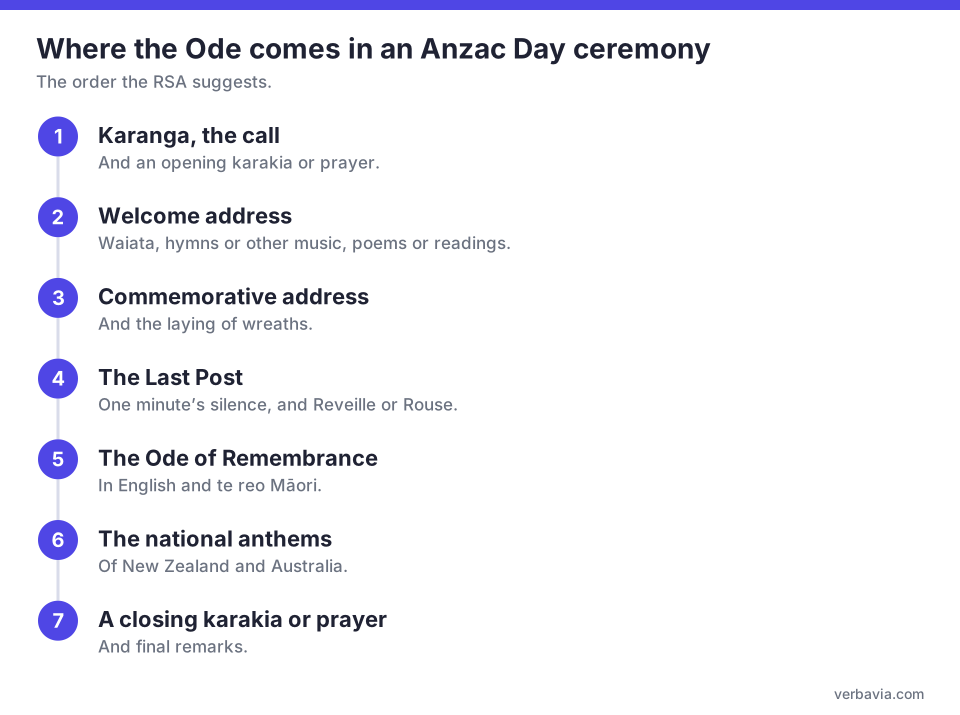
The RSA’s suggested order for an Anzac Day ceremony puts the Ode near the end:
- Karanga, the call, and an opening karakia or prayer
- Welcome address, waiata, hymns or other music, poems or readings
- Commemorative address, and the laying of wreaths
- The Last Post, one minute’s silence, and Reveille or Rouse
- The Ode of Remembrance, in English and te reo Māori
- The national anthems of New Zealand and Australia
- A closing karakia or prayer, and final remarks
The New Zealand anthem, verse by verse in both languages, is in the national anthem in Māori. RNZ adds that the Ode is recited at other commemorations too, including military funerals, and each evening at RSAs, and that it is typically followed by one minute’s silence. The RSA uses the last line, Ka maumahara tonu tātou ki a rātou, as the heading of its Anzac Day material.
For a funeral or a tangihanga, the words used to farewell the dead are in poroporoaki, and messages of sympathy are in condolences in Māori.
How do you say the Māori Ode?
Every vowel is said, and a vowel with a macron is held longer: rātou and tātou each have a long first syllable, and kaumātuatia a long ā in the middle. The five vowels and the ng of ngoikore and hekenga are explained in the Māori pronunciation guide. Many of the Ode’s words, among them maumahara, tātou, rātou and ahakoa, are taught in Verbavia’s free te reo Māori course, where you can hear them.
Other set texts New Zealanders say together are taken line by line in the Lord’s Prayer in Māori and karakia for meetings.
A family’s own remembrance, about a year after a tangi, is the hura kōhatu, the unveiling of the headstone.
Learn te reo Māori with Verbavia
Verbavia’s free te reo Māori course starts with the most common words, explains the grammar properly, and plays every example in Papa Reo’s native te reo voice. One lesson a day, from your first word to B1.
Quick questions
What is we will remember them in Māori?
Ka maumahara tonu tātou ki a rātou. It is the last line of the Māori Ode, and it is said twice.
How does the Ode of Remembrance start in Māori?
E kore rātou e kaumātuatia, in the RSA version used since 2015, for They shall grow not old.
Why did the Māori Ode change?
In 2015 koroheketia, growing to be an old man, was replaced by kaumātuatia, which refers to men and women alike, to recognise the service of women in the military.
What is the Ode of Remembrance?
The fourth stanza of Laurence Binyon’s poem For the Fallen, first published in September 1914, said at Anzac Day services and other commemorations in English and in te reo Māori.
Sources
- RSA: The Ode of Remembrance (the Māori and English text, and the history of the Ode)
- RSA: Anzac Day ceremony — suggested order of service
- New Zealand Defence Force: The Ode, te reo and English (RSA version, a 28th Māori Battalion version, and the Merchant Navy prelude)
- RNZ, 31 July 2015: Māori Ode of Remembrance gets update
- NZHistory (Manatū Taonga — Ministry for Culture and Heritage): Anzac Day
- Te Aka Māori Dictionary: kaumātua — (verb, -tia) to grow old, grow up.
- Te Aka Māori Dictionary: koroheke — (verb, -tia) to become elderly.
- Te Aka Māori Dictionary: koroua — to be old, elderly; wawe — too soon, prematurely.
- Te Aka Māori Dictionary: kore — not, no longer, used in negatives after e and ka.
- Te Aka Māori Dictionary: pēnei — like this; mahue — to be left.
- Te Aka Māori Dictionary: ngoikore — to be weak, feeble.
- Te Aka Māori Dictionary: ahakoa — although, no matter; pēhea — how?
- Te Aka Māori Dictionary: āhuatanga — way, aspect, circumstance.
- Te Aka Māori Dictionary: hekenga — descent, go down.
- Te Aka Māori Dictionary: tae noa ki — until; aranga — rising up.
- Te Aka Māori Dictionary: maumahara — to remember; tonu — still, unceasing.