Māori verbs: 36 common ones and how they work
The most useful Māori verbs to learn first are haere ‘to go’, kai ‘to eat’, inu ‘to drink’, noho ‘to sit, stay, live’, kite ‘to see’, kōrero ‘to speak’, mahi ‘to work, do’ and mōhio ‘to know’, and none of them ever changes for tense: a small word in front of the verb does that. Below are 36 common Māori verbs (often typed “maori verbs”), each with a sentence from Verbavia’s course, followed by the few things a Māori verb does do: take an ending in the passive, point with mai and atu, and choose between ki and i.
Tap 🔊 to hear an example. Māori examples play Papa Reo, the te reo Māori voice made by Te Hiku Media from recordings of native speakers. Every sentence in the free course is spoken like this.
On this page
- The common Māori verbs at a glance
- What are the most common verbs in Māori?
- Do Māori verbs change for tense?
- How do you give an order in Māori?
- What is the passive in Māori?
- What do mai and atu do after a verb?
- Which Māori verbs take ki and which take i?
- What is a stative verb in Māori?
- Learning Māori verbs
- Quick questions
The common Māori verbs at a glance
| English | Māori | English | Māori |
|---|---|---|---|
| to go | haere | to know | mōhio |
| to come back | hoki mai | to think | whakaaro |
| to arrive | tae | to want | hiahia |
| to sit, stay, live | noho | to speak, talk | kōrero |
| to eat | kai | to learn, teach | ako |
| to drink | inu | to write | tuhi |
| to sleep | moe | to work, do | mahi |
| to see | kite | to help | āwhina |
| to hear, feel | rongo | to buy, sell | hoko |
| to look at | titiro | to give (to me) | homai |
Every meaning on this page is Te Aka Māori Dictionary’s, shortened. The sections below group 36 verbs by what they are about, with an example of each one at work.
What are the most common verbs in Māori?
Coming and going
| Māori | Meaning | In a sentence |
|---|---|---|
| haere | to go, travel; to come, with mai | Kei te haere au ki te kura. ‘I am going to school.’ |
| hoki | to go back, return | Kua hoki mai rātou. ‘They have come back.’ |
| tae | to arrive, reach | Kua tae mai ia. ‘He has arrived.’ |
| noho | to sit, stay, live | E noho ana māua ki te whare. ‘The two of us are staying at the house.’ |
| tū | to stand | E tū! ‘Stand up!’ |
| oma | to run | Ka oma au ia rā. ‘I run every day.’ |
| hīkoi | to walk, step, march | Tekau meneti te hīkoi. ‘It’s a ten-minute walk.’ |
How to get somewhere by bus, car or plane, with the verbs for getting on and off, is in transport in Māori, and the words for left, right and straight on are in Māori directions.
Eating, sleeping and the day
| Māori | Meaning | In a sentence |
|---|---|---|
| kai | to eat; also food | Kua kai koe? ‘Have you eaten?’ |
| inu | to drink | Kei te inu au i te wai. ‘I am drinking the water.’ |
| moe | to sleep | Kei te moe te pēpi. ‘The baby is sleeping.’ |
| oho | to wake up | I ngā rā katoa, ka oho au i te ono karaka. ‘Every day, I wake up at six.’ |
| horoi | to wash, clean | Māku e horoi ngā rīhi. ‘I’ll do the dishes.’ |
Kai is a verb and a noun at once, which is why food in Māori starts with it.
The senses and the mind
| Māori | Meaning | In a sentence |
|---|---|---|
| kite | to see, perceive | I kite au i a Mere. ‘I saw Mere.’ |
| rongo | to hear, feel, smell, taste | I rongo au i te waiata. ‘I heard the song.’ |
| titiro | to look at | Titiro ki te maunga. ‘Look at the mountain.’ |
| whakarongo | to listen | Whakarongo ki tō whaea. ‘Listen to your mother.’ |
| mōhio | to know, understand | Kei te mōhio au ki a ia. ‘I know him.’ |
| whakaaro | to think, consider | Māku e whakaaro. ‘I’ll think about it.’ |
| hiahia | to want, wish for | E hiahia ana au ki te haere. ‘I’d like to go.’ |
| maumahara | to remember | E maumahara ana koe? ‘Do you remember?’ |
Te Aka gives rongo for every sense except sight, so the same verb hears a song and feels pain. The course pairs it with whakarongo: rongo is what reaches you, and whakarongo is listening on purpose, with whaka- on the front. In the north that whaka- is often said haka-, one of the differences in Māori dialects. Maumahara is the verb in the last line of the Ode of Remembrance in Māori.
Talking, learning and writing
| Māori | Meaning | In a sentence |
|---|---|---|
| kōrero | to speak, talk, tell | Kei te kōrero au ki a Mere. ‘I’m talking to Mere.’ |
| pātai | to ask | I pātai mai ia kei hea au e noho ana. ‘He asked me where I lived.’ |
| ako | to learn; also to teach | Kei te ako au i te reo. ‘I’m learning the language.’ |
| whakaako | to teach | Kei te whakaako ia i te reo. ‘She teaches the language.’ |
| tuhi | to write, draw | I tuhi ia i te pukapuka. ‘He wrote the book.’ |
| pānui | to read; to announce | I mua i te moe, ka pānui au. ‘Before bed, I read.’ |
The question words that go with pātai are on their own page, Māori question words. The words for a classroom, from kaiako ‘teacher’ up, are in te reo for teachers.
Doing, giving and getting
| Māori | Meaning | In a sentence |
|---|---|---|
| mahi | to work, do, make; also work | I mahi ia inanahi. ‘He worked yesterday.’ |
| hanga | to make, build | I hangaia te whare e ia. ‘The house was built by him.’ |
| āwhina | to help | I āwhina au i a ia. ‘I helped him.’ |
| tatari | to wait for | Kei te tatari au ki a koe. ‘I’m waiting for you.’ |
| tīmata | to begin, start | Kāore anō te hui kia tīmata. ‘The meeting has not started yet.’ |
| hoko | to buy, sell | I haere au ki te hoko kai. ‘I went to buy food.’ |
| tiki | to fetch, go and get | Māna e tiki te wai. ‘He will fetch the water.’ |
| kawe | to carry | Mā wai e kawe ngā pēke? ‘Who will carry the bags?’ |
| hoatu | to give, away from the speaker | Hoatu ki a ia. ‘Give it to him.’ |
| homai | to give, towards the speaker | Homai koa he pene. ‘Pass me a pen, please.’ |
Hoko is both buying and selling; the shop words are in shopping in Māori. Mahi is the work you do as well as doing it, and the words for a workplace are in Māori words at work.
Do Māori verbs change for tense?
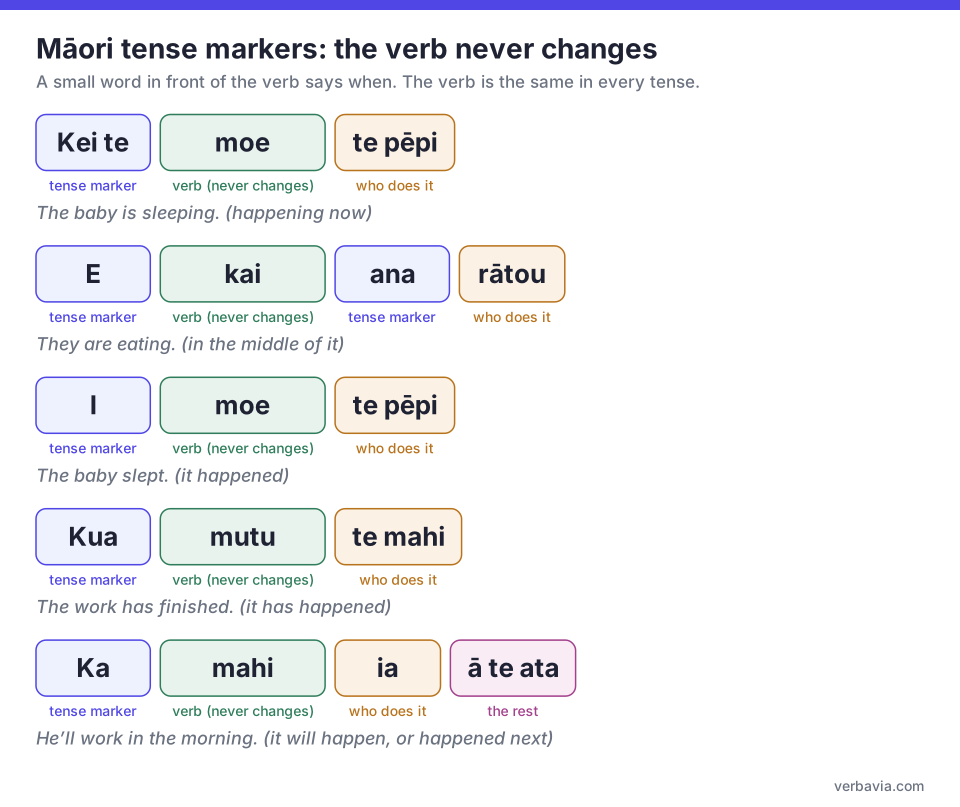
No. The verb is the same in every tense, and a small word in front of it, the tense marker, says when. The verb also stays the same whoever does it: there is no ending for I, you or they.
| Māori | English | The marker |
|---|---|---|
| Kei te moe te pēpi. | The baby is sleeping. | kei te: happening now |
| E kai ana rātou. | They are eating. | e … ana: in the middle of it |
| I moe te pēpi. | The baby slept. | i: it happened |
| Kua mutu te mahi. | The work has finished. | kua: it has happened |
| Ka mahi ia ā te ata. | He’ll work in the morning. | ka: it will happen, or happened next |
The verb comes after the marker and before the person doing it, so Kei te kai au. ‘I am eating.’ is, word for word, is-now eat I. How the rest of the sentence lines up behind it, and how kāore makes it negative, is in Māori sentence structure. The words for I, you and we, all four of them, are in Māori pronouns.
How do you give an order in Māori?
An order is the bare verb, and whether it needs a small e in front depends on the length of the verb, not its meaning. A verb of one or two syllables takes e; a verb of three or more takes nothing.
| Māori | English | Why |
|---|---|---|
| E noho! | Sit down! | no-ho: two syllables, so e |
| E tū! | Stand up! | tū: one syllable, so e |
| Haere mai! | Come here! | ha-e-re: three syllables, nothing |
| Whakarongo mai. | Listen to me. | four syllables, nothing |
| Kaua e haere! | Don’t go! | kaua e for don’t, whatever the length |
| E noho koa. | Please sit down. | koa, please, goes at the end |
A welcome is an order of exactly this kind. Te Ara’s account of Māori manners opens with one that begins Haere mai, quoted in what happens at a pōwhiri.
What is the passive in Māori?
The passive is the one place a Māori verb changes its own shape: it takes an ending. Māori uses it far more than English does, often where English would say it the active way, so a learner meets it early.
| Verb | Passive | In a sentence |
|---|---|---|
| kai eat | kainga | I kainga te kai e rātou. ‘The food was eaten by them.’ |
| kite see | kitea | I kitea te ika. ‘The fish was seen.’ |
| mahi do | mahia | Kua mahia te mahi. ‘The work has been done.’ |
| tuhi write | tuhia | Tuhia tō ingoa! ‘Write your name!’ |
| hoko buy | hokona | I hokona te pukapuka. ‘The book was bought.’ |
| hanga build | hangaia | I hangaia te whare e ia. ‘The house was built by him.’ |
| horoi wash | horoia | Kua horoia ngā rīhi? ‘Have the dishes been washed?’ |
| kawe carry | kawea | Kawea ngā pēke ki te waka. ‘Carry the bags to the car.’ |
| titiro look | tirohia | Tirohia! ‘Look at it!’ |
| kōrero speak | kōrerotia | Te Aka also lists -hia and -ngia |
There is no rule for which ending a verb takes: -a, -ia, -tia, -hia, -na, -ngia and others all occur, and Te Aka lists five endings for ako alone. Learn each verb with its passive. When you must guess, -tia is the safe one, because new and borrowed verbs take it.
In the sentence, what was the object becomes the subject, and the doer, if you name them at all, takes e: I kai rātou i te kai. ‘They ate the food.’ becomes I kainga te kai e rātou. Orders with something to act on are usually passive too, which is why a teacher says Tuhia tō ingoa! and not the plain verb.
What do mai and atu do after a verb?
Two small words after the verb say which way it points: mai towards the speaker, atu away. English often needs two different verbs for that, come and go, bring and take; Māori keeps one verb and turns it.
| Māori | English |
|---|---|
| Haere mai! | Come here! (and welcome) |
| Haere atu! | Go away! |
| Hoki mai! | Come back! |
| Titiro mai! | Look at me! |
Leave mai off Haere mai and the welcome becomes plain “go”. Homai and hoatu are the same idea built into the verb: give towards me, give away from me.
Which Māori verbs take ki and which take i?
Many verbs need a small word before the thing they act on, and which one is not something the English tells you. These are the common ones the course teaches.
| Takes ki | Takes i |
|---|---|
| kōrero ki ‘speak to’ | āwhina i ‘help’ |
| whakarongo ki ‘listen to’ | kite i ‘see’ |
| titiro ki ‘look at’ | hoko i ‘buy’ |
| mōhio ki ‘know’ | inu i ‘drink’ |
| tatari ki ‘wait for’ | ako i ‘learn’ |
| hiahia ki ‘want’ |
Before a person’s name or a pronoun both grow an a: ki a Mere, i a ia. And there is no verb to like at all: He pai ki a au te kai. ‘I like the food.’ is “the food is good to me”. Possession works the same way, with no verb to have, as Māori possessives explains.
What is a stative verb in Māori?
A handful of verbs describe a state something has ended up in, and nothing is done to anything. Te Aka labels them stative. They never take an object and are never made passive.
| Māori | English |
|---|---|
| Kua pau te kai. | The food is all gone. |
| Kua oti te mahi. | The work is finished. |
| Kua mau i a au te ika. | I have caught the fish. |
When you do name who caused the state, they take i, not the e of a real passive: Kua pau i a rātou te kai. ‘They have eaten all the food.’
Learning Māori verbs
Each verb on this page is taught in Verbavia’s free te reo Māori course, where every sentence above comes from and can be heard. A plan for the first 30 days is in learn Māori for beginners. If you know the verbs of another language, the lists of the most common Spanish verbs and the most common English verbs show how much more work a verb does there: Spanish changes the end of a verb for each person and tense, which Māori never does. To test the basics, try our te reo Māori quiz.
Why Māori places the past in front of you is in ka mua, ka muri: walking backwards into the future.
Whakarongo and whakaako are built with the prefix whaka-; what it does to rongo, ako and other words is in what does whaka mean. Te Aka labels some describing words statives too, iti and makariri among them: see the most common Māori adjectives.
Learn te reo Māori with Verbavia
Verbavia’s free te reo Māori course starts with the most common words, explains the grammar properly, and plays every example in Papa Reo’s native te reo voice. One lesson a day, from your first word to B1.
Quick questions
What is the Māori word for go?
Haere. With mai after it, it means come: Haere mai! is come here, and welcome.
Do Māori verbs have tenses?
Not in the verb itself. A marker in front sets the time: kei te for now, i for the past, kua for what has happened, ka for what will happen.
How do you say to eat in Māori?
Kai, which is also the word for food. To drink is inu.
How do you make a Māori verb passive?
Add its passive ending, which has to be learned with each verb: kai becomes kainga, kite becomes kitea, mahi becomes mahia. -tia is the ending new verbs take.
Sources
- Te Aka Māori Dictionary: haere — to go, depart, travel, walk, come (with mai).
- Te Aka Māori Dictionary: hoki — to go back, return; tae — to arrive.
- Te Aka Māori Dictionary: noho — to sit, stay, dwell, live; tū — to stand.
- Te Aka Māori Dictionary: oma — to run; hīkoi — to step, stride, march, walk.
- Te Aka Māori Dictionary: kai — to eat (passive -nga, -ngia); inu — to drink.
- Te Aka Māori Dictionary: moe — to sleep; oho — to wake up; horoi — to wash, clean.
- Te Aka Māori Dictionary: kite — to see, perceive (experience verb).
- Te Aka Māori Dictionary: rongo — to hear, feel, smell, taste, perceive.
- Te Aka Māori Dictionary: titiro — to look at (passive tirohia); whakarongo — to listen.
- Te Aka Māori Dictionary: mōhio — to know, understand; whakaaro — to think; hiahia — to want; maumahara — to remember.
- Te Aka Māori Dictionary: kōrero — to tell, say, speak, read, talk; pātai — to ask.
- Te Aka Māori Dictionary: ako — to learn, study, instruct, teach (passives -hia, -na, -ngia, -ria, -tia, ākona); whakaako — to teach.
- Te Aka Māori Dictionary: tuhi — to write, draw; pānui — to announce; to read aloud.
- Te Aka Māori Dictionary: mahi — to work, do, make; hanga — to make, build; āwhina — to help; tatari — to wait for; tīmata — to begin.
- Te Aka Māori Dictionary: hoko — to buy, sell; tiki — to fetch; kawe — to carry.
- Te Aka Māori Dictionary: hoatu — to give (away from the speaker); homai — to give (towards the speaker); neither takes a passive ending as a command.
- Te Aka Māori Dictionary: pau, oti and mau — statives: used up; finished; caught.