Feliz Ano Novo meaning: Happy New Year in Portuguese
Feliz Ano Novo! means "Happy New Year" in Portuguese, said roughly "feh-LEEZ AH-noo NOH-voo", and it is the same words in Portugal, Brazil and every other Portuguese-speaking country. What changes is the sound, the spelling and the night around it: Brazilians dress in white and jump seven waves at the virada, while in Portugal the passagem de ano comes with twelve raisins. Below are both pronunciations, the names of the night, wishes to copy for each country, and the customs of each.
On this page
What does Feliz Ano Novo mean?
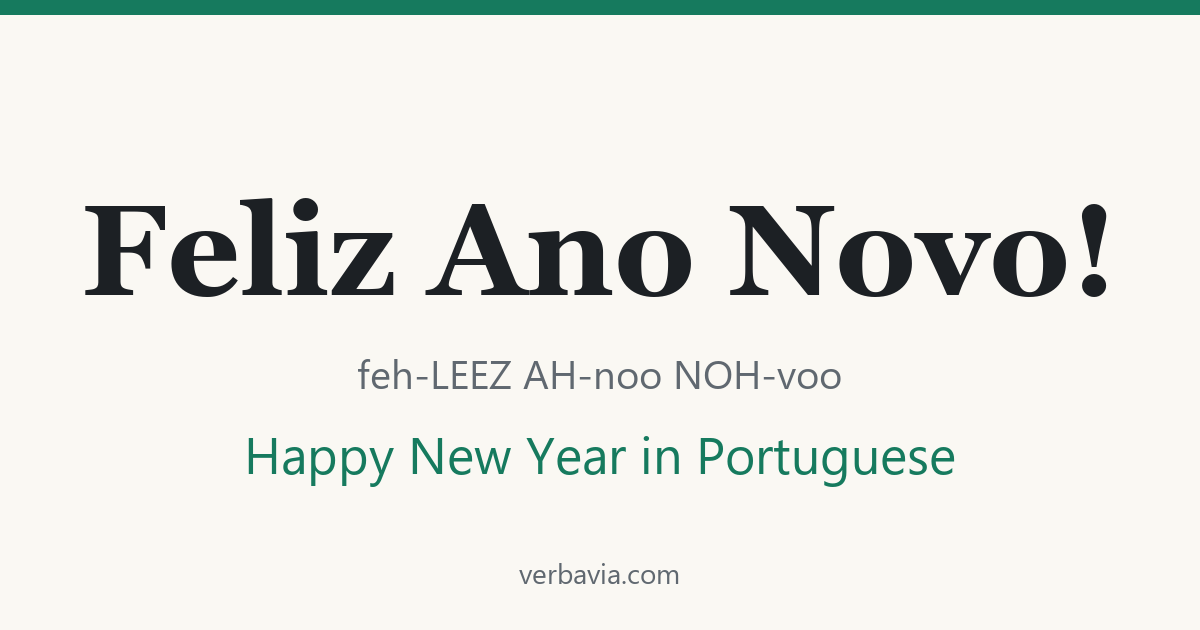
Feliz Ano Novo (feh-LEEZ AH-noo NOH-voo) means "Happy New Year" in Portuguese, word for word "happy new year", and it is the New Year greeting in Brazil, Portugal and the rest of the Portuguese-speaking world.
- Feliz is "happy", from Latin felix, the same word as in Feliz Natal and feliz aniversário.
- Ano is "year", and novo is "new". As with most Portuguese adjectives, novo comes after its noun.
Saying it in Brazil and in Portugal
Wiktionary gives three pronunciations, and they are noticeably different.
| Where | IPA | Say it |
|---|---|---|
| Brazil | /feˈliz ˈɐ̃.nu ˈno.vu/ | feh-LEEZ AHN-noo NOH-voo, the first a through the nose |
| Portugal | /fɨˈliz ˈɐ.nu ˈno.vu/ | f’LEEZ AH-noo NOH-voo, the first e barely said |
| Northern Portugal | /fɨˈliz ˈa.nu ˈno.bu/ | f’LEEZ AH-noo NOH-boo, with v sounding close to b |
In both countries the z of feliz runs into the vowel of ano as a z sound, and the final o of ano and novo is an "oo". The wider differences between the two accents are in Brazilian vs European Portuguese.
Ano Novo or ano-novo?
The holiday is spelt differently on each side of the Atlantic. Portuguese Wikipedia sums it up: in Portugal the word has no hyphen and is written with capitals, Ano Novo; in Brazil it has a hyphen and is written in lower case, ano-novo. As a greeting at the start of a sentence or on a card, Feliz Ano Novo! with capitals is what you will see in both.
Réveillon, virada or passagem de ano?
| Portuguese | Where | What it is |
|---|---|---|
| o réveillon | both | the night, or the party, of the turn of the year |
| a virada (do ano) | Brazil | the night of 31 December to 1 January |
| a passagem de ano | both, the usual word in Portugal | the same night |
| a véspera de Ano Novo | both | New Year’s Eve, 31 December, also called Dia do Ano Velho, "Old Year’s Day" |
| o Ano Novo / o ano-novo | Portugal / Brazil | New Year’s Day, 1 January |
Réveillon is French, as the Priberam dictionary says outright, and it keeps its French accent and spelling: "heh-veh-YOHN" in Brazil, where an initial r sounds like an h, and "reh-veh-YOHN" in Portugal. It comes from réveil, "waking", because the guests stay awake until morning. Portuguese Wikipedia traces it to the all-night dinners of the French nobility in the eighteenth century; Priberam defines it only as "the night or party of the passagem de ano".
Virada is labelled Brazilian in Priberam: virada do ano, "the night of 31 December to 1 January, when the arrival of the new year is celebrated", with passagem do ano as its synonym. So a Brazilian asks Onde você vai passar a virada?, "where are you spending New Year’s Eve?", and TV Globo’s big New Year’s Eve programme is called the Show da Virada.
New Year wishes in Portuguese, ready to copy
Brazil says você to almost everyone it knows; Portugal says tu to family and friends and keeps você and o senhor, a senhora for more distance. Where the two differ, both are given.
| Brazil | Portugal | English |
|---|---|---|
| Feliz Ano Novo, mãe! Te amo. | Feliz Ano Novo, mãe! Amo-te. | Happy New Year, Mum! I love you. |
| Que 2027 seja um ano cheio de saúde, paz e alegria. | (the same) | May 2027 be a year full of health, peace and joy. |
| Que todos os seus sonhos se realizem! | Que todos os teus sonhos se realizem! | May all your dreams come true! |
| Um brinde a 2027 e a nós! | (the same) | A toast to 2027, and to us! |
| Obrigado por este ano. Feliz 2027! | (the same) | Thank you for this year. Happy 2027! (Obrigada if you are a woman) |
| Desejamos a você e à sua família um próspero ano-novo. | Desejamos-lhe, a si e à sua família, um próspero Ano Novo. | We wish you and your family a prosperous New Year. (formal, to clients) |
Two differences show in the first and last rows. Brazil puts the little pronoun before the verb, te amo; Portugal hangs it after the verb with a hyphen, amo-te, desejamos-lhe. And obrigado agrees with the person speaking, not the person thanked. The year is said dois mil e vinte e sete, with e, "and", between each part; the rest of the numbers are in numbers 1 to 100 in Portuguese.
New Year’s Eve in Brazil
Most of Brazil is south of the Equator, so New Year falls in summer, and much of it happens on the beach.
- White clothes. Brazilians see the year in dressed in white. On Copacabana beach the custom began in the 1970s, when followers of Candomblé started spending the night there, all in white to greet Iemanjá, the orixá of the sea; Portuguese Wikipedia says that in Candomblé the colour stands for the mourning for the death that allows rebirth. The custom has since spread across the country and well beyond the faith.
- Other colours. English Wikipedia lists the meanings people give their colours: white for luck, yellow for good energy, happiness and money, red for love.
- Seven waves. At midnight people walk into the sea and pular sete ondas, jump seven waves, with a wish or a thank-you for each one. The custom comes from Umbanda and honours Iemanjá, queen of the sea; the seven is linked to the Seven Lines of Umbanda. It became known across Brazil from the rituals on the beaches of Rio’s Zona Sul in the 1950s and 1960s.
- Flowers for Iemanjá were carried into the sea before midnight.
- Food for luck: grapes, lychees, lentils and pomegranate seeds are all eaten for the year ahead.
Copacabana and Avenida Paulista
The best-known party is the Réveillon de Copacabana in Rio de Janeiro. Its fireworks began in 1978, on the initiative of the owner of a steakhouse in Leme, at the end of the beach. After an accident on the sand at the turn of 2000 to 2001 they moved out to sea: they are now fired from barges, four of them at first, about ten in recent years. Portuguese Wikipedia’s table puts the crowd at five million for the turn of 2024 to 2025.
In São Paulo the party is on the Avenida Paulista, where the Corrida de São Silvestre starts and finishes, the city’s New Year’s Eve race, named after the saint of 31 December. The journalist Cásper Líbero founded it on the last day of 1925, after seeing a night race in Paris in which the runners carried torches. It was run at night until 1988, has been 15 km since 1991, and has been open to runners from anywhere in the world since 1947.
New Year’s Eve in Portugal
- Twelve raisins. At midnight people drink champagne and eat doze passas, twelve raisins, one for each month of the year, making a wish with each. It is the Portuguese cousin of the twelve grapes of Spain.
- Funchal, Madeira. The fireworks over Funchal have been listed in the Guinness World Records as the world’s largest fireworks display.
- Lisbon counts down from the Terreiro do Paço, the great square on the river; Porto celebrates on the Avenida dos Aliados.
- On 1 January Lisbon has its New Year’s Concert in the evening, at the Centro Cultural de Belém, played by the Lisbon Metropolitan Orchestra.
| Brazil | Portugal | |
|---|---|---|
| The night | a virada, o réveillon | a passagem de ano |
| The holiday | o ano-novo | o Ano Novo |
| At midnight | seven waves, white clothes | twelve raisins, a wish for each |
| The big party | Copacabana, Avenida Paulista | Funchal, Terreiro do Paço, Avenida dos Aliados |
| "I love you" on the card | te amo | amo-te |
The words of New Year in Portuguese
| Portuguese | English |
|---|---|
| o réveillon | New Year’s Eve, or its party |
| a virada / a passagem de ano | the turn of the year (Brazil / Portugal) |
| a meia-noite | midnight |
| os fogos de artifício | fireworks |
| o brinde | the toast |
| o espumante, o champanhe | sparkling wine, champagne |
| as passas | raisins |
| as lentilhas | lentils |
| a romã | pomegranate |
| as ondas | waves |
The countdown runs dez, nove, oito, sete, seis, cinco, quatro, três, dois, um… Feliz Ano Novo! The names of the months that begin on 1 January, janeiro in lower case, are in the months of the year in Portuguese.
Learn the language behind the greeting
A greeting is the first sentence of a language; bom dia, tudo bem and the rest are in Portuguese greetings. Verbavia teaches Portuguese from the most common words up, a lesson a day, free on the web, and the words it starts with are in the most common Portuguese words.
A week before the virada comes Christmas: Feliz Natal, the consoada and the ceia, with wishes for both countries, are in Merry Christmas in Portuguese. The greeting in eight other languages is in Merry Christmas and Happy New Year in other languages.
Merry Christmas in other languages
- Bonne année: Happy New Year in French
- Buon anno: Happy New Year in Italian
- Buon Natale: Merry Christmas in Italian
- Christmas words in Spanish: Navidad, Nochebuena, Reyes
- Feliz Año Nuevo: Happy New Year in Spanish
- Feliz Natal: Merry Christmas in Portuguese
- Feliz Navidad: Merry Christmas in Spanish
- Frohe Weihnachten: Merry Christmas in German
- Frohes neues Jahr: Happy New Year in German
- Joyeux Noël: Merry Christmas in French
- Meri Kirihimete: Merry Christmas in Māori
- Merry Christmas and Happy New Year in other languages
- 圣诞快乐 (Shèngdàn kuàilè): Merry Christmas in Chinese
Learn Portuguese
Start the free Portuguese course
9 languages, each taught from a frequency list, with the grammar explained properly and reading and listening built from words you already know. One lesson a day, free. See all 9.
Quick questions
What does Feliz Ano Novo mean in English?
"Happy New Year". Feliz is "happy", ano is "year" and novo is "new".
How do you say Happy New Year in Brazilian Portuguese?
Feliz Ano Novo!, said "feh-LEEZ AHN-noo NOH-voo", with the first a of ano through the nose. In Portugal the same words sound more like "f’LEEZ AH-noo NOH-voo".
What does réveillon mean in Portuguese?
The night, or the party, of the turn of the year, 31 December into 1 January. It is a French word, from réveil, "waking", because people stay up all night.
Why do Brazilians wear white on New Year’s Eve?
The custom comes from Candomblé: followers spent the night on Copacabana beach in white to greet Iemanjá, the orixá of the sea, and the rest of Brazil took it up.
What is passagem de ano?
The Portuguese name for the night of New Year’s Eve, "the passing of the year"; Brazilians mostly say a virada.
Sources
- Wiktionary: feliz ano novo (the Brazilian, Portuguese and northern Portuguese pronunciations).
- Priberam, Dicionário da Língua Portuguesa: réveillon ("palavra francesa"; noite ou festa da passagem de ano; pronounced |rèvèiõ|) and virada (virada do ano, labelled Brazilian, synonym passagem do ano).
- Wikipedia in Portuguese: Ano-Novo (Ano Novo in Portugal, ano-novo in Brazil; Dia do Ano Velho); Réveillon (from réveil, "acordar"; the eighteenth-century French nobility; the party before New Year’s Day in Portuguese-speaking countries); Véspera de ano-novo (passagem de ano and virada de ano; white clothes and offerings to Iemanjá; pomegranate seeds; Copacabana; Avenida Paulista; Funchal in the Guinness World Records; Terreiro do Paço; Avenida dos Aliados); Réveillon de Copacabana (Candomblé in the 1970s and the meaning of white; fireworks from 1978; the barges after 2000–2001; five million in 2024–2025; flowers for Iemanjá); Pular sete ondas (the custom, Umbanda, Iemanjá, the Seven Lines, Rio’s Zona Sul in the 1950s and 1960s); Corrida Internacional de São Silvestre (Cásper Líbero, 1925, the Paris night race, 15 km since 1991, at night until 1988, international from 1947, finish on Avenida Paulista).
- Wikipedia in English: New Year’s Eve (Brazil: colours and their meanings; grapes, lychees and lentils; TV Globo’s Show da Virada. Portugal: champagne and twelve raisins with a wish each; the New Year’s Concert at the Centro Cultural de Belém on 1 January).