Happy Mother’s Day in Māori: Te Rā o Māmā, card messages
To say happy Mother’s Day in Māori, write Ngā mihi me te aroha nui mō te Rā o Māmā ‘Love and best wishes for Mother’s Day’, the greeting Te Taura Whiri i te Reo Māori, the Māori Language Commission, prints on its Mother’s Day cards. Its name for the day is Te Rā o Māmā ‘Mother’s Day’, and its shortest wish is Whakanuia te Rā o Māmā! ‘Celebrate Mother’s Day!’ Below are those words one by one, the dictionary’s longer name for the day, which word for mother to use, how to address a card to your mum, your nan, an aunty or a mother-in-law, card messages to copy, what is and is not attested for I love you and thank you, and Father’s Day.
Tap 🔊 to hear an example. Māori examples play Papa Reo, the te reo Māori voice made by Te Hiku Media from recordings of native speakers. Every sentence in the free course is spoken like this.
On this page
- What is Mother’s Day in Māori?
- Which word for mother: māmā, whaea, kōkā or whaene?
- Mā: the short form on the cards
- Nan, aunty and mother-in-law in Māori
- Mother’s Day card messages in Māori
- I love you, Mum, and thank you, in Māori
- Phrases you will see online that no dictionary prints
- When is Mother’s Day in New Zealand?
- Happy Father’s Day in Māori
- Going further
- Quick questions
| Māori | English | When to use it |
|---|---|---|
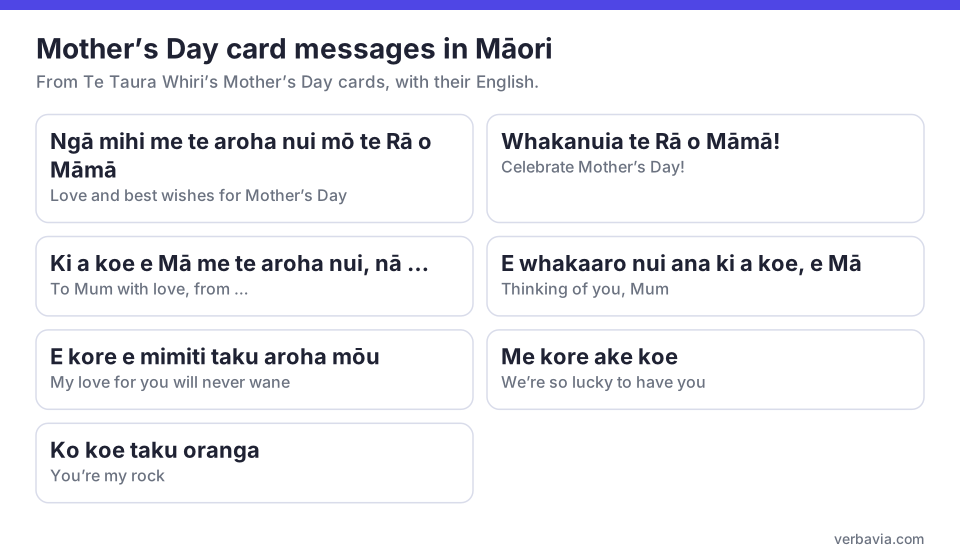
| Ngā mihi me te aroha nui mō te Rā o Māmā | Love and best wishes for Mother’s Day | The greeting on a card, a text or a post. |
| Whakanuia te Rā o Māmā! | Celebrate Mother’s Day! | A one-line wish, for anyone. |
| Ki a koe e Mā me te aroha nui, nā … | To Mum with love, from … | The opening and the sign-off of a card to your mum. |
| E whakaaro nui ana ki a koe, e Mā | Thinking of you, Mum | A card or a message when you are apart. |
| E kore e mimiti taku aroha mōu | My love for you will never wane | Inside the card, above your name. |
| Me kore ake koe | We’re so lucky to have you | From the whole family. |
| Ko koe taku oranga | You’re my rock | Te Taura Whiri’s own translation; see below. |
Every line in that table is printed, in that form, on Te Taura Whiri’s 2021 Te Rā o Māmā poster and tiles, which it publishes for anyone to download and share.
What is Mother’s Day in Māori?
There are two names, and both are correct. Te Taura Whiri calls the day Te Rā o Māmā: rā ‘day’, o ‘of’ and Māmā ‘Mum’, so word for word the day of Mum. Te Aka Māori Dictionary has a headword for it in a longer form, Te Rā Whakanui i ngā Māmā, which it glosses Mother’s Day: the day of honouring the mums, since whakanui is to celebrate, honour and ngā makes māmā plural. Te Aka’s example sentence for it is about choosing the right present for your mum for the day.
| Te Taura Whiri i te Reo Māori | Te Aka Māori Dictionary | |
|---|---|---|
| Mother’s Day | Te Rā o Māmā | Te Rā Whakanui i ngā Māmā |
| Father’s Day | Te Rā o Pāpā | Te Rā Whakanui i ngā Pāpā |
| Where it appears | Posters and social tiles for both days, 2021 | Dictionary headwords with example sentences |
| The wish | Whakanuia te Rā o Māmā! | No greeting given, only the name |
Neither source mentions the other’s form. The short one is what goes on a card; the long one is useful in a sentence, as in Te Aka’s Father’s Day example below. In Whakanuia, the ending -a is the passive form Te Aka lists for whakanui, which turns it into a request: let Mother’s Day be celebrated. The same Māori-language day names for birthdays and Christmas are in happy birthday in Māori and Merry Christmas in Māori.
Ngā mihi me te aroha nui, word by word
| Māori | Word for word |
|---|---|
| ngā mihi | the greetings, acknowledgements |
| me te aroha nui | and the great love |
| mō te Rā o Māmā | for the day of Mum |
Ngā mihi is the same phrase that closes a work email, explained in Māori email sign-offs, and aroha nui is the much love of I love you in Māori. Te Taura Whiri renders the whole line love and best wishes for Mother’s Day.
Which word for mother: māmā, whaea, kōkā or whaene?
Te Aka lists ten words for mother as synonyms of each other. The everyday one is māmā, mother, mum, which Te Aka marks as a loan from English; it is the word in both Te Taura Whiri’s name for the day and Te Aka’s. The others differ in who else they cover and where they are said:
| Word | Te Aka’s meaning | Note |
|---|---|---|
| māmā | mother, mum | Loan from English; the warm, everyday word. |
| whaea | mother, aunt, aunty | Also an aunty. Plural whāea with some iwi. |
| kōkā | mother, aunty | Te Aka marks it eastern dialect. |
| whaene | mother, aunt | Te Aka gives no region for it. |
| hākui | mother, mum, old woman, elderly woman | Older and more formal. |
| kōkara | mother, especially birth mother | |
| ūkaipō | mother, source of sustenance | Also origin, real home. |
So the choice is mostly about warmth and region. For your own mum on a card, māmā is the word both official sources use. Whaea reaches further: it covers aunts as well, and Te Taura Whiri’s own website puts Whaea before the name of a woman teacher. If your family speaks an eastern dialect and says kōkā, that is the word to use; how dialects differ, including Ngāi Tahu’s words for a grandmother, is in Māori dialects. The rest of the family words are in Māori family words.
Ūkaipō carries more than the person: Te Aka’s second sense is origin, real home, the place that fed you. Te Aka’s example of the first sense names a man’s hapū through his ūkaipō, his mother’s side.
Mā: the short form on the cards
Te Taura Whiri’s cards do not write e Māmā. They write e Mā: Ki a koe e Mā, to you, Mum, and E whakaaro nui ana ki a koe, e Mā, thinking of you, Mum. The Father’s Day cards do the same with e Pā. Te Aka has no entry for Mā or Pā as short forms; its mā is the particle for, and its pā a fortified village. The cards are the source for the short form, and it fits Te Aka’s rule for the particle e, which goes before a name of one long vowel when you address someone, and before terms of address. More on e in Māori greetings.
Nan, aunty and mother-in-law in Māori
Mother’s Day cards also go to grandmothers, aunties and the mother of a partner. Te Aka’s words for each:
| English | Māori | Te Aka’s note |
|---|---|---|
| grandmother, nan | kuia | elderly woman, grandmother, female elder |
| grandma (to her face) | kui | a term of address for an older woman |
| granny | karani | loan; Te Aka’s example is a nickname, Karani Tōpia, Granny Tōpia |
| grandmother | tāua | grandmother, old woman, grandparent |
| grandmother (Ngāi Tahu) | taua | Ngāi Tahu dialect |
| aunt, aunty | whaea kēkē | the specific word; whaea and kōkā also cover an aunty |
| mother-in-law | hungarei, hungawai | both mean mother-in-law or father-in-law |
Te Aka has no Māori form of nan or nana; the borrowed word it records is karani, from granny. For calling your grandmother by name in a card, kui is the one Te Aka describes as a term of address, and the condolences guide shows it with e as e kui. Neither in-law word is a term of address: in a card, use her name.
Mother’s Day card messages in Māori
Every Mother’s Day card line below is built the same way: who it goes to, the wish, and who sent it. Ki a is to before a name or a pronoun, and nā before a name is from. Te Taura Whiri’s frame is Ki a koe e Mā me te aroha nui, nā …; Christchurch City Libraries prints the same card with the word itself in place of you: Ki a Māmā, me te aroha nui, nā Emākoau. ‘To Mum, with love, from Emākoau.’ Each message below is quoted from those two sources or swaps one word into their frames, and says which.
To Mum, from one of her children
Quoted from Te Taura Whiri, with the fill-in for a daughter:
Ngā mihi me te aroha nui mō te Rā o Māmā ‘Love and best wishes for Mother’s Day’
E kore e mimiti taku aroha mōu ‘My love for you will never wane’
Ki a koe e Mā me te aroha nui, nā tō tamāhine ‘To Mum with love, from your daughter’
The card gives five ways to sign it after nā, all Te Taura Whiri’s:
| Māori | English |
|---|---|
| nā tō tamāhine | from your daughter |
| nā tō tama | from your son |
| nā tō tino tamaiti | from your favourite child |
| nā ō tamariki | from your children |
| nā mātou | from us |
Tō is your for one person or thing, and ō the plural, as the guide to Māori possessives explains; Te Aka describes tō as the neutral form, outside the a and o categories, so it is right for a child of either sex. Tino tamaiti is the cards’ joke: your very child, the favourite.
From the whole family
Quoted from Te Taura Whiri:
Whakanuia te Rā o Māmā! ‘Celebrate Mother’s Day!’
Me kore ake koe ‘We’re so lucky to have you’
Ki a koe e Mā me te aroha nui, nā ō tamariki ‘To Mum with love, from your children’
To Mum when you are far away
Quoted from Te Taura Whiri:
E whakaaro nui ana ki a koe, e Mā ‘Thinking of you, Mum’
Ki a koe e Mā me te aroha nui, nā tō tama ‘To Mum with love, from your son’
To your partner, the mother of your children
Te Taura Whiri’s greeting and its you’re my rock, signed with a name as in the Christchurch card:
Ngā mihi me te aroha nui mō te Rā o Māmā ‘Love and best wishes for Mother’s Day’
Ko koe taku oranga ‘You’re my rock’
Nā Hone ‘From Hone’
For words a partner would use, such as e te tau ‘my darling’, see the terms of endearment.
To your nan
Te Taura Whiri’s frame with two words swapped in: kui, Te Aka’s term of address for a grandmother, in place of Mā, and tō mokopuna ‘your grandchild’ in place of the card’s tō tama:
Ki a koe e kui me te aroha nui, nā tō mokopuna ‘To you, Nan, with love, from your grandchild’
or, in the Christchurch frame, Ki a Karani, me te aroha nui, nā Aroha ‘To Granny, with love, from Aroha’
Mokopuna is grandchild; use ō mokopuna ‘your grandchildren’ from several. Te Aka’s own example writes Karani with a capital, as part of a name.
To an aunty or a mother-in-law
The Christchurch frame with a name, which suits anyone:
Ki a Mere, me te aroha nui, nā Hēmi ‘To Mere, with love, from Hēmi’
Ngā mihi me te aroha nui mō te Rā o Māmā
Te Aka’s whaea already covers an aunty, so an aunty who mothered you can be greeted on the day like a mother. No source reached prints a Mother’s Day line addressed with e whaea, so it is not offered as a quotation.
I love you, Mum, and thank you, in Māori
Te Taura Whiri’s Mother’s Day line for love is E kore e mimiti taku aroha mōu ‘My love for you will never wane’. Mimiti is Te Aka’s be dried up, diminished: the love will never run dry. Massey University’s list of whakataukī about love prints the same saying with te in place of taku, E kore e mimiti te aroha mōu, and gives the same English. Both are sound; Te Taura Whiri’s my love is the more personal for a card.
For a plain I love you, Massey lists Ka nui taku aroha ki a koe ‘My love for you knows no bounds’; to say it to your mum, add the cards’ address after it, Ka nui taku aroha ki a koe, e Mā. That last form is built from the two sources rather than quoted. The other ways to say it, and what aroha covers, are in I love you in Māori.
Thank you, Mum
Te Aka gives tēnā koe as hello and also thank you, to one person, so Tēnā koe, e Mā, built from that entry and the cards’ address, is a thank-you on its own. No dictionary or official source reached prints a fixed Māori thank you for everything. What Te Taura Whiri’s cards use instead is Me kore ake koe, we’re so lucky to have you, and Te Aka explains why it works: me kore ake is an idiom praising the importance of someone’s contribution, thanks to. Its example could go in a card to a mother who taught you everything:
| Māori (Te Aka) | English (Te Aka) |
|---|---|
| Me kore ake koe hei whakaako mai i a mātou. | We were fortunate to have you to teach us. |
The same idiom has a second sense, just like, and Te Aka’s example of that one is about mothers too: Me kore ake te whaea. ‘She’s just like her mother.’ The words for how you feel on the day, from happy to proud, are in Māori words for feelings.
Ko koe taku oranga: why the rock?
Te Taura Whiri translates Ko koe taku oranga as you’re my rock. Word for word it says more: Te Aka’s oranga is food, livelihood, welfare, health, living, so the mother is what keeps you alive and well. On the Father’s Day cards the same English, you’re my rock, translates a different line, Ko koe taku toka tū moana: a toka tū moana is a rock standing in the ocean, which Te Aka glosses as a person who is there for you through thick and thin, and Te Aka’s own example is ko koe taku toka tū moana. Both are right for either parent; the cards simply chose one for each day.
Phrases you will see online that no dictionary prints
Search for Mother’s Day in Māori and other wordings turn up on gift shops, card templates and social posts: Hari Rā Māmā, Kia hari te rā Māmā, Rā o te Whaea and Ngā mihi o te rā o ngā whaea. None of them is in Te Aka, and none appears in Te Taura Whiri’s Mother’s Day resources, so they are not offered here; the attested name is Te Rā o Māmā or Te Aka’s Te Rā Whakanui i ngā Māmā.
The same goes for a proverb. A saying Ko te whaea te takere o te waka, comparing a mother to the hull of a canoe, is quoted in an opinion piece, but no dictionary, encyclopedia or university list reached prints it with a translation, and Te Aka’s own takere o te waka ‘the hull of the canoe’ is a saying about the greatest descendants of a hapū or iwi, not about mothers. So no whakataukī is given here. Proverbs that are attested, with their sources, are collected in whakataukī: Māori proverbs.
When is Mother’s Day in New Zealand?
Mother’s Day in Aotearoa New Zealand falls on the second Sunday in May, the same day as in the United States, as the NZ Herald set out in 2023. It is a family occasion, not a public holiday. Father’s Day comes at the start of spring, on a Sunday in early September, a date New Zealand shares with Australia rather than with Britain or the United States, which mark it in June. The month names in te reo, including Mei ‘May’, are in Māori numbers, days and months.
For some people the day is hard. If you are writing to someone whose mother has died, the wording for that is in moe mai rā and condolences in Māori; no Mother’s Day source reached has a line of its own for it. For a mother celebrating her first Mother’s Day, the messages for a new arrival are in new baby messages in Māori.
Happy Father’s Day in Māori
Father’s Day follows the same pattern. Te Taura Whiri calls it Te Rā o Pāpā, and Te Aka has Te Rā Whakanui i ngā Pāpā, with this example: Mō Te Rā Whakanui i ngā Pāpā, e whai ana au kia peka atu ki tōna taha. ‘For Father’s Day, I plan on visiting him.’ The greeting is Ngā mihi me te aroha nui mō te Rā o Pāpā ‘Love and best wishes for Father’s Day’, and the card frame is Ki a koe e Pā me te aroha nui, nā … Three lines appear only on the Father’s Day cards:
| Māori | English (Te Taura Whiri’s) |
|---|---|
| Ko koe taku toka tū moana | You’re my rock |
| Ko koe a tuahangata | You’re my hero |
| Kei tawhiti koe! | You’re number one! |
Tuahangata is Te Aka’s hero, male idol, a familiar name for the main male character of a story, so it is a Father’s Day word rather than a Mother’s Day one. Pāpā is father, uncle, dad in Te Aka, so an uncle can have the card too.
Going further
Māmā, whaea, aroha and the possessives on these cards are early words in the free te reo Māori course, one lesson a day. For the other times of year a card goes out, see happy birthday in Māori and happy Easter in Māori; for the pronouns behind ki a koe and ki a koutou, Māori pronouns; and for saying the long vowels in Māmā right, the pronunciation guide.
Learn te reo Māori with Verbavia
Verbavia’s free te reo Māori course starts with the most common words, explains the grammar properly, and plays every example in Papa Reo’s native te reo voice. One lesson a day, from your first word to B1.
Quick questions
How do you say happy Mother’s Day in Maori?
Write Ngā mihi me te aroha nui mō te Rā o Māmā ‘Love and best wishes for Mother’s Day’, Te Taura Whiri’s greeting, or simply Whakanuia te Rā o Māmā!
What is the Māori word for mum?
Māmā, a loan from English; whaea (mother, aunt) and, in the eastern dialect, kōkā are also used. On cards Te Taura Whiri shortens it to e Mā.
What do I write in a Mother’s Day card in Māori?
Ki a koe e Mā me te aroha nui, nā and your name, or nā ō tamariki (from your children): To Mum with love, from …
What is Father’s Day in Māori?
Te Rā o Pāpā on Te Taura Whiri’s cards, and Te Rā Whakanui i ngā Pāpā in Te Aka Māori Dictionary.
Sources
- Te Taura Whiri i te Reo Māori: Te Rā o Māmā – Mother’s Day (2021; poster and social tiles)
- Te Taura Whiri i te Reo Māori: Te Rā o Pāpā – Father’s Day (2021; poster and social tiles)
- Te Taura Whiri i te Reo Māori: Te Rā o Māmā A3 poster (image)
- Te Taura Whiri i te Reo Māori: Te Rā o Pāpā A3 poster (image)
- Te Taura Whiri i te Reo Māori: a reo Māori event page using Whaea as a teacher’s title
- Christchurch City Libraries: Te Kupu o Te Wiki – Māmā (Mum), 27 June 2016
- Massey University: Whakataukī – Māori proverbs (whakataukī aroha)
- Te Aka Māori Dictionary: Te Rā Whakanui i ngā Māmā (Mother’s Day)
- Te Aka Māori Dictionary: Te Rā Whakanui i ngā Pāpā (Father’s Day)
- Te Aka Māori Dictionary: māmā (mother, mum)
- Te Aka Māori Dictionary: whaea
- Te Aka Māori Dictionary: whāea
- Te Aka Māori Dictionary: kōkā (eastern dialect)
- Te Aka Māori Dictionary: whaene
- Te Aka Māori Dictionary: hākui
- Te Aka Māori Dictionary: kōkara
- Te Aka Māori Dictionary: ūkaipō
- Te Aka Māori Dictionary: kuia
- Te Aka Māori Dictionary: kui (term of address)
- Te Aka Māori Dictionary: karani
- Te Aka Māori Dictionary: tāua
- Te Aka Māori Dictionary: taua (Ngāi Tahu dialect)
- Te Aka Māori Dictionary: whaea kēkē
- Te Aka Māori Dictionary: hungarei
- Te Aka Māori Dictionary: hungawai
- Te Aka Māori Dictionary: pāpā
- Te Aka Māori Dictionary: e (the particle used when addressing someone)
- Te Aka Māori Dictionary: mā (the particle)
- Te Aka Māori Dictionary: tō (the neutral your)
- Te Aka Māori Dictionary: nā
- Te Aka Māori Dictionary: whakanui (to celebrate, honour)
- Te Aka Māori Dictionary: mimiti
- Te Aka Māori Dictionary: mōu
- Te Aka Māori Dictionary: oranga
- Te Aka Māori Dictionary: toka tū moana
- Te Aka Māori Dictionary: tuahangata
- Te Aka Māori Dictionary: me kore ake
- Te Aka Māori Dictionary: me/mai/mei kore ake (with “Me kore ake te whaea”)
- Te Aka Māori Dictionary: tēnā koe (hello, thank you)
- Te Aka Māori Dictionary: takere o te waka
- Te Aka Māori Dictionary: tawhiti
- Te Aka Māori Dictionary: peka (to call in, visit)
- NZ Herald: Why do we celebrate Father’s Day and Mother’s Day on different dates in different countries? (27 August 2023)

