New baby messages in Māori: congratulations and welcome
To say congratulations on your new baby in Māori, write Ngā mihi nui ki a kōrua! ‘Congratulations to you both!’ to the parents, and welcome the baby itself with Nau mai! ‘Welcome!’ Use ki a koe instead of ki a kōrua for one parent, and ki a koutou for the whole family. This guide gives ready-to-copy messages for a card, a text and a work email, for a boy, a girl, twins and a new grandchild, then the Māori words for pregnancy and birth, from hapū ‘pregnant’ to whenua ‘placenta’, with what the dictionary and the encyclopedia say about each.
Tap 🔊 to hear an example. Māori examples play Papa Reo, the te reo Māori voice made by Te Hiku Media from recordings of native speakers. Every sentence in the free course is spoken like this.
On this page
- How do you say congratulations on a new baby in Māori?
- How do you say welcome baby in Māori?
- New baby card messages in Māori, ready to copy
- What to call the baby and the family
- Māori words for pregnancy and birth
- Whenua and pito: the placenta and the cord
- Tohi: a ceremony for a new child
- What is an oriori?
- Gifts for a new baby: koha or present?
- Going further
- Quick questions
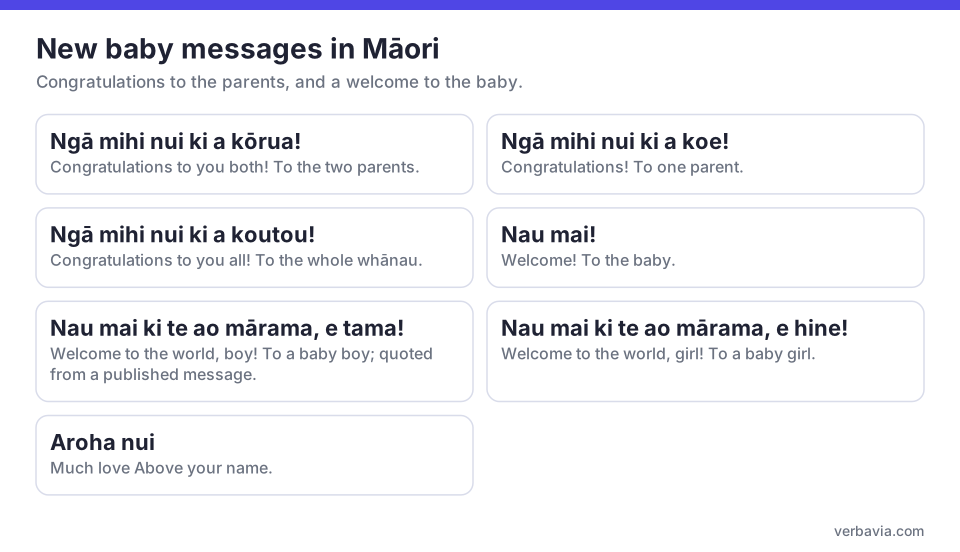
| Māori | English | When to use it |
|---|---|---|
| Ngā mihi nui ki a kōrua! | Congratulations to you both! | To the two parents. |
| Ngā mihi nui ki a koe! | Congratulations! | To one parent. |
| Ngā mihi nui ki a koutou! | Congratulations to you all! | To the whole whānau. |
| Nau mai! | Welcome! | To the baby. |
| Nau mai ki te ao mārama, e tama! | Welcome to the world, boy! | To a baby boy; quoted from a published message. |
| Nau mai ki te ao mārama, e hine! | Welcome to the world, girl! | To a baby girl. |
| Aroha nui | Much love | Above your name. |
How do you say congratulations on a new baby in Māori?
There is no single fixed phrase for a birth. Te Aka Māori Dictionary, searched for congratulations, gives one word, whakamihi: as a verb to praise, pay tribute to, congratulate, compliment, acknowledge, and as a noun tribute, congratulations, greeting. It prints no phrase for congratulating someone on a baby, and neither does Massey University’s guide to te reo in letters and emails. What people write is the general congratulation, sent to the parents.
That general congratulation is Ngā mihi nui ki a koe!, which our course teaches as Congratulations! in its lesson on congratulating and condoling. Mihi is, in Te Aka, to greet, acknowledge and thank, and as a noun a speech of greeting; nui makes it big. So the phrase is literally great acknowledgements to you, and it fits a birth as well as a graduation or a new job. The common Māori phrases guide lists it among the other everyday congratulations.
Koe, kōrua or koutou: who the card is to
The last word changes with how many people you are congratulating, the three-way split explained in Māori pronouns: koe for a single parent, kōrua for the pair and koutou for the wider family. A baby usually has two parents, so the card to a couple says Ngā mihi nui ki a kōrua!; the same choice is made for a wedding couple in Māori wedding words. To a single parent it is ki a koe, and to a household with older children or grandparents in it, ki a koutou. The three forms with kōrua and koutou are built by swapping the pronoun, not quoted from a birth card.
How do you say welcome baby in Māori?
The word for welcoming anyone is nau mai, which Te Aka glosses welcome! and illustrates with a gathering of 1899 where Ngā Puhi stood and called “Nau mai! Nau mai!” Haere mai! is come here, welcome, and the two together, Nau mai, haere mai., are the host’s welcome that the course teaches early on. Said to a newborn, the house is the host and the baby is the guest who has just arrived.
One published welcome adds where the baby has arrived. When the MP Tāmati Coffey and his husband Tim announced the birth of their son in July 2019, the NZ Herald reported that Coffey’s fellow Labour MP Kiri Allan wrote Nau mai ki te ao mārama, e tama ‘Welcome to the world, boy’. The Herald prints ki te run together as kite and glosses the line “welcome to the world”. Each piece is in Te Aka:
| Māori | Te Aka’s meaning | In the welcome |
|---|---|---|
| nau mai | welcome! | welcome |
| ki te | to the | to the |
| ao mārama | world of life and light, Earth, physical world | world |
| e | the particle used when addressing someone | — |
| tama | son, boy; a term of address to a boy or a man younger than the speaker | boy, son |
For a girl, Te Aka’s matching term of address is hine, girl, daughter, used to a girl or younger woman, so the welcome becomes Nau mai ki te ao mārama, e hine! A grandparent can use moko, which Te Aka describes as how an older person addresses a grandchild or a young child: Nau mai ki te ao mārama, e moko! These two are built from the published line by swapping in Te Aka’s own terms of address, not quoted. With a name, put it after e, as in Nau mai, e Mere!; the guide to Māori baby names has the names themselves, with their meanings.
Ao mārama is more than the world. Te Aka’s example for it comes from the story of how life began, where the first beings ask how to bring descendants into “this world of light and life”. Te Ara’s account of the first birth tells the same story: the children of Ranginui and Papatūānuku lived in darkness until Tāne separated their parents, so that they could live in the light.
New baby card messages in Māori, ready to copy
Each message is put together from the phrases above, with your own English where no attested Māori exists. Swap in your names. Nā before a name means from, as in a birthday or Christmas card.
To both parents
Tēnā kōrua,
Congratulations on your beautiful baby. We can’t wait to meet her.
Ngā mihi nui ki a kōrua!
Aroha nui, nā Hone
To one parent
Kia ora, e Mere,
I’m so happy for you.
Ngā mihi nui ki a koe!
Aroha nui, nā Ani
To the whole family
E te whānau, tēnā koutou,
What wonderful news. Congratulations to every one of you.
Ngā mihi nui ki a koutou!
Ka nui te aroha ki a koutou.
Nā Hēmi
For a baby boy
Nau mai ki te ao mārama, e tama!
Ngā mihi nui ki a kōrua!
Aroha nui, nā Aroha
For a baby girl
Nau mai ki te ao mārama, e hine!
Ngā mihi nui ki a kōrua!
Aroha nui, nā Aroha
For twins
Tēnā kōrua,
Two at once! Congratulations on your twins.
Ngā mihi nui ki a kōrua!
Aroha nui, nā Mere
Twins are māhanga in Te Aka, whose example, from a family history of 1991, reads He māhanga ngā mātāmua, he tāne ‘the first-born were twins, and males’. Triplets are māhanga tokotoru. No source found prints a welcome addressed to twins, so welcome each baby by name, or keep the card to the parents. Te Aka also has a separate māhanga meaning a snare, which the sentence around it rules out.
For a new grandparent
Kia ora, e Mere,
Congratulations on your new mokopuna!
Ngā mihi nui ki a koe!
Nā Hone
And from the grandparent to the baby: Nau mai ki te ao mārama, e moko!
As a text
Nau mai, e Ani! Congratulations, she’s gorgeous. Aroha nui
In a work email
Tēnā koe, e Hēmi,
Congratulations from all of us on the birth of your son. Take all the time you need.
Ngā mihi nui ki a koe!
Ngā manaakitanga,
Nā Mere
Tēnā koe, e … and Kia ora, e … are the openings Massey University gives for a letter or email to a named person, and Ngā manaakitanga is its sign-off for many blessings. Why nā comes before the name, and the other ways to close, are in Māori email sign-offs; Aroha nui and the warmer words for the people closest to you are in I love you in Māori.
What to call the baby and the family
| Māori | English (Te Aka) | Note |
|---|---|---|
| pēpi | baby, infant | A loanword; also to be a baby. |
| pēpē | baby | A loanword; Te Aka lists it as a synonym of pēpi. |
| piripoho | breastfeeding baby, babe in arms, newborn | Its first sense is treasured, precious. |
| tamaiti | child | Only in the singular; more than one is tamariki. |
| tama | son, boy | Also a term of address: e tama. |
| kōtiro | girl, daughter | |
| tamāhine | daughter, girl | |
| mokopuna | grandchild; descendant | Moko when speaking to them. |
| māhanga | twins, twin | |
| whānau | extended family | Also to be born (below). |
Te Aka has no entry for new baby as a phrase; its word for a newborn is piripoho, whose example compares something to a newborn waiting in its mother’s womb. Its examples describe a birth with the sex in apposition, as in Nō te whānautanga o Te Ataihaea, he kōtiro ‘when Te Ataihaea, a girl, was born’, from the same 1991 family history as the twins.
For the baby’s older brothers and sisters, the word depends on who is speaking. An older sibling of the same sex is the baby’s tuakana, and the baby is their teina; across the sexes a brother calls his sister his tuahine and a sister calls her brother her tungāne, whatever their ages. The full set, with a worked example, is in Māori family words, which also explains why your children and grandchildren take tāku, not tōku. Te Aka records a gentle idiom for the whole brood: a pā harakeke, a flax plantation, said of one’s children and grandchildren, as in E pēwhea ana tō pā harakeke e hoa? ‘How are your children and grandchildren, mate?’
Māori words for pregnancy and birth
Te Ara, the Encyclopedia of New Zealand, opens its account of traditional practice with two words: whānau means both to give birth and family, and hapū both pregnant and clan, which, it says, illustrates the significance of pregnancy and childbirth to Māori. The words below are Te Aka’s.
| Māori | English (Te Aka) | Note |
|---|---|---|
| hapū | to be pregnant; pregnant, expectant | Also a subtribe. Te Aka’s example: ka hapū anō tō mātau whāea ‘our mother became pregnant again’. |
| whānau | to be born, give birth | The verb behind rā whānau ‘birthday’. |
| whānautanga | birth | The noun from whānau. |
| whakawhānau | to give birth; labour, childbirth; midwifery | |
| kaiwhakawhānau | midwife | Also wahine whakawhānau. |
| kōpū | belly; womb, uterus | |
| whare tangata | house of humanity, womb | |
| whenua | placenta, afterbirth | Also land: see below. |
| pito | navel; the end of the umbilical cord nearest the baby | |
| rauru | the end of the umbilical cord attached to the mother | |
| ūkaipō | mother, source of sustenance; origin, real home | |
| oriori | a song composed on the birth of a child | See below. |
| wahakura | a woven harakeke bassinet for infants | |
| owhaowha | to roll over for the first time (of a baby) | Also the baby who has just learnt to. |
Whānau as a verb is how Māori says a baby was born, and its noun whānautanga often comes with a naming. Te Aka’s example: I taku whānautanga, ka hiahia taku matua kēkē ki te tapa i tōna ingoa Ruakāwhena ki a au ‘when I was born, my uncle wanted to give me his name, Ruakāwhena’. How to give your own birth date is in happy birthday in Māori. Ūkaipō is worth knowing because it is not only a word for a mother: Te Aka’s second sense is origin, real home, the place that fed you. Messages for mothers themselves are in happy Mother’s Day in Māori.
Whenua and pito: the placenta and the cord
Te Aka’s whenua is land, country and ground, and in its fifth sense placenta, afterbirth. Te Ara explains the link through what was done after a birth: the whenua was taken and buried on ancestral land, which linked the baby with their tribal land, and the practice continues among some whānau today. Te Ara adds that hospitals became increasingly sensitive to Māori practices such as keeping the whenua. How the word sits among the other land words is in Māori nature words.
Māori names three parts of the umbilical cord. Te Aka quotes Williams’s dictionary of 1971: the end attached to the mother is the rauru, the end fixed to the child is the pito, and the middle is the iho. Te Ara says the cord was tied with flax fibre, and that the iho was disposed of with care in a tapu hollow tree or at the foot of a boundary post. In 2025 RNZ reported midwives in Ōtautahi, Christchurch, who tie the pito with muka ‘prepared flax fibre’ instead of plastic clamps, encourage an ipu whenua, a woven basket for the placenta, and let fathers or other whānau catch the baby. What to expect, and what to ask, differs between families: ask the parents rather than assume.
Tohi: a ceremony for a new child
Te Aka describes tohi as a rite performed over a child in flowing water, petitioning the atua to give the child the mental and physical qualities wished for; the child was dedicated to that atua by immersion or by sprinkling with water from a branch dipped in the stream. Te Ara gives the atua: Tūmatauenga or Rongo for a boy, Hineteiwaiwa for a girl. It was followed, Te Ara says, by the pure ceremony, with karakia and speeches, then a feast for the parents and their relations. Who those atua are is in Māori gods.
When to hold it was set by the baby. Te Aka and Te Ara both quote the saying Kia owhaowha te tamaiti, kātahi ka tohia ‘when the child can roll over, then the tohi should be performed’; Te Ara prints katahi without the macron, Te Aka with it. This is history as Te Ara records it, not a description of what every family does now; the wider idea of doing things the right way is in what tikanga means.
What is an oriori?
An oriori is usually translated lullaby, but Te Aka defines it as a song composed on the birth of a chiefly child about the child’s ancestry and tribal history, and as a verb, to chant a lullaby. Te Ara draws the same line: oriori differ from lullabies because they contain the whakapapa, histories and legends of the newborn’s whānau, and they are still composed to celebrate the coming or the arrival of a new baby. It names two that are widely sung, Pō! Pō!, composed by Enoka Te Pakaru of Te Aitanga-a-Mahaki, and Pine pine te kura, composed for Te Umurangi of Ngāti Kahungunu. Their words belong to the people they were made for, and are not printed here. Other kinds of waiata are set out in Māori songs.
Gifts for a new baby: koha or present?
A present handed to the parents is a perehana, the same word as for a birthday. A koha is a different kind of gift, one given within a relationship and answered in time, most often at a hui, a pōwhiri or a tangihanga; no source this guide found describes a set koha for a birth, so none is suggested. What koha is, and when it is given, is in koha. Te Ara’s history of the wahakura, the woven bassinet revived for modern use to keep sleeping babies safe, is a reminder that the most useful gift may be the practical one: ask the parents what they need.
Going further
Nau mai, ngā mihi, whānau, pēpi and the three words for you are early words in our free te reo Māori course; Ngā mihi nui ki a koe!, the frame every card above is built on, has a lesson of its own there. For a new parent learning alongside a little one, te reo Māori for kids has first words and songs for home, and the words for how everyone is feeling, from joy to exhaustion, are in Māori words for feelings. When the news is a loss rather than a birth, the right words are different, and they are in condolences in Māori.
Learn te reo Māori with Verbavia
Verbavia’s free te reo Māori course starts with the most common words, explains the grammar properly, and plays every example in Papa Reo’s native te reo voice. One lesson a day, from your first word to B1.
Quick questions
How do you say congratulations on your new baby in Maori?
Write Ngā mihi nui ki a kōrua! to both parents, or Ngā mihi nui ki a koe! to one. Te Aka prints no special phrase for a birth.
How do you say welcome baby in Māori?
Say Nau mai!, or, as one published message put it, Nau mai ki te ao mārama, e tama! ‘Welcome to the world, boy!’ For a girl, use e hine.
What is the Māori word for baby?
Pēpi or pēpē, both loanwords in Te Aka; a newborn is piripoho, and a child tamaiti.
What does hapū mean when someone is pregnant?
Hapū means pregnant, and also a subtribe; Te Ara says the double meaning shows how much pregnancy and birth matter.
Sources
- Te Aka Māori Dictionary: whakamihi (to congratulate; congratulations)
- Te Aka Māori Dictionary: search for “congratulations”
- Te Aka Māori Dictionary: mihi
- Te Aka Māori Dictionary: nau mai
- Te Aka Māori Dictionary: haere mai!
- Te Aka Māori Dictionary: ao (world)
- Te Aka Māori Dictionary: ao mārama
- Te Aka Māori Dictionary: tama (term of address, e tama)
- Te Aka Māori Dictionary: hine (term of address, e hine)
- Te Aka Māori Dictionary: moko (to a grandchild)
- Te Aka Māori Dictionary: mokopuna
- Te Aka Māori Dictionary: pēpi
- Te Aka Māori Dictionary: pēpē
- Te Aka Māori Dictionary: piripoho (newborn)
- Te Aka Māori Dictionary: tamaiti
- Te Aka Māori Dictionary: kōtiro
- Te Aka Māori Dictionary: tamāhine
- Te Aka Māori Dictionary: māhanga (twins)
- Te Aka Māori Dictionary: māhanga (snare)
- Te Aka Māori Dictionary: māhanga tokotoru (triplets)
- Te Aka Māori Dictionary: Pā harakeke
- Te Aka Māori Dictionary: whānau (to be born; family)
- Te Aka Māori Dictionary: whānautanga (birth)
- Te Aka Māori Dictionary: whakawhānau
- Te Aka Māori Dictionary: kaiwhakawhānau (midwife)
- Te Aka Māori Dictionary: wahine whakawhānau (midwife)
- Te Aka Māori Dictionary: hapū (pregnant; subtribe)
- Te Aka Māori Dictionary: kōpū (belly; womb)
- Te Aka Māori Dictionary: whare tangata
- Te Aka Māori Dictionary: whenua (sense 5, placenta)
- Te Aka Māori Dictionary: pito (navel; umbilical cord)
- Te Aka Māori Dictionary: rauru (umbilical cord)
- Te Aka Māori Dictionary: muka (flax fibre)
- Te Aka Māori Dictionary: ūkaipō
- Te Aka Māori Dictionary: oriori
- Te Aka Māori Dictionary: tohi (child dedication rite)
- Te Aka Māori Dictionary: owhaowha
- Te Aka Māori Dictionary: pure
- Te Aka Māori Dictionary: wahakura
- Te Aka Māori Dictionary: hou (new)
- Te Aka Māori Dictionary: aroha nui
- Te Aka Māori Dictionary: perehana
- Te Aka Māori Dictionary: koha
- Hope Tupara, ‘Te whānau tamariki – pregnancy and birth’, Te Ara – the Encyclopedia of New Zealand
- Massey University: Using te reo Māori in letters and emails
- NZ Herald (Rotorua Daily Post): Waiariki MP Tāmati Coffey and husband Tim’s new baby boy brings messages of joy (10 July 2019)
- RNZ: Midwives reclaiming tikanga Māori in birthing care across Ōtautahi (Layla Bailey-McDowell, 7 August 2025)