Beautiful in Māori: ātaahua, and how to give a compliment
The Māori word for beautiful is ātaahua ‘beautiful, handsome, pretty, lovely’, and to say how beautiful! you say Te ātaahua hoki! ‘How beautiful!’ Te Aka Māori Dictionary glosses ātaahua “beautiful, handsome, pleasant, pretty, good-looking, gorgeous, lovely”, so one word covers a person, a place, a day and a song. This guide gives the other words for beautiful and handsome and what sets each apart, how to tell someone they are beautiful, compliments on cooking, clothes, singing and someone’s te reo, and what the sources say about receiving praise modestly, including the whakataukī about the kūmara that does not speak of its own sweetness.
Tap 🔊 to hear an example. Māori examples play Papa Reo, the te reo Māori voice made by Te Hiku Media from recordings of native speakers. Every sentence in the free course is spoken like this.
On this page
- What does ātaahua mean?
- Other Māori words for beautiful, pretty and handsome
- How do you say you are beautiful in Māori?
- Beautiful places, days and things
- Compliments on cooking, clothes and singing
- How do you say well done in Māori?
- How do you reply to a compliment in Māori?
- Whakaiti: humility, and the kūmara that does not boast
- Describing someone’s appearance
- Going further
- Quick questions
| Māori | English | Where it comes from |
|---|---|---|
| Te ātaahua hoki! | How beautiful! | Hēmi Kelly’s te reo guide for Tātaki Auckland Unlimited. |
| Tō ātaahua hoki! | You’re beautiful! | Toi Mata Hauora’s te reo list; the same frame as Te Taura Whiri’s Tō waimarie hoki! ‘Aren’t you lucky!’ |
| Me te rearea! | How beautiful! How stunning! | Te Aka, said of a person. |
| He wahine ātaahua ia. | She is a beautiful woman. | The University of Auckland’s Kuputaka. |
| He ātaahua rirerire te rā nei. | This is an exceptionally beautiful day. | Te Aka. |
| Te reka hoki! | How tasty! | Hēmi Kelly; for cooking. |
| Kino kē koe! | You’re good alright! | Te Aka; for a skill. |
| Kia ora rawa atu. | Many thanks. | Victoria University of Wellington; a reply to praise. |
What does ātaahua mean?
Ātaahua means beautiful, and Te Aka lists it in three roles. As a stative, to be beautiful, its example is a line from 2009, Ātaahua ana ā rātou hei ‘their necklaces are beautiful’. As a modifier it follows the noun, as in a 1913 story of a small bird that flies up to ngā rākau ātaahua, teitei ‘the beautiful, tall trees’. And as a noun it is beauty: in a fable of 1887 a bird is told that ahakoa rite tō ātaahua ki tō te makipai ‘although your beauty is like a magpie’s’, it cannot sing a single tune.
Say it in five syllables, Ā-ta-a-hu-a: a long first ā, then two short a sounds side by side, each said in full. The Māori pronunciation guide explains the vowels. Because the gloss runs from pretty to handsome, ātaahua suits anyone; it is also one of the most popular girls’ names in the Māori baby names lists.
The University of Auckland’s Kuputaka defines ātaahua as “an aesthetically pleasing or visually attractive quality of a person”, and its Māori definition speaks of what is pleasing to the eye or the ear, which is why the word fits a song as well as a face.
Other Māori words for beautiful, pretty and handsome
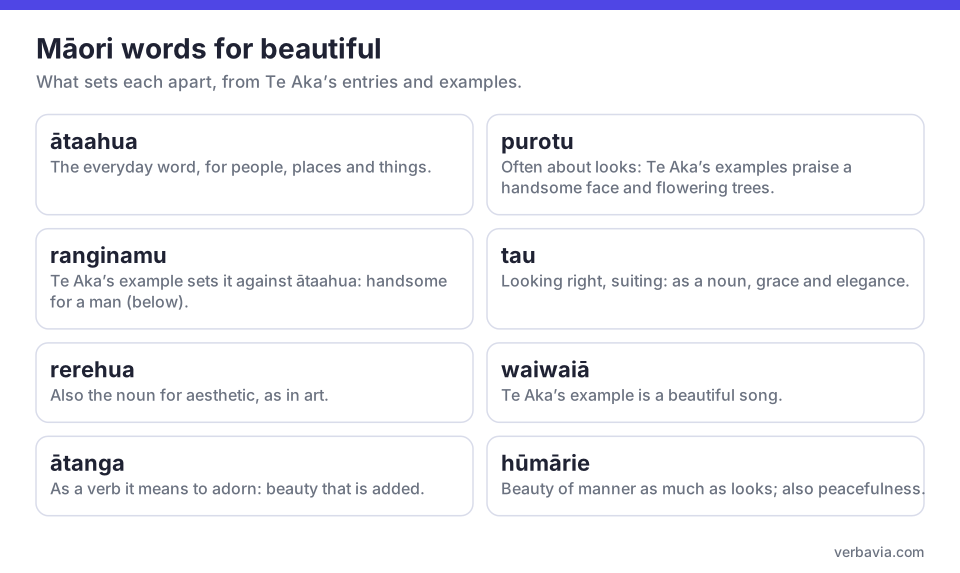
Te Aka lists a long row of synonyms under ātaahua. These are the ones it glosses with beautiful, handsome, attractive or gorgeous, and what its entries say sets each one apart:
| Māori | Te Aka’s meaning | What sets it apart |
|---|---|---|
| ātaahua | beautiful, handsome, pleasant, pretty, good-looking, gorgeous, lovely | The everyday word, for people, places and things. |
| purotu | beautiful, handsome, good-looking, attractive, gorgeous, pleasant, agreeable | Often about looks: Te Aka’s examples praise a handsome face and flowering trees. |
| ranginamu | nice, handsome, fine | Te Aka’s example sets it against ātaahua: handsome for a man (below). |
| tau | neat, comely, smart, attractive, handsome, becoming, beautiful, cute, befitting | Looking right, suiting: as a noun, grace and elegance. |
| rerehua | pleasant to the sight, fancy, aesthetically pleasing, appealing | Also the noun for aesthetic, as in art. |
| waiwaiā | beautiful; beauty | Te Aka’s example is a beautiful song. |
| ātanga | beautiful, attractive, stunning, exquisite, comely | As a verb it means to adorn: beauty that is added. |
| hūmārie | handsome, pleasant, beautiful, gentle, amiable, nice, easy-going | Beauty of manner as much as looks; also peacefulness. |
| huatau | comely, suitable, elegant, graceful | Elegance, style, dignity. |
| paruhi | beautiful, fine, calm (of weather) | For a fine day. |
| pīwari | to be beautiful | Te Aka’s example is a war canoe adorned with feathers. |
| turua | beautiful, handsome, exquisite | Te Aka’s example: Ka turua rā! ‘It was exquisite!’, of a carved fishing lure. |
| koea | brilliant, beautiful | Te Aka: used in karakia. |
| pai | good, pleasant, handsome, good-looking | The plain word for good; as a noun it includes good looks. |
For a compliment in conversation, ātaahua is the one to learn first. The others are worth recognising: you will meet purotu and tau in writing about people, rerehua in writing about art, and koea only in karakia. Te Aka also gives mateoha, lovable, endearing, adorable, whose example is a lovable child.
Handsome in Māori: ranginamu and purotu
Ātaahua can mean handsome, but Te Aka’s entry for ranginamu quotes a dictionary of 1993 drawing a line: E kī ana tātau he ranginamu te tāne, engari ko te wahine he ātaahua. ‘We say a man is handsome, but a woman is beautiful.’ So for a man, ranginamu or purotu is the more specific choice. Te Aka’s example of purotu is a tribute that looks past the face: Ehara i te tangata purotu, engari he tangata koi te hinengaro ‘He wasn’t a handsome man, but he had a sharp mind’.
How do you say you are beautiful in Māori?
The ready-made line is Tō ātaahua hoki! ‘You’re beautiful!’, from the te reo list Toi Mata Hauora, the senior doctors’ union, published for Te Wiki o te Reo Māori in 2023. Tō is your and ātaahua here is the noun, beauty, so word for word it is your beauty, indeed! It is the same exclamation as Te Taura Whiri i te Reo Māori’s Christmas-morning Tō waimarie hoki! ‘Aren’t you lucky!’, and Hēmi Kelly’s Te ātaahua hoki! ‘How beautiful!’ is its general form, with te ‘the’ in place of tō.
| Māori | English | Source |
|---|---|---|
| Tō ātaahua hoki! | You’re beautiful! | Toi Mata Hauora (2023). |
| He ātaahua hoki! | That’s beautiful! | Toi Mata Hauora (2023). |
| He ātaahua koe. | You are beautiful. | Built: koe ‘you’ in place of te wahine in Te Aka’s sentence above. |
| He ranginamu koe. | You are handsome. | Built the same way from he ranginamu te tāne. |
| He wahine ātaahua koe. | You are a beautiful woman. | Built: koe in place of ia ‘she’ in Kuputaka’s example. |
| Me te rearea! | How stunning! | Te Aka, about someone you are looking at. |
Te Aka’s example of me te rearea is said to a third person about someone else: Titiro ki a Ngāhuia. Me te rearea! ‘Look at Ngāhuia. She’s stunning!’ Rearea on its own is the bellbird, the songbird known for its clear, liquid song. For one person use koe; to praise two people or a group, the Māori pronouns guide gives kōrua and koutou.
These are compliments, not endearments. The words for calling a partner darling or my love are in I love you in Māori, and the everyday words for a friend in friend in Māori.
Beautiful places, days and things
Te Aka’s examples are full of beautiful landscapes, and a few make ready compliments for a view or a day:
| Māori | English (Te Aka’s) |
|---|---|
| Kei whea mai te ātaahua o ngā maunga o Te Tiritiri-o-te-moana! | How outstandingly beautiful the mountains of the Southern Alps are! |
| He ātaahua rirerire te rā nei. | This is an exceptionally beautiful day. |
| Ka tino purotu te puāwai o te rākau. | The flowers of the trees were quite beautiful. |
| Ātaahua ana ā rātou hei. | Their necklaces are beautiful. |
Kei whea mai is an eastern-dialect idiom of praise, explained with others in kīwaha: Māori idioms; here it praises a mountain range. Rirerire is an intensifier Te Aka keeps for words of beauty, exceptionally. For the weather, paruhi means a fine, calm day: Te Aka quotes a winter column of 1994 looking forward to ngā rangi paruhi ‘the beautiful days’ still to come, and a story of 1928 in which a face is like a beautiful summer day. The words for the mountains, rivers and sky themselves are in Māori nature words, and the seasons in seasons in Māori.
Compliments on cooking, clothes and singing
Food
Hēmi Kelly’s guide uses the same exclamation for a meal: Te reka hoki! ‘How tasty!’ Reka is Te Aka’s sweet, tasty, palatable, and as a noun the sweetness or flavour of something. For something more than tasty, his Te mīharo hoki! ‘How amazing!’ uses mīharo, marvellous, amazing. The names of the dishes are in Māori food words.
Clothes
No dictionary or official source reached prints a ready line for your dress is beautiful, so none is offered here. Te Aka does give the words: kākahu whakapaipai ‘beautiful clothes’, from a newspaper of 1901 describing women dressed for a haka of welcome, and kākahu huatau ‘elegant clothes’, from a biography of a woman who liked them along with jazz and parties. Whakapaipai as a noun is jewels, finery, make-up. Each piece of clothing has its name in clothes in Māori, and Te ātaahua hoki! works for any of them.
Singing
Te Aka’s example for waiwaiā is a verdict on a song: Ka mutu te waiata waiwaiā ko tērā ‘what a beautiful song that is’, because of the elegance of the words and the nice tune. To tell a singer that nobody sings better, Massey University’s frame is in the kīwaha guide; the songs themselves are in Māori songs.
How do you say well done in Māori?
Praise for work has whole guides of its own, so one line each here. Ka pai (good, well done), ka rawe (excellent) and ka mau te wehi (awesome) are in common Māori phrases, with Te Aka’s warning that ka pai can also mean serves you right; tau kē and the rest of a classroom’s praise are in te reo for teachers; Koia kei a koe! ‘good on you!’ and Kei runga noa atu! ‘top-notch!’ are in the kīwaha guide; and where the English word kapai came from is in Māori slang.
Three more compliments for a skill, none of them on those pages, all from Te Aka:
| Māori | Te Aka’s meaning | Example |
|---|---|---|
| Kino kē koe! | gee you’re the one, you’re good alright, you’re too much, awesome | Kino kē kōrua, e hoa mā! ‘You two are good alright, my friends!’ |
| Taputapu kē! | neat, choice, cool, excellent, fantastic: compliments the listener on something done | Taputapu kē nei koutou! ‘You’re neat alright!’ |
| Auahi ana! | how fast it travelled! how good was that! | Praise for speed, or for an achievement. |
Kino on its own means bad, and that is the surprise: in kino kē it turns into praise, much as English says wicked. Te Aka’s fuller form is te kino kē hoki, excellent, really skilled, masterful, first-rate, as in He kino kē te kuia rā ki te whatu kākahu ‘that elderly lady is first-rate at weaving cloaks’. The Ministry of Education’s classroom sheet of praise uses it the same way: Kino kē tō mahi e hoa! ‘That’s wild and wonderful work!’
Complimenting someone’s te reo Māori
Te Aka’s example for autaia is about exactly this: He autaia tonu te kōhine rā ki te kōrero Māori. ‘The girl over there is pretty good at speaking Māori.’ Its second example speaks of ētahi tāngata autaia nei te matatau ki te reo ‘some other people who are pretty fluent in the language’. Use it with care: Te Aka glosses it pretty good, not too bad, perhaps better than expected, so it is warm between friends and can sound grudging to someone you hardly know. For a learner who has worked hard, Kino kē koe! says more.
How do you reply to a compliment in Māori?
No dictionary or official source reached prints a set reply to a compliment. What they do print is thanks: Victoria University of Wellington gives Kia ora ‘Thanks’ and Kia ora rawa atu ‘Many thanks’, and Hēmi Kelly’s guide uses Kia ora! for thank you. For a compliment that comes with a gift, Te Taura Whiri’s Christmas phrases have Tēnā koe i tēnei taonga ‘Thank you for this present’.
Many people will also turn the praise aside or pass it to someone else, and the sources below explain why that is not a refusal of the compliment.
Whakaiti: humility, and the kūmara that does not boast
Te Aka gives whakaiti a range of senses, from to belittle to, as a noun, humility, self-effacement. Its example of the good sense comes from a biography: Te Kere i tino kaha te whakaiti, was very self-effacing, and did not want the people to make much of what he had done. Its opposite is whakahīhī ‘vain, conceited, arrogant’, and one of Te Aka’s examples puts the two together as a piece of advice: Ko āna tohutohu ko te ngākau whakaiti, ā, kia kaua e whakahīhī, e whakamanamana ‘Her advice was to be humble and not to be conceited or boastful’. A third word, whakamōwai, modest, unassuming, comes with an example from a biography of Te Heuheu, whose authentic mana is described as that of a quiet and unassuming person rather than a braggart.
The whakataukī most often quoted about this is about the kūmara, the sweet potato. RNZ’s Te Ahi Kaa printed it in 2016 as “Kāore te kumara e kōrero ana mo tōna ake reka”, “The kumara does not brag about its own sweetness”; Royal Society Te Apārangi prints it with mō and translates “The kūmara does not talk about its own sweetness”. Neither marks the long vowel of kūmara in the Māori, which Te Aka spells with a macron. Reka is the same word as in Te reka hoki!: the sweetness is the quality, and the kūmara leaves others to praise it.
RNZ’s programme put the saying to several Māori scholars and leaders, and they did not read it the same way. Dr Wayne Ngata linked it to manaakitanga, putting others before yourself. Dr Nick Roskruge warned against reading it literally and recalled his grandfather teaching that being humble was being strong. Tamati Waaka said his grandparents urged people me whakaiti ‘be humble’, and that the saying has a time, a place and a purpose. Dr Ella Henry saw it as a hindrance in workplaces that reward self-promotion, and Puawai Cairns described practising it as “a delicate dance between remaining humble and having a space to talk about yourself”. More whakataukī, with how to use them, are in whakataukī: Māori proverbs.
What this means for a compliment is modest: the sources describe humility as valued, and a person who answers praise with kia ora and a word about the people who helped is not brushing you off. None of them sets a rule for how a compliment should be given or received, and this guide does not invent one. The feelings on either side, from pride to whakamā ‘shyness, embarrassment’, are in Māori words for feelings.
Describing someone’s appearance
Te Aka’s examples praise people for their manner at least as often as their looks. Hūmārie covers both, and its example from 1902 is a whole character sketch: He tangata ngāwari, he hūmārie ‘a gentle, pleasant person’. When its examples do describe a face, they keep to what is pleasing: Te Aka quotes a description of 1843 in which the eyes are pleasing to look at, and a biography in which photographs and a portrait by C. F. Goldie show te waiwaiā o tōna āhua ‘how beautiful she was’. The words for the face and body are in Māori body parts.
For a new baby, the words most people want are in new baby messages in Māori, and Te ātaahua hoki! needs no change to fit a newborn.
Going further
Our free te reo Māori course introduces ātaahua, pai and reka early on, along with the sentence patterns these compliments are built on, in one short lesson a day.
To say very or extremely beautiful, tino goes before the describing word and rawa after it: see the most common Māori adjectives.
Learn te reo Māori with Verbavia
Verbavia’s free te reo Māori course starts with the most common words, explains the grammar properly, and plays every example in Papa Reo’s native te reo voice. One lesson a day, from your first word to B1.
Quick questions
How do you say beautiful in Maori?
Say ātaahua. To exclaim how beautiful!, say Te ātaahua hoki!
How do you say you are beautiful in Māori?
Tō ātaahua hoki! ‘You’re beautiful!’ is the published exclamation; He ātaahua koe. says it plainly.
What is handsome in Māori?
Ranginamu or purotu. Te Aka quotes the saying that a man is ranginamu but a woman ātaahua, though ātaahua itself can mean handsome.
What does ātaahua mean?
Beautiful, handsome, pretty, good-looking, gorgeous or lovely, and as a noun, beauty.
How do you say well done in Māori?
Ka pai! is the everyday one; for real skill, Te Aka gives Kino kē koe! ‘You’re good alright!’
Sources
- Te Aka Māori Dictionary: ātaahua
- Te Aka Māori Dictionary: search for “beautiful”
- Te Aka Māori Dictionary: search for “handsome”
- Te Aka Māori Dictionary: purotu
- Te Aka Māori Dictionary: ranginamu
- Te Aka Māori Dictionary: tau (sense 3, attractive, handsome, cute)
- Te Aka Māori Dictionary: rerehua
- Te Aka Māori Dictionary: waiwaiā
- Te Aka Māori Dictionary: ātanga
- Te Aka Māori Dictionary: hūmārie
- Te Aka Māori Dictionary: hūmārire
- Te Aka Māori Dictionary: huatau
- Te Aka Māori Dictionary: paruhi
- Te Aka Māori Dictionary: pīwari
- Te Aka Māori Dictionary: turua
- Te Aka Māori Dictionary: koea
- Te Aka Māori Dictionary: pai
- Te Aka Māori Dictionary: mateoha
- Te Aka Māori Dictionary: rirerire
- Te Aka Māori Dictionary: me te rearea
- Te Aka Māori Dictionary: rearea (bellbird)
- Te Aka Māori Dictionary: kei whea mai
- Te Aka Māori Dictionary: whakapaipai
- Te Aka Māori Dictionary: reka
- Te Aka Māori Dictionary: mīharo
- Te Aka Māori Dictionary: kino kē koe
- Te Aka Māori Dictionary: te kino kē hoki
- Te Aka Māori Dictionary: taputapu kē
- Te Aka Māori Dictionary: auahi ana
- Te Aka Māori Dictionary: autaia
- Te Aka Māori Dictionary: ka pai
- Te Aka Māori Dictionary: whakapai (to praise, compliment)
- Te Aka Māori Dictionary: whakaiti (humility, self-effacement)
- Te Aka Māori Dictionary: whakahīhī
- Te Aka Māori Dictionary: whakamōwai
- Te Aka Māori Dictionary: kūmara
- Kuputaka, University of Auckland: ātaahua
- Hēmi Kelly, Your guide to using te reo Māori in Tāmaki Makaurau (Tātaki Auckland Unlimited)
- Toi Mata Hauora (ASMS): Te wiki o te reo Māori is here! (10 September 2023)
- Te Taura Whiri i te Reo Māori: Te Rā Kirihimete – Christmas Day (Te Reo o te Raumati phrase tiles)
- Victoria University of Wellington: Māori greetings and phrases
- Ministry of Education (Ako Panuku): Te reo Māori in the classroom, He kupu whakamihi 1
- RNZ, Te Ahi Kaa: The sweetness of the kumara (31 July 2016)
- Royal Society Te Apārangi: Giving voice to the humble kūmara (Marsden Fund 2022)