Kīwaha: Māori idioms and everyday sayings, with meanings
A kīwaha ‘colloquialism, colloquial saying, slang, idiom’ is a Māori idiom or everyday saying, a phrase whose meaning you cannot work out from its words, such as Koia kei a koe! ‘good on you!’ or Kei runga noa atu! ‘top-notch!’ Te Aka Māori Dictionary defines the word as “colloquialism, colloquial saying, slang, idiom”. This guide lists more than 50 kīwaha with the meaning a dictionary gives each one, an example sentence where the dictionary prints one, grouped by what you use them for: praising, agreeing, surprise, saying no, telling someone off, bad luck and everyday replies. It also says which ones a source marks as sarcastic or blunt, and how they differ from whakataukī.
Tap 🔊 to hear an example. Māori examples play Papa Reo, the te reo Māori voice made by Te Hiku Media from recordings of native speakers. Every sentence in the free course is spoken like this.
On this page
- Kīwaha at a glance
- What is a kīwaha?
- Kīwaha already explained elsewhere on this site
- Kīwaha for praise and encouragement
- Kīwaha for agreeing
- Kīwaha for surprise and disbelief
- Kīwaha for saying no and disagreeing
- Kīwaha for cheek, telling off and hurrying someone
- Kīwaha for when things go wrong
- Kīwaha for everyday replies
- Which kīwaha are safe for the classroom?
- Do kīwaha differ from region to region?
- How to learn and use kīwaha
- Quick questions
Kīwaha at a glance
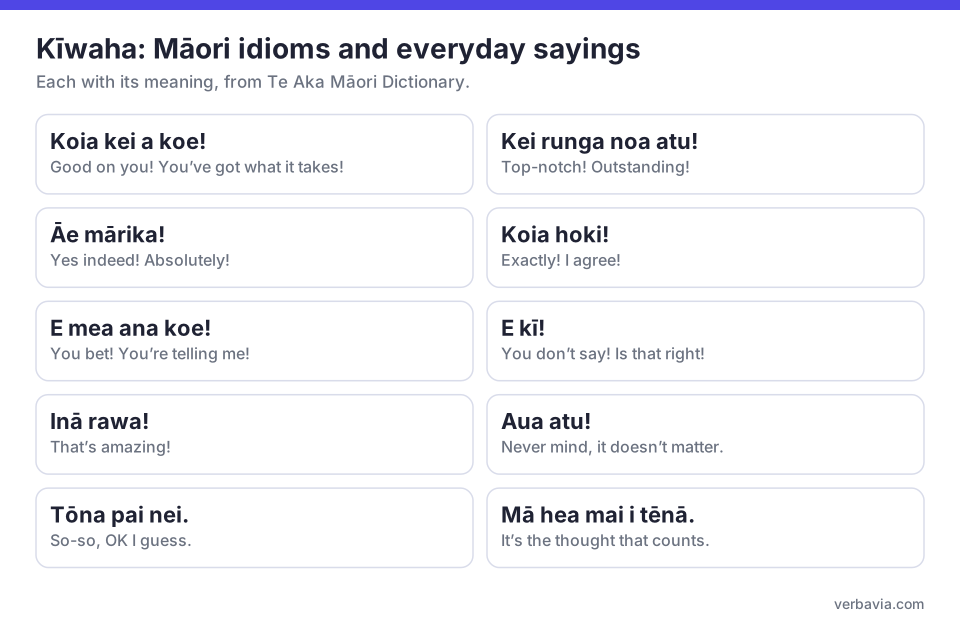
Ten to start with. All of them are safe in a classroom or an office, and all are replies: you say them back to something someone has just said or done.
| Kīwaha | Meaning | Say it when |
|---|---|---|
| Koia kei a koe! | Good on you! You’ve got what it takes! | Someone has done something clever or useful. |
| Kei runga noa atu! | Top-notch! Outstanding! | Praising a piece of work. |
| Āe mārika! | Yes indeed! Absolutely! | Agreeing strongly. |
| Koia hoki! | Exactly! I agree! | Someone has put it just right. |
| E mea ana koe! | You bet! You’re telling me! | The answer to the question is obvious. |
| E kī! | You don’t say! Is that right! | Surprising news. |
| Inā rawa! | That’s amazing! | You have just learnt something remarkable. |
| Aua atu! | Never mind, it doesn’t matter. | A small thing has gone wrong. |
| Tōna pai nei. | So-so, OK I guess. | Someone asks how something was, and it was only fine. |
| Mā hea mai i tēnā. | It’s the thought that counts. | Thanking someone for a small gift or effort. |
Meanings are Te Aka Māori Dictionary’s, shortened, and the Massey University kīwaha page’s where it gives one. The rest of the list, with example sentences, follows.
What is a kīwaha?
Te Aka defines kīwaha as a noun meaning “colloquialism, colloquial saying, slang, idiom”, and lists kīrehu as another word for idiom. Its example for both is a 1997 line from Te Taura Whiri i te Reo Māori, the Māori Language Commission, hoping for “a collection of colloquialisms and idioms, that is the aspects of the language that have long been missing amongst most of the tribes”. In 1999 the Commission published He Kohinga Kīwaha, a collection of kīwaha, and many of Te Aka’s example sentences for the expressions below are taken from it.
RNZ, introducing its 2018 podcast series on them, put it more simply: kīwaha “are colloquial sayings or slang and they are great phrases to drop into your everyday conversation even if you are speaking English.” What makes a kīwaha is that the whole means something the parts do not. Kei runga noa atu is built from ordinary words, but nothing in them says excellent; you have to be told.
Kīwaha, whakataukī, kupu whakarite and slang
| Term | What it is (Te Aka) | Where you meet it |
|---|---|---|
| kīwaha | colloquialism, colloquial saying, slang, idiom | Everyday talk: replies, exclamations, banter. |
| whakataukī | proverb, significant saying, formulaic saying, cryptic saying, aphorism | Speeches: Te Aka calls whakataukī, like whakatauākī and pepeha, “essential ingredients in whaikōrero”. |
| whakatauākī | proverb, significant saying, particularly those urging a type of behaviour | Speeches; Te Aka’s example says most were made by people of status. |
| kupu whakarite | metaphor, simile, figurative language, figure of speech | Any register: a comparison rather than a fixed phrase. |
So the difference is mostly one of register. A whakataukī is a proverb with a lesson in it, and it is quoted, often with its author; the whakataukī guide explains the best-known ones. A kīwaha is what you say across the kitchen table. On slang, Te Aka includes slang in its definition of kīwaha, so in Māori there is no sharp line. What English speakers in New Zealand call Māori slang, words such as chur, cuz and bro, is mostly English, and its origins are traced in Māori slang.
Kīwaha already explained elsewhere on this site
Some of the most famous kīwaha have their own explanations, so they get one line here. Ka mau te wehi! ‘awesome!’, karawhiua! ‘go for it!’ and hōhā! ‘what a nuisance!’ are in Māori slang; ka rawe!, taihoa and mahi tika ana! are with the everyday lines in common Māori phrases; e hika and e hoa mā e! are in friend in Māori; and hoea tō waka ‘paddle your canoe’, go ahead then, please yourself, is in Māori waka. Kia kaha has a guide of its own.
Kīwaha for praise and encouragement
| Kīwaha | Meaning | Note |
|---|---|---|
| Koia kei a koe! | good on you, you’re awesome, no flies on you | Massey: “support and admiration”. Te Aka adds a second sense, what a cheek: with the wrong tone it criticises. |
| Kei runga noa atu! | top-notch! great! outstanding! on to it! | Massey: “Next level!” Add a pronoun to aim it: kei runga noa atu koe. |
| Ka wani kē! | you’re clever, a master, a genius, neat alright | Praise for someone’s knowledge or skill. |
| Kei whea mai! | it was outstanding, terrific, that’s wonderful | Te Aka: an eastern dialect idiom; also kei hea mai. |
| Ehara i te hanga! | it’s no ordinary thing, it’s pretty amazing | For something impressive. |
| Kei reira!, Kei konā katoa! | that’s the one! right on! it’s her forte! | Praise for someone’s particular talent. |
| Pai mutunga | great, wonderful, marvellous | Te pai mutunga o tēnei mōtēra. ‘What a great motel this is.’ |
| Engari tonu! | for sure! good on you! get you! | Praise for a person or a cause. |
| Ko te painga atu! | that would be great! | Massey’s; for a good idea or a welcome offer. |
| Kāore i tua atu i a koe mō te … | nobody … better than you | Massey’s frame; fill the gap with an activity. |
Te Aka’s and Massey’s examples, with their translations:
- Ka rawe! Koia kei a rātou! ‘Brilliant! They’ve got the goods!’ Massey’s reply to news that a kapa haka group has made the national competition; rātou ‘they’ takes the place of koe ‘you’.
- Kei runga noa atu rāua ki te tiaki i ō rāua mātua. ‘They are so good at caring for their parents.’ (Te Aka)
- Ka wani kē tō kāri putiputi. ‘Your flower garden is inspired.’ (Te Aka)
- Kua kite koe i a Tarati e pūkana ana? — Āna, e hoa. Kei reira! ‘Have you seen Dorothy doing the pūkana? — Yes, indeed, my friend. It’s her forte!’ (Te Aka)
- Kāore i tua atu i a koe mō te waiata. ‘Nobody sings better than you.’ (Massey)
- E hoa, ko te painga atu tēnā! ‘Mate, that would be great!’ (Massey)
For classroom praise in plain words, such as ka pai and tino pai, see te reo for teachers; the kīwaha above are the next step up.
Kīwaha for agreeing
| Kīwaha | Meaning | Note |
|---|---|---|
| Āe mārika! | yes indeed, for sure, certainly | Mārika intensifies the word before it, Te Aka says. |
| Ehara ehara!, Engari engari! | my oath, you bet, yes indeed | Strong agreement with a statement. |
| Koia hoki! | I agree! exactly! that is it in a nutshell! | Agreeing with an opinion. |
| Koinā te kōrero. | yes indeed, I agree, I support that | Supporting what has just been said. |
| Kei konā au. | I’m there with you on that, I agree | |
| E mea ana koe! | you bet! (Te Aka); you’re telling me! (Massey) | The answer was obvious. As a question, E mea ana koe?, Massey gives you reckon? |
| Ko māua māua. | you and me both, we are both the same | Te Aka’s pattern: say the same pronoun twice. |
| Āna! | yes, yes indeed, agreed | Careful: to a negative question, Te Aka says, it means no. |
- Kei te haere tonu koe ki te pō whakangahau a Hana? — Āe mārika! ‘Are you still going to Hana’s party? — I certainly am!’ (Te Aka)
- Kei te haere koe ki te whutupōro, nē rā? — E mea ana koe! ‘You’re going to the rugby, aren’t you? — You bet!’ (Te Aka)
- Kei te tino mōhio koe ki a ia? — E mea ana koe? Ko māua māua i te whare wānanga. ‘Do you really know her? — You bet. We were both at university together.’ (Te Aka)
Kīwaha for surprise and disbelief
| Kīwaha | Meaning | Note |
|---|---|---|
| E kī!, E kī rā! | you don’t say! is that right! well, well! | Surprise, amazement, or anger, at what has been heard or seen. |
| I nei!, I neki? | really! is that a fact! no way! | Amazement, and sometimes doubt. |
| E hawa, e hawa! | no way, you’re joking, get away | Te Aka: it usually follows ehara ehara from the other speaker. |
| Inā rawa! | that’s amazing, how amazing | At something you have just learnt. |
| Wehi nā! | oh my goodness, that’s amazing | |
| Kātahi rā hoki! | how astounding, good grief, heavens above | Amazement or disapproval at an unusual idea. |
| Hika mā! | good heavens! whoa! for goodness sake! | Te Aka: a mild exclamation of surprise, dismay or irritation. |
| E tama! | good heavens boy! goodness me! | Any term of address works: e kui, e hine, e koro. |
| Auē taukuri ē! | oh dear! for crying out loud! | Taukuri alone is Te Aka’s oh dear!, of distress or surprise. |
- E kī, kua oti tō tuhinga whakapae i a koe te tuhi! ‘Is that right, you’ve finished writing your thesis!’ (Te Aka)
- Kua panaia a Piripi i tana mahi. — I neki? He tangata pukumahi hoki ia. ‘Phillip has been sacked from his job. — Really? And he’s such a hard worker.’ (Te Aka)
- I puta pai a tama waimori i tana whakamātautau. — Inā rawa! ‘Lazybones son passed his examination. — That’s amazing!’ (Te Aka, from He Kohinga Kīwaha)
- E hika mā! Nō hea tōu pōtae weriweri? ‘Good heavens! Where did you get that horrible hat from?’ (Te Aka)
Te Aka notes that e tama and its variants can, “with the appropriate intonation”, show surprise, amazement, disbelief, disagreement, disappointment or support. The tone carries the meaning, which is why these are best learnt by hearing them. More words for how you feel are in Māori words for feelings.
Kīwaha for saying no and disagreeing
| Kīwaha | Meaning | Note |
|---|---|---|
| Engari mō tēnā! | not a chance! not likely! I don’t think so! | Emphatic refusal; also that’s not right. |
| Nōhea!, Nōhea hoki! | never, not on your life, there’s no way | Also disbelief at what someone has said. |
| He aha hoki! | no way! says who! yeah right! | Te Aka: “sometimes with an element of scorn”. |
| Tēnā rūkahu tēnā! | that’s a load of rubbish, you’re so wrong | Blunt. Rūkahu is to tell lies; Te Aka says pōhēhē, to think mistakenly, can take its place. |
- E Wini, māu taku reta e tuhi, nē? — Engari mō tēnā! Māu tonu e tuhi. ‘Wini, you will write my letter, won’t you? — Not on your life! You write it yourself.’ (Te Aka)
- Māu tā tātou rēwena e pokepoke, nē? — He aha hoki! Kāore aku take mō taua mahi. ‘You’ll knead our rēwena bread, won’t you? — No way! I’m useless at that job.’ (Te Aka)
Kīwaha for cheek, telling off and hurrying someone
These are said at someone, so they are the ones to use with care. Te Aka marks each as a criticism, a warning or a lack of sympathy.
| Kīwaha | Meaning | Note |
|---|---|---|
| Tahi rā koe! | what a cheek, what a nerve | Someone is being presumptuous. |
| Puku kau anō! | what a cheek you’ve got, cheeky alright | Te Aka’s example is from the Tainui collection (below). |
| Tō hia kaha! | you’ve got a nerve! the cheek of it! | Disgust and amazement at what someone has done. |
| Ākuni koe i a au! | I’ll get you! you’d better watch out! | A warning from someone fed up; also ākuanei koe i a au. |
| Anā tō kai!, E koe, e koe! | take that! serves you right! | Unsympathetic: they brought it on themselves. |
| Mahi atu! | forget it, go on then, do it | Te Aka: also get lost, or a warning not to. |
| Kua puku te rae. | angry, annoyed, livid with rage | Describing someone. |
| Kua kino ngā piropiro. | in a bad mood | The opposite is kua pai ngā piropiro, in a good mood. |
- E hoa, tīkina he inu māku. — Ko wai koe? Tahi rā koe! ‘My friend, fetch me a drink. — Who do you think you are? You’ve got a nerve!’ (Te Aka, from He Kohinga Kīwaha)
- Ākuni koe i a au. Kia tere tō heke mai i te rākau nā! ‘You’ll be in trouble soon. Hurry up and get down from that tree!’ (Te Aka)
- Ākuanei koe i a au. Kia tere tō hoki mai ki te kāinga! ‘You’ll be in trouble soon. Hurry up and come home!’ (Te Aka)
- I mahue au i te pahi ki te kura i te ata nei. — Anā tō kai! Kāore koe i maranga i te wā e tika ana. ‘I missed the school bus this morning. — Serves you right! You didn’t get up when you should have.’ (Te Aka)
For the plain command to hurry, Kia tere!, and the classroom instructions around it, see Māori for kids and the teachers’ guide. Stronger words, the ones not on this page, are in Māori swear words.
Kīwaha for when things go wrong
| Kīwaha | Meaning | Note |
|---|---|---|
| E taea te pēwhea?, E kore e taea te pēhea. | nothing can be done about it, it can’t be helped | For a problem that cannot be fixed. |
| Nā wai i hē, kātahi ka tino hē kē atu. | going from bad to worse | Te Aka: the same word goes in both halves. |
| Kei raro e putu ana. | down in a heap, snowed under, defeated | Putu is to lie in a heap; also said of someone sick or overworked. |
| He aha te aha! | nothing changed, it was a waste of time | Said at the end of a sentence. |
| Auare ake. | no such luck, no success, not a chance | Something was not achieved. |
- Kei raro a Te Murumāra e putu ana, he nui nō ana mahi. ‘Murumāra is snowed under, he’s got so much work.’ (Te Aka)
- Kua hia marama ia e ako ana ki te kauhoe, he aha te aha! ‘Although she has been learning to swim for many months, she still can’t!’ (Te Aka)
Words for a working day around these, for when you are snowed under, are in Māori words at work.
Kīwaha for everyday replies
| Kīwaha | Meaning | Note |
|---|---|---|
| Aua atu!, Aua atu rā! | never mind, it doesn’t matter, don’t worry | Nothing to be concerned about. |
| Hei aha koa. | it doesn’t matter, so what, anyway | |
| Hei aha māu. | don’t worry about it, don’t let it bother you | Also mind your own business, Te Aka adds. |
| Kia ahatia! | so what, never mind, what does it matter | Dismissive; Te Aka’s example is a parent’s reply. |
| Mā hea mai i tēnā. | it’s the thought that counts, better than nothing | Accepting a small gift or effort. |
| Tōna pai nei. | so so, not too bad, OK I guess | Qualified praise. |
| He autaia. | pretty good, not too bad | Better than expected. |
| Mā te aha. | well, it was alright | Less good than others claim. |
| Kei kō atu o kō mai. | somewhere or other | A vague, sometimes cheeky answer to where? |
- Kua pau te miraka. — Aua atu. Māku e hoko i te ahiahi nei. ‘The milk’s run out. — Never mind. I’ll buy some this afternoon.’ (Te Aka)
- Ai! I wareware i a au taku pukapuka. — Hei aha koa. Kei a au tāku. ‘Heck! I’ve forgotten my book. — It doesn’t matter. I have mine.’ (Te Aka)
- Anei taku koha, ahakoa iti. — Kei te pai. Mā hea mai i tēnā. ‘Here’s my gift, although it’s small. — That’s OK. It’s the thought that counts.’ (Te Aka)
- I pēhea tāu hararei? — Tōna pai nei. ‘How was your holiday? — It was OK.’ (Te Aka)
Tōna pai nei is a frame: Te Aka’s second example swaps in another word, Kei te wera tō kawhe? — Tōna wera nei. ‘Is your coffee hot? — It’s OK I guess.’ Ordering that coffee in the first place is covered in ordering coffee in Māori.
At the table
Three kīwaha are about food. Someone who piles up their plate may hear E hoe ana tō waka ki whea? ‘you going on a long trip?’ or Kua hūnuku tonu atu koe! ‘you moving off somewhere!’: Te Aka explains both as teasing, as if the person were stocking up before a journey. A host who feeds you well earns He nui te homai ‘what a generous serving’. More food words are in Māori food words.
Which kīwaha are safe for the classroom?
Te Aka marks a kīwaha’s tone in its definition, which makes sorting them straightforward:
| Group | Kīwaha | What Te Aka says |
|---|---|---|
| Safe anywhere | The praise, agreement, surprise and everyday-reply kīwaha above, such as kei runga noa atu, āe mārika, e kī, aua atu, mā hea mai i tēnā | No warning given. |
| Can criticise or dismiss | koia kei a koe, kia ahatia, mā te aha | Praise that can turn into what a cheek; so what; not as good as is being claimed. |
| Blunt | he aha hoki, tēnā rūkahu tēnā, mahi atu | Scorn, you’re so wrong, get lost. |
| Unsympathetic | anā tō kai, e koe, e koe, ākuni koe i a au | Serves you right; a warning. |
| Left off this page | Several kīwaha whose dictionary meaning is vulgar | See Māori swear words. |
For teaching, the first row is the place to start: each is short, positive and a natural reply, so a class can use one the moment someone answers well. The ones that tease, like the food kīwaha, work among people who know each other.
Do kīwaha differ from region to region?
Some do, and Te Aka labels them. It calls kei whea mai and kei hea mai “an eastern dialect idiom”, and notes that tū can replace mai in it. Te Aka also draws on a regional collection: alongside Te Taura Whiri’s national He Kohinga Kīwaha (1999), it cites He Kohinga Kīwaha nō Tainui (2011) by Pānia and Rāhui Papa, the source of its example for puku kau anō. Beyond those labels, this guide found no source that maps kīwaha by region, so it makes no claim about where any other one is said. Differences in sound and word choice between iwi are covered in Māori dialects.
How to learn and use kīwaha
- One at a time. Pick a single kīwaha and use it for a week. Most on this page are replies, so it is easy to find a moment: e kī! for any news, aua atu for any small mishap.
- In reply to something real. Te Aka’s examples are nearly all two-person exchanges, and some kīwaha only work as an answer: e hawa, e hawa follows ehara ehara, and e mea ana koe answers a question whose answer was obvious.
- Listen for the tone. Te Aka says several of these change meaning with intonation, from praise to criticism. Hearing them used matters more than reading them. RNZ’s eight-part podcast Kīwaha – Give it a go! (2018) presents a few at a time, and the Te Whanake textbook Te Pihinga has a page and an audio exercise of them, which Te Aka cites throughout.
- Learn the frame, not just the phrase. Many kīwaha have a slot: kei runga noa atu + a pronoun, kāore i tua atu i a koe mō te + an activity, ko māua māua with whichever pronoun fits. The pronouns themselves are in Māori pronouns.
Kīwaha land best on top of ordinary sentences. The free te reo Māori course builds those one lesson a day, so that e kī! has something to answer. Māori Language Week is a good time to try a first one: see Te Wiki o te Reo Māori. And for words that, like kīwaha, have no neat English match, see Māori words with no English equivalent.
For compliments on looks rather than work, from ātaahua to me te rearea, see beautiful in Māori, and how to give a compliment.
Learn te reo Māori with Verbavia
Verbavia’s free te reo Māori course starts with the most common words, explains the grammar properly, and plays every example in Papa Reo’s native te reo voice. One lesson a day, from your first word to B1.
Quick questions
What does kīwaha mean?
Te Aka Māori Dictionary defines kīwaha as “colloquialism, colloquial saying, slang, idiom”: an everyday saying whose meaning is not in its words.
What are some common Maori idioms?
Koia kei a koe! (good on you), Kei runga noa atu! (top-notch), Āe mārika! (yes indeed), E kī! (you don’t say) and Aua atu! (never mind).
What is the difference between a kīwaha and a whakataukī?
A whakataukī is a proverb, which Te Aka calls an essential ingredient of speeches; a kīwaha is a colloquial saying for everyday talk.
Which kīwaha can I use in a classroom?
The praise, agreement and surprise kīwaha, such as kei runga noa atu and āe mārika. Avoid the ones Te Aka marks as scornful or unsympathetic, such as he aha hoki and anā tō kai.
Sources
- Te Aka Māori Dictionary: kīwaha
- Te Aka Māori Dictionary: kīrehu
- Te Aka Māori Dictionary: whakataukī
- Te Aka Māori Dictionary: whakatauākī
- Te Aka Māori Dictionary: kupu whakarite
- Te Aka Māori Dictionary: search with the Idioms filter
- Te Aka Māori Dictionary: sources (HKK, He Kohinga Kīwaha, 1999; HKKT, He Kohinga Kīwaha nō Tainui, 2011)
- Te Aka Māori Dictionary: koia kei a [koe]
- Te Aka Māori Dictionary: kei runga noa atu!
- Te Aka Māori Dictionary: kei runga noa atu [koe]
- Te Aka Māori Dictionary: ka wani kē
- Te Aka Māori Dictionary: kei whea mai (eastern dialect)
- Te Aka Māori Dictionary: kei hea mai
- Te Aka Māori Dictionary: ehara i te hanga
- Te Aka Māori Dictionary: kei konā (katoa)!
- Te Aka Māori Dictionary: kei reira (katoa)!
- Te Aka Māori Dictionary: pai mutunga
- Te Aka Māori Dictionary: engari (tonu)
- Te Aka Māori Dictionary: āe mārika
- Te Aka Māori Dictionary: mārika
- Te Aka Māori Dictionary: ehara ehara
- Te Aka Māori Dictionary: engari engari
- Te Aka Māori Dictionary: koia hoki
- Te Aka Māori Dictionary: koinā te kōrero
- Te Aka Māori Dictionary: kei konā au
- Te Aka Māori Dictionary: e mea ana [koe]
- Te Aka Māori Dictionary: ko [tāua tāua]
- Te Aka Māori Dictionary: āna
- Te Aka Māori Dictionary: e kī (e kī)
- Te Aka Māori Dictionary: i nei
- Te Aka Māori Dictionary: i neki
- Te Aka Māori Dictionary: e hawa (e hawa)
- Te Aka Māori Dictionary: inā rawa
- Te Aka Māori Dictionary: wehi nā
- Te Aka Māori Dictionary: kātahi rā hoki
- Te Aka Māori Dictionary: hika mā!
- Te Aka Māori Dictionary: e [tama] (mā) (e)
- Te Aka Māori Dictionary: auē taukuri ē
- Te Aka Māori Dictionary: taukuri
- Te Aka Māori Dictionary: engari mō tēnā
- Te Aka Māori Dictionary: nōhea
- Te Aka Māori Dictionary: he aha hoki
- Te Aka Māori Dictionary: tēnā rūkahu tēnā
- Te Aka Māori Dictionary: tēnā pōhēhē tēnā
- Te Aka Māori Dictionary: rūkahu
- Te Aka Māori Dictionary: pōhēhē
- Te Aka Māori Dictionary: tahi rā koe
- Te Aka Māori Dictionary: puku kau anō
- Te Aka Māori Dictionary: [tō] hia kaha
- Te Aka Māori Dictionary: ākuni [koe] i a au
- Te Aka Māori Dictionary: ākuanei [koe] i a au
- Te Aka Māori Dictionary: anā [tō] kai!
- Te Aka Māori Dictionary: e koe (e koe)!
- Te Aka Māori Dictionary: mahi atu
- Te Aka Māori Dictionary: hoea tō waka
- Te Aka Māori Dictionary: puku te rae
- Te Aka Māori Dictionary: … kino ngā piropiro
- Te Aka Māori Dictionary: … pai ngā piropiro
- Te Aka Māori Dictionary: e taea (hoki) te pēwhea
- Te Aka Māori Dictionary: e kore e taea te pēhea
- Te Aka Māori Dictionary: nā wai i …, kātahi ka tino … kē/rawa atu
- Te Aka Māori Dictionary: kei raro e putu ana
- Te Aka Māori Dictionary: putu (to lie in a heap)
- Te Aka Māori Dictionary: he aha te aha
- Te Aka Māori Dictionary: auare ake
- Te Aka Māori Dictionary: aua atu (rā)
- Te Aka Māori Dictionary: hei aha (koa/noa iho)
- Te Aka Māori Dictionary: hei aha (atu) [māu]
- Te Aka Māori Dictionary: kia ahatia
- Te Aka Māori Dictionary: mā hea mai i/ki tēnā
- Te Aka Māori Dictionary: tōna [pai] nei
- Te Aka Māori Dictionary: he autaia
- Te Aka Māori Dictionary: mā te aha
- Te Aka Māori Dictionary: kei kō atu i/o kō mai
- Te Aka Māori Dictionary: e hoe ana tō waka ki whea?
- Te Aka Māori Dictionary: kua hūnuku tonu atu koe
- Te Aka Māori Dictionary: he nui te homai
- Massey University: Kīwaha – Idioms and colloquialisms
- RNZ: Kīwaha – Give it a go! (about the series, 2018)
- RNZ: Kīwaha – Give it a go!, episode 5 (13 September 2018)