Answering the phone in Māori: a script for work calls
When answering the phone in Māori at work, say Kia ora, the name of your organisation, and ko Mere tēnei ‘this is Mere’ with your own name in place of Mere: that is the opening Te Taura Whiri i te Reo Māori, the Māori Language Commission, prints on its office phone sheet, with Mōrena for good morning as the alternative to Kia ora. Below is the rest of the call in order, the receptionist’s lines and the caller’s: asking for someone, putting them through, taking a message, asking for a repeat, giving a number, saying goodbye, what to say when the Māori runs out, and a short voicemail greeting.
Tap 🔊 to hear an example. Māori examples play Papa Reo, the te reo Māori voice made by Te Hiku Media from recordings of native speakers. Every sentence in the free course is spoken like this.
On this page
- What is phone in Māori?
- How do you answer the phone in Māori at work?
- The whole call, start to finish
- Asking for someone: kei konā or kei konei?
- Putting someone through, or asking them to hold
- When the person is not there: taking a message
- Asking a caller to repeat or slow down
- Giving a phone number in Māori
- How do you end a phone call in Māori?
- What if the caller keeps going in Māori?
- A voicemail message in Māori
- Making the call yourself: the caller’s lines
- For reception staff: the lines to pin by the phone
- Going further
- Quick questions
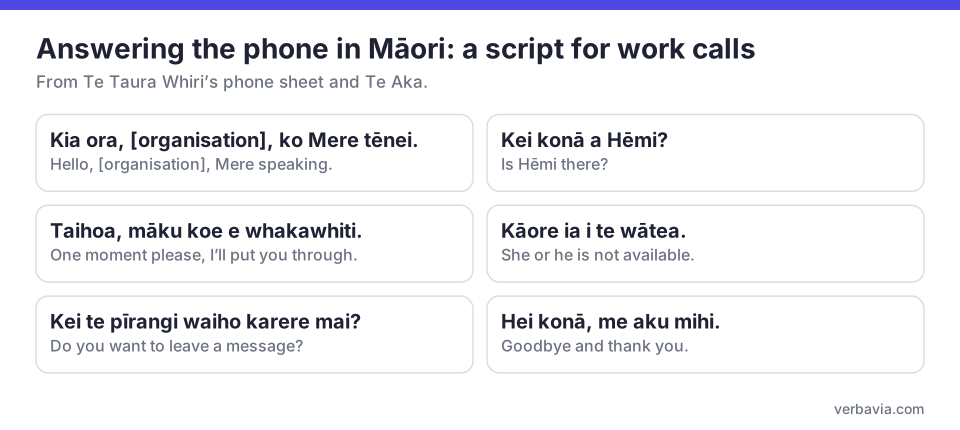
| Māori | English | When |
|---|---|---|
| Kia ora, [organisation], ko Mere tēnei. | Hello, [organisation], Mere speaking. | Answering a work line. Te Taura Whiri’s phone sheet. |
| Kei konā a Hēmi? | Is Hēmi there? | The caller asking for someone. |
| Taihoa, māku koe e whakawhiti. | One moment please, I’ll put you through. | Transferring the call. Te Taura Whiri. |
| Kāore ia i te wātea. | She or he is not available. | Te Taura Whiri. |
| Kei te pīrangi waiho karere mai? | Do you want to leave a message? | Te Taura Whiri. |
| Hei konā, me aku mihi. | Goodbye and thank you. | Ending the call. Te Aka Māori Dictionary. |
What is phone in Māori?
A phone is a waea, and to phone someone is also waea. Te Aka Māori Dictionary marks it as a loan, and its senses show how it arrived: to send a telegram, a telegram, a cable, a wire, and then a telephone. The same word covered every message that travelled down a line. A mobile is a waea pūkoro, a pocket phone, a compound the guide to English words in Māori takes apart, and Te Aka adds waea atamai for a smartphone.
| Māori | English | Note |
|---|---|---|
| waea | phone; to phone, ring | Te Aka: loan, also telegram, wire. |
| waea pūkoro | mobile phone, cellphone | Te Aka. |
| waea atamai | smartphone | Te Aka: loan. |
| tau waea, nama waea | phone number | Te Aka lists both as synonyms. |
| karere ā-waea | phone message, text message | Te Aka. |
| waea kore utu | free phone (an 0800 line) | Te Aka. |
| papawaea | switchboard | Te Aka. |
| pukapuka waea | phone book | Te Aka: loan. |
| rīngi | to telephone | Te Aka: loan, from ring. |
| terepōno, terewhōno | telephone | Te Aka: obsolete loans. |
Two old newspaper sentences in Te Aka show the verb and the noun at work. One, from 1911, tells how people waeatia atu ki te pirihimana ‘phoned the police’. The other, from 1912, describes a shop where ka tangi te waea ‘the phone rang’ and the owner went ki te whakahoki atu i te karanga ‘to answer the call’. So the phone tangi, sounds, and you answer it by returning the call, whakahoki. The everyday office words around the phone, from hui to rorohiko, are in Māori words at work.
How do you answer the phone in Māori at work?
Te Taura Whiri’s sheet for the phone, part of its Te reo o te tari: Māori for the office series, gives the opening as a frame with three parts: a greeting, the organisation’s name, and who is speaking.
- The greeting. Kia ora at any time, or Mōrena in the morning. Te Herenga Waka – Victoria University of Wellington, in its own guide to the phone, also lists Ata mārie for good morning and the more formal Tēnā koe.
- The organisation. Its name as it is normally said, Māori or English, straight after the greeting.
- Your name. Ko Mere tēnei. ‘This is Mere.’ Te Taura Whiri glosses the line Mere speaking.
Put together, with Te Taura Whiri’s own name standing in for yours as an example (built from its frame): Kia ora, Te Taura Whiri i te Reo Māori, ko Mere tēnei. ‘Hello, the Māori Language Commission, Mere speaking.’ In the morning: Mōrena, then the same.
Ko Mere tēnei is a ko sentence, the pattern Māori uses to name someone; how it is built is in Māori sentence structure. Tēnei means this, near the speaker, so on the phone it is the voice the caller is hearing. Te Herenga Waka gives the same line with another name, Ko Pita tēnei for This is Peter, and Verbavia’s course teaches Kia ora, ko Mere tēnei. as the way to identify yourself on the phone.
When you know who is ringing
If the caller’s name is on the screen, Te Herenga Waka’s pattern is the greeting and their name: Tēnā koe, Aroha. ‘Hello, Aroha.’ or Kia ora, Aroha. (its frame with a different name). Tēnā koe is the formal one and Kia ora the everyday one; which to choose, and the forms for two or more people, are explained in Māori greetings.
The whole call, start to finish
Here is a work call in order, from the ring to the goodbye. Every line is quoted from a printed source or the course; the one marked built swaps a name or pronoun into a printed frame.
| Who | Māori | English | Source |
|---|---|---|---|
| Reception | Mōrena, [organisation], ko Mere tēnei. | Good morning, [organisation], Mere speaking. | Te Taura Whiri, phone sheet |
| Caller | Mōrena, kei konā a Hēmi? | Good morning, is Hēmi there? | Te Taura Whiri’s frame; the name from the course |
| Reception | Ko wai tēnā? | Who’s that? | Course |
| Caller | Ko Hone tēnei. | This is Hone. | Built: the same frame |
| Reception | Taihoa, māku koe e whakawhiti. | One moment please, I’ll put you through. | Te Taura Whiri |
| Reception | Kāore ia i te wātea. Kei te pīrangi waiho karere mai? | She’s not available. Do you want to leave a message? | Te Taura Whiri |
| Caller | Āe. | Yes. | Te Taura Whiri |
| Reception | Māku koe e tuku ki tōna pae karere. | I’ll put you through to her answerphone. | Te Taura Whiri |
| Caller | Kia ora rawa atu. | Thank you very much. | Te Herenga Waka |
| Reception | Hei konā, me aku mihi. | Goodbye and thank you. | Te Aka |
If the caller says no to a message, Te Taura Whiri’s sheet closes it with Ka pai. Hei konā. ‘Good. Goodbye.’ The pieces are explained in the sections below.
Asking for someone: kei konā or kei konei?
The caller’s question is Kei konā a Hēmi? ‘Is Hēmi there?’ The course teaches it in exactly that form, and Te Taura Whiri and Te Herenga Waka both print the same frame with a name in the gap. A is the small word that comes before a person’s name after kei; leave it out and the sentence is wrong.
The word to watch is konā, there, where you are. Te Herenga Waka sets the two side by side: Kei konā a … for the telephone, and Kei konei a … for someone standing in the office, where the person asked about would be here. Te Taura Whiri does the same, with kei konā on its phone sheet and kei konei on its sheet for a visitor at reception. Kei asks where someone is right now, like kei hea among the Māori question words.
Who is calling?
To ask who is on the line, the course gives Ko wai tēnā? ‘Who’s that?’: tēnā is that, near you, the caller’s end. The reception sheet’s Ko wai tō ingoa? ‘What is your name?’ works too, and the caller answers with the same ko sentence the receptionist used: Ko Hone tēnei. Asking what is it about? or how can I help? is not printed in any of the office sheets reached for this page. A caller who wants help can ask with the course’s Ka taea e koe te āwhina i a au? ‘Can you help me?’
Putting someone through, or asking them to hold
Te Taura Whiri’s line is Taihoa, māku koe e whakawhiti. ‘One moment please, I’ll put you through.’ Taihoa is wait; Te Aka glosses it by and by, wait, don’t … yet, and the course teaches it alone as hold on. Whakawhiti is Te Aka’s to transfer, convey, the same word as crossing over: the call crosses to another desk. Māku at the front makes it a promise, I will.
Te Herenga Waka has a version with yes in front, for when the person asked for is there: Āe, taihoa ake nei. ‘Yes, one moment please.’ Te Aka lists taihoa ake as wait a second. Neither source prints a separate phrase for putting a caller on hold; taihoa does the job.
When the person is not there: taking a message
The simplest answer is Te Taura Whiri’s Kāore ia i te wātea. ‘She or he is not available.’ Ia is he and she alike, so the sentence never changes, and wātea is Te Aka’s free, available, unoccupied. Te Herenga Waka gives three more exact reasons:
| Māori | English (Te Herenga Waka’s) |
|---|---|
| Kāo, kei te hui ia. | Sorry, she or he is in a meeting. |
| Kāo, kei te whakaako ia. | Sorry, she or he is in a class. |
| Āe, engari kāore ia i te wātea i tēnei wā. | Yes, but unfortunately she or he is busy at the moment. |
Then the offer of a message. The two Te Taura Whiri sheets word it differently:
| Māori | English | Where Te Taura Whiri prints it |
|---|---|---|
| Kei te pīrangi waiho karere mai? | Do you want to leave a message? | Phone sheet |
| He karere tāu māna? | Do you want to leave a message? | Reception sheet |
| He kupu āu māna? | Do you want to leave a message? | Reception sheet |
The first is built on pīrangi, to want, and waiho, Te Aka’s to leave, put, with karere, message. The other two ask, literally, have you a message for him or her?, with māna meaning for him or her; the reception sheet offers either. If the caller says yes, the phone sheet’s next line passes the call to the person’s answerphone: Māku koe e tuku ki tōna pae karere. ‘I’ll put you through to his or her answerphone.’ Tuku is Te Aka’s to send, pass. Pae karere for the answerphone is Te Taura Whiri’s term; it is not an entry in Te Aka, which has karere ā-waea for the message itself.
Neither sheet prints a line for writing a message down yourself, or for can I take your number?. Te Aka’s example for tau waea comes closest, from a notice asking people kia whakarērea mai tō tau waea ‘to leave your phone number’, but it is part of a longer sentence and not a ready-made question.
Asking a caller to repeat or slow down
A phone line is harder to follow than a face. Four lines cover it:
| Māori | English | Source |
|---|---|---|
| Tēnā kōrero mai anō? | Can you repeat that please? | Te Taura Whiri, reception sheet |
| Kia āta kōrero. | Slowly please. | Te Taura Whiri, reception sheet |
| Kōrero anō, koa. | Say it again, please. | Course |
| Kāore au i te rongo i a koe. | I can’t hear you. | Course, its phone lesson |
Āta means carefully, unhurriedly, and it goes before any verb. More lines for not understanding are in common Māori phrases. There is no printed way to ask someone to spell a name: Te Aka has no entry for spelling out a word letter by letter, and none of the office sheets includes it, so it is not offered here.
Giving a phone number in Māori
Te Herenga Waka’s example says each digit on its own: Waeahia te nama rima, kore, rima, kore. ‘Call 5050.’ Waeahia is the command form of waea, and Te Aka gives it both endings, waeahia and waeatia. Kore is zero. The course does the same with the emergency number: Waea atu ki te kotahi kotahi kotahi! ‘Ring 111!’ All the digits, and the e that comes before some numbers in other uses, are in Māori numbers, days and months.
Atu points away from the speaker, so waea atu is ring out, to someone else, and waea mai is ring me, as in the course’s Ki te kore koe e waea mai, kāore au e haere. ‘Unless you call, I won’t go.’ To promise a call back, the course has Ka waea atu au ā muri ake nei. ‘I’ll ring back shortly.’
How do you end a phone call in Māori?
Te Aka has a goodbye made for the phone. Its entry for hei konā reads goodbye (to someone remaining on the phone), and its example is the line in the at-a-glance table: Hei konā, me aku mihi. ‘Goodbye and thank you.’ Konā is again there, where you are: you are wishing the caller well where they stay. Both of Te Taura Whiri’s sheets end with Ngā mihi or Hei konā, thanks or goodbye.
| Māori | English | Source |
|---|---|---|
| Hei konā. | Goodbye. | Te Taura Whiri, Te Herenga Waka, Te Aka |
| Hei konā mai. | Goodbye. | Te Herenga Waka |
| Hei konā, me aku mihi. | Goodbye and thank you. | Te Aka |
| Ngā mihi. | Thanks. | Te Taura Whiri |
| Kia ora rawa atu. | Thank you very much. | Te Herenga Waka |
| Ka pai, mā te wā. | Good, until next time. | Course |
| Ka kite anō. | See you again. | Te Herenga Waka; Te Aka calls it a shortening |
Te Herenga Waka lists Ka kite and Ka kite anō for the end of a call. Te Aka enters only the full sentence, Ka kite anō au i a koe ‘I’ll see you again’, and marks the clipped versions as wrong even though people say them all the time. On a phone line, hei konā sidesteps the argument altogether. The written counterpart of all this, from Ngā mihi to Nāku noa, nā, is in Māori email sign-offs.
What if the caller keeps going in Māori?
Answering in Māori invites a reply in Māori, and both Te Taura Whiri sheets plan for the moment it goes past what you know. The phone sheet’s line is Mō taku hē, kei te ako tonu au i te reo Māori. ‘I’m sorry, I’m still learning te reo Māori.’ The reception sheet adds Aku whakapāha, kāore au i te mārama ki ō kōrero. ‘My apologies, I don’t understand what you are saying.’
Te Taura Whiri’s note under the first line is the only advice in print about mixing the two languages on a work call: the caller, it says, will understand and revert to English. So answering in Māori and carrying on in English is what the sheet expects of someone still learning. Hē is Te Aka’s wrong, mistaken, so mō taku hē is for my mistake; whakapāha is apology; and ako is to learn, with tonu for still.
A voicemail message in Māori
Te Herenga Waka says the same phrases can go in a voicemail greeting, and gives the closings for the end of “a phone call or phone message”. No source reached for this page prints a complete voicemail greeting, so the one below is assembled from printed lines, and each is labelled:
| Māori | English | Source |
|---|---|---|
| Kia ora, ko Mere tēnei. | Hello, this is Mere. | Course; Te Herenga Waka’s frame |
| Kāore au i te wātea. | I’m not available. | Built: Te Taura Whiri’s Kāore ia i te wātea with au ‘I’ |
| Ka waea atu au ā muri ake nei. | I’ll ring back shortly. | Course |
| Hei konā mai. | Goodbye. | Te Herenga Waka, for a phone message |
For a work line, put the organisation after Kia ora as on the phone sheet. No source prints please leave a message after the tone, so that part is best said in English. Te Aka has no word for voicemail or answerphone; Te Taura Whiri’s sheet uses pae karere, and a 2002 listening test from the University of Otago’s National Education Monitoring Project calls an answerphone te waea hopu kōrero, the phone that catches speech: Te Aka’s hopu kōrero is a dictaphone.
Making the call yourself: the caller’s lines
That Otago test is also a model message from the caller’s side. A man from the town library rings a school and leaves a message for a teacher. It opens with Kia ora, then his name in the same ko … tēnei sentence, then nō and the library, to say where he is calling from. With a course name in place of his, the opening is Kia ora, ko Hone tēnei. (built). Nō is the same word as in Nō hea koe? ‘Where are you from?’
The message then states its purpose, Kei te hiahia whakarere mai au i tētahi kōrero mō tētahi o ngā kaiako ‘I’d like to leave a message for one of the teachers’, gives the details after Tēnā, kī atu ki a ia ‘Please tell her’, and ends Hei konā! Whakarere is Te Aka’s to leave behind. Using tātou or mātou for we on the phone, where the person listening is not with you, is set out in Māori pronouns.
For reception staff: the lines to pin by the phone
Te Taura Whiri’s sheet is a single page made to be printed, and the lines below are the ones a front desk uses most, in the order a call needs them. Te Aka’s words for the job are kiripaepae or kaiwhakatau manuhiri, receptionist, and taupaepae, reception area, the title of Te Taura Whiri’s sheet for the front desk.
- Kia ora, [organisation], ko Mere tēnei.
- Ko wai tēnā?
- Taihoa, māku koe e whakawhiti.
- Kāore ia i te wātea. Kei te pīrangi waiho karere mai?
- Māku koe e tuku ki tōna pae karere.
- Tēnā kōrero mai anō?
- Mō taku hē, kei te ako tonu au i te reo Māori.
- Hei konā, me aku mihi.
A public-service line that answers with its organisation’s Māori name can find it in Māori names of government agencies. Te Taura Whiri’s coffee card, from the same shelf of everyday resources as its office sheets, is the basis of ordering coffee in Māori.
Going further
The phone call is lesson 178 of Verbavia’s free te reo Māori course, with Ko wai tēnā?, Kei konā a Hēmi? and Taihoa., and the numbers, the greetings and the repair phrases come in the lessons around it, one short lesson a day. To get the macrons right in a bilingual email signature that lists your waea, see how to type Māori macrons.
Learn te reo Māori with Verbavia
Verbavia’s free te reo Māori course starts with the most common words, explains the grammar properly, and plays every example in Papa Reo’s native te reo voice. One lesson a day, from your first word to B1.
Quick questions
How do you answer the phone in Maori?
Say Kia ora, then your organisation, then ko Mere tēnei ‘this is Mere’ with your own name: Te Taura Whiri’s sheet for office phones prints that frame, with Mōrena as the morning alternative.
What is the Māori word for phone?
Waea, a loan that Te Aka gives as both phone and to phone. A mobile is a waea pūkoro.
How do you say goodbye on the phone in Māori?
Say Hei konā, which Te Aka glosses goodbye (to someone remaining on the phone), or Hei konā, me aku mihi ‘goodbye and thank you’.
How do you ask for someone on the phone in te reo?
Say Kei konā a Hēmi? ‘Is Hēmi there?’ with their name; konā is there, where you are, and a must come before the name.
Sources
- Te Taura Whiri i te Reo Māori: Reo for the Office (Te reo o te tari), with the sheets “Waea / Phone” and “Taupaepae / Reception” (2022)
- Te Taura Whiri i te Reo Māori: Te reo o te tari 01, Waea / Phone (ZIP of PDFs)
- Te Taura Whiri i te Reo Māori: Te reo o te tari 03, Taupaepae / Reception (ZIP of PDFs)
- Te Herenga Waka – Victoria University of Wellington: Using te reo Māori on the phone
- Te Herenga Waka – Victoria University of Wellington: Māori greetings and phrases
- National Education Monitoring Project (University of Otago), Māori 2002: He Pānui Waea — Phone Message
- Te Aka Māori Dictionary: waea (telephone; to telephone)
- Te Aka Māori Dictionary: waea pūkoro (mobile phone)
- Te Aka Māori Dictionary: waea atamai (smartphone)
- Te Aka Māori Dictionary: tau waea (phone number)
- Te Aka Māori Dictionary: nama waea (phone number)
- Te Aka Māori Dictionary: karere ā-waea (telephone message)
- Te Aka Māori Dictionary: waea kore utu (free phone)
- Te Aka Māori Dictionary: pukapuka waea (telephone directory)
- Te Aka Māori Dictionary: papawaea (switchboard)
- Te Aka Māori Dictionary: rīngi (to telephone)
- Te Aka Māori Dictionary: terepōno (telephone, obsolete)
- Te Aka Māori Dictionary: terewhōno (telephone, obsolete)
- Te Aka Māori Dictionary: hei konā (goodbye to someone remaining on the phone)
- Te Aka Māori Dictionary: taihoa (wait)
- Te Aka Māori Dictionary: taihoa ake (wait a second)
- Te Aka Māori Dictionary: whakawhiti (to transfer, convey)
- Te Aka Māori Dictionary: wātea (free, available)
- Te Aka Māori Dictionary: pīrangi (to want)
- Te Aka Māori Dictionary: waiho (to leave, put)
- Te Aka Māori Dictionary: karere (message)
- Te Aka Māori Dictionary: tuku (to send, pass)
- Te Aka Māori Dictionary: whakarere (to leave behind)
- Te Aka Māori Dictionary: whakapāha (apology)
- Te Aka Māori Dictionary: hē (wrong, mistaken)
- Te Aka Māori Dictionary: ako (to learn)
- Te Aka Māori Dictionary: taupaepae (reception area)
- Te Aka Māori Dictionary: kiripaepae (receptionist)
- Te Aka Māori Dictionary: kaiwhakatau manuhiri (receptionist)
- Te Aka Māori Dictionary: hopu kōrero (dictaphone)
- Te Aka Māori Dictionary: Ka kite anō au i a koe