How to order coffee in Māori: He kawhe māku
To order coffee in Māori, say He kawhe māku. ‘A coffee for me.’ Put the drink you want after he: He mōwai nui māku. ‘A large flat white for me.’ Or ask with please on the end, the way Te Taura Whiri i te Reo Māori, the Māori Language Commission, prints it on its coffee card: He mōwai koa. ‘A flat white, please.’ This page gives the names of the drinks as Te Taura Whiri and Te Aka Māori Dictionary print them, milk, sugar, sizes, having it here or taking it away, and the whole exchange at the counter in order, with the barista’s lines as well as the customer’s.
Tap 🔊 to hear an example. Māori examples play Papa Reo, the te reo Māori voice made by Te Hiku Media from recordings of native speakers. Every sentence in the free course is spoken like this.
On this page
- What is coffee in Māori?
- How do you order a coffee in Māori?
- The whole order, start to finish
- Coffee names in Māori: flat white, long black, latte
- Tea, water and hot chocolate
- Milk, sugar, sizes and cups
- Two coffees: ordering for more than one
- How do you say please in Māori?
- How to pronounce the coffee words
- For café staff: taking an order in te reo
- Going further
- Quick questions
| Māori | English | When |
|---|---|---|
| He kawhe māku. | A coffee for me. | The order itself. Swap in any drink below. |
| He mōwai koa. | A flat white, please. | Te Taura Whiri’s card: He … koa. |
| He mōwai nui māku. | A large flat white for me. | Size goes after the drink. |
| Hei heri atu. | Takeaway. | To take it with you. |
| Ki konei koa. | Have here, thanks. | To drink it in the café. |
| Anei, taku kapu mahi rua. | Here is my reusable cup. | Handing over your own cup. |
| Tēnā koe. | Thank you. | Te Taura Whiri glosses it hi and thank you. |
What is coffee in Māori?
Coffee is kawhe. Te Aka Māori Dictionary lists it as a loan from English, and its example comes from a Māori-language newspaper of 1855, describing a country where he kawhe, he huka ‘coffee, sugar’ and many other good things are grown. Te Aka also keeps an older spelling, kawhi, from a paper of 1899. The wh stands where English has f, one of the sound changes set out in English words in Māori, and it is said much like an English f, so the word comes out close to kah-feh.
Te Aka has a small family of coffee words built on it: kawhe kutē ‘espresso’, kanokawhe ‘coffee bean’, mīhini kawhe ‘coffee machine’ and tuari mahi kawhe ‘barista’. Hot coffee is kawhe wera, with wera, hot, coming after the noun it describes.
How do you order a coffee in Māori?
There are two printed ways, and both are short. Each starts with he, a or some, and the drink.
He … māku: a … for me
Māku is for me. Te Taura Whiri’s 2005 Māori Language Week booklet on food, He kōrero mō te kai, orders every drink this way, and adds the details after a comma:
| Māori | English (the booklet’s) |
|---|---|
| He kawhe māku, kia kotahi te huka, kāore he miraka. | Coffee for me, one sugar, no milk. |
| He kawhe māku, kia rua ngā huka, kāore he miraka. | Coffee for me, two sugars, no milk. |
| He tī māku, kāore he huka, he iti noa iho te miraka. | Tea for me, no sugar, a little milk. |
| He wai noa iho māku. | Just water for me. |
The same frame turns up wherever cafés take orders in te reo. A teacher writing on Te Taura Whiri’s Te Wiki o te Reo Māori site in 2022 described a student-run coffee cart where every order in te reo earned a free coffee, and what started as he mōwai nui māku read off notes soon grew into short conversations. In 2025 RNZ’s Morning Report headed its story on a Taihape food truck making the same offer He Kapu Kawhe Māku ‘a cup of coffee for me’.
Why māku and not mōku? Both mean for me, but Te Aka gives māku for what the person will have control of, and food and drink you are about to consume belong in that group. The two categories, and the other words they shape, are explained in Māori possessives: a and o. Te Aka’s own example of māku is a request in the same mould: Homai he rare māku. ‘Give me some sweets, please.’
He … koa: a …, please
Te Taura Whiri’s 2018 coffee card, made with Massey University for its #TeReoKawhe campaign, prints the order as a frame: He … koa, Can I have a … please, with four drinks to put in the gap:
| Māori | English (the card’s) |
|---|---|
| He kawhe koa. | Can I have a coffee, please. |
| He pango poto koa. | Can I have a short black, please. |
| He pango roa koa. | Can I have a long black, please. |
| He mōwai koa. | Can I have a flat white, please. |
RNZ’s Māori news director used the same line on Morning Report during Te Wiki o te Reo Māori in 2019, rendering He mowai koa as a flat white please. Any drink in the next section can go in either frame: He rate koa., He moka māku. The course teaches the shortest form of all, the drink and koa alone, as an answer: He kawhe, he tī rānei? — He tī, koa. ‘Coffee or tea? — Tea, please.’
The whole order, start to finish
Here is a visit to the counter in order. Each line is quoted from Te Taura Whiri’s card or booklet, Te Aka or Verbavia’s course, except two marked built, which put a drink from the card into a printed frame.
| Who | Māori | English | Source |
|---|---|---|---|
| Barista | Mōrena! | Good morning! | Card; after midday, Ngā mihi o te ahiahi. |
| Customer | Tēnā koe. | Hello. | Card |
| Barista | E pēhea ana tō rā? | How’s your day going? | Card |
| Customer | Ka pai. | Good. | Course |
| Barista | He aha tō hiahia? | What would you like? | Booklet, 2005 |
| Customer | He pango roa māku. | A long black for me. | Built: card’s drink, booklet’s frame |
| Barista | He miraka mō tō kawhe? | Milk in your coffee? | Booklet |
| Customer | Kāo. | No. | Card |
| Barista | He huka māu? | Would you like sugar? | Te Aka and the booklet |
| Customer | Āe, kia kotahi māku. | Yes, one for me. | Booklet |
| Customer | Hei heri atu. | Takeaway. | Card |
| Customer | Anei, taku kapu mahi rua. | Here is my reusable cup. | Card |
| Barista | Ko wai tō ingoa? | What’s your name? | Course |
| Customer | Ko Mere. | Mere. | Course |
| Customer | E hia te utu? | How much is it? | Course |
| Barista | E ono tāra. | Six dollars. | Course |
| Barista | Ka utu koe mā te aha? | How will you pay? | Course |
| Customer | Mā te kāri. | By card. | Course |
| Barista | Anei. | Here you are. | Course |
| Customer | Kia ora rā! | Thanks a lot! | Booklet |
| Barista | Ka kite anō! | See you later! | Card |
| Customer | Hei konā rā! | Goodbye! | Card; Te Aka: said to someone staying |
To drink it in, swap Hei heri atu. for Ki konei koa. For a flat white with soy milk, say He mōwai māku. and then Miraka pīni, koa., the second built from the card’s word for soy milk and koa as the course uses it. Paying, prices in tāra and hēneti, and the card or cash question are covered in full in shopping in Māori.
Two goodbyes need care. Hei konā rā is the one Te Aka gives for someone staying, so it belongs to the customer walking out, not to the barista. And the card’s Ka kite anō is, in Te Aka, a shortened form: its entry is Ka kite anō au i a koe ‘I’ll see you again’, and it calls the short form incorrect. Both are in everyday use; the long one is the one Te Aka prints. More hellos and goodbyes are in Māori greetings.
Nothing reached for this page prints a barista’s question about size, about having it here or taking it away, or anything else?, so none is offered. The customer’s answers above work without the question.
Coffee names in Māori: flat white, long black, latte
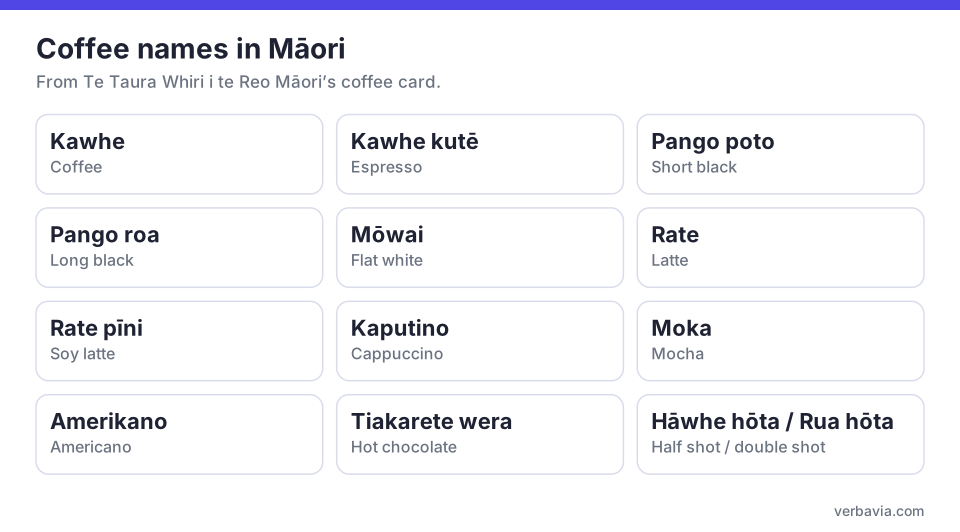
Te Taura Whiri’s 2018 card is the fullest list in print. Te Aka has some of the same words, and where it does they agree, apart from one macron.
| English | Te Taura Whiri card (2018) | Te Aka Māori Dictionary |
|---|---|---|
| Coffee | Kawhe | kawhe, also kawhi |
| Espresso | Kawhe kutē | kawhe kutē |
| Short black | Pango poto | No entry |
| Long black | Pango roa | No entry; used in an example as kawhe pango roa |
| Flat white | Mōwai | No coffee sense; mōwai is smooth, calm |
| Latte | Rate | rate, loan, no macron |
| Soy latte | Rate pīni | No entry; pīni is bean |
| Cappuccino | Kaputino | kaputīno and kaputino, both loans |
| Mocha | Moka | moka, loan |
| Americano | Amerikano | No entry |
| Hot chocolate | Tiakarete wera | No entry; tiakarete is chocolate |
| Half shot / double shot | Hāwhe hōta / Rua hōta | hōta only as lead shot |
The pattern is easy to see. The drinks with Italian names keep them, reshaped to Māori sounds: rate, kaputino, moka, amerikano. The drinks New Zealand named in English get Māori words instead. A short black is pango poto and a long black pango roa, from pango ‘black’, poto ‘short’ and roa ‘long’. A flat white is mōwai, a Māori word Te Aka gives as smooth, calm, with no coffee sense yet in the dictionary. Te Aka’s own latte example orders a round: Tīkina atu kia rua ngā kawhe pango roa, kia toru ngā rate mā tātou. ‘Go and get two long black coffees and three lattes, please.’
For cappuccino, Te Aka has two entries, kaputīno with a long ī and kaputino without, and the card uses the second. Both are in the dictionary, so either is defensible. A milo, chai or iced coffee has no name in either source, and no name is offered here.
Tea, water and hot chocolate
| Māori | English | Note |
|---|---|---|
| tī | tea | Te Aka: loan. A different word from tī ‘cabbage tree’. |
| kaputī | cup of tea | Te Aka and the card; Te Aka also gives teacup. |
| tī Ingarihi | English Breakfast tea | Card. |
| tī kākāriki | green tea | Card; kākāriki is green. |
| tī hīoi | peppermint tea | Card; Te Aka’s hīoi is a native mint. |
| tī otaota | herbal tea | Te Aka and the booklet. |
| tiakarete wera | hot chocolate | Card. |
| wai | water | |
| wai makariri | cold water | Card; makariri is cold. |
| wai wera | hot water | Card; Te Aka writes it as two words too. |
Te Aka’s examples give the offer for each: He kapu tī māu? ‘Would you like a cup of tea?’ to one person, and He tī otaota mā kōrua? ‘Would you two like herbal tea?’ to two. Māu is for you, one person; how kōrua and koutou count people is in Māori pronouns. The everyday food words, from kai to bread and butter, are in food in Māori, which this page does not repeat.
Milk, sugar, sizes and cups
Milk in Māori
Milk is miraka, a loan, which Te Aka also records as a verb, to milk a cow. The card names three kinds:
| Māori | English |
|---|---|
| miraka kirīmi | full cream milk |
| miraka kore kirīmi | trim milk |
| miraka pīni | soy milk |
Kirīmi is cream and kore is without, so trim milk is milk without cream; Te Aka lists it the same way. Pīni is bean. Oat milk and almond milk are not printed by either source. Te Aka has ōti ‘oats’, but no compound with miraka, so neither is given here. The booklet’s way of declining milk is kāore he miraka ‘no milk’, and the barista’s question is He miraka mō tō kawhe?
Sugar
Sugar is huka, and Te Aka’s example is the barista’s question word for word: He huka māu? ‘Would you like some sugar?’ Answer Āe or Kāo, or give a number with kia: kia kotahi te huka ‘one sugar’, kia rua ngā huka ‘two sugars’, as the booklet does. Te Aka has another huka meaning snow, frost, foam, an older Māori word unrelated to the loan.
Sizes: paku, waenga, nui
The card’s heading for size is Rahi, and it gives three cup sizes: paku ‘small’, waenga ‘medium’ and nui ‘large’. Te Aka glosses paku small, little and waenga the middle. The size follows the drink, as in the school cart’s he mōwai nui māku. The card adds half and double shots: hāwhe hōta and rua hōta.
Cups, here or takeaway
| Māori | English | Source |
|---|---|---|
| kapu | cup | Te Aka, loan |
| kapu rahi | mug | Te Aka |
| kapu rangaranga | takeaway cup | Te Aka |
| kapu mahi rua | reusable cup | Card |
| Hei heri atu. | Takeaway. | Card |
| Ki konei koa. | Have here, thanks. | Card |
Heri is Te Aka’s to take, carry, a dialect form of hari, and atu points away from the speaker, so hei heri atu is roughly to carry away. Ki konei is here. Te Aka’s noun for takeaway food is ō rangaranga, the same rangaranga as in the takeaway cup.
Two coffees: ordering for more than one
Numbers come in with kia, the form for how many are wanted. The booklet answers an offer of biscuits with Āe rā, kia rua māku. ‘Of course, two for me.’, and Te Aka’s latte example orders kia rua ngā kawhe pango roa ‘two long blacks’. Put a drink from the card in the same place and two flat whites are kia rua ngā mōwai (built: Te Aka’s frame with the card’s noun). Ngā is the for more than one.
To offer a round to a group, the booklet has He kawhe mā koutou? ‘Does anyone want coffee?’ The numbers to ten and beyond, and the small e that goes before some of them, are in Māori numbers, days and months.
How do you say please in Māori?
Te Aka gives two ways, and the café uses both. Koa goes after the request, and Te Aka describes it as implying entreaty, used with requests “to soften them and to make them more polite”; its example is Homai koa te miraka. ‘Pass the milk, please.’ Tēnā koa goes at the start: Tēnā koa, … So the card’s He mōwai koa. is a flat white, please, and its Ki konei koa. is glossed have here thanks. How koa works across other everyday requests is in common Māori phrases.
For thank you, the card gives Tēnā koe, and the booklet Kia ora rā ‘thanks a lot’. The card also prints Namunamuā as delicious, but Te Aka gives namunamuā as a noun, flavour, flavouring; the course’s word for delicious is reka, as in He reka!
How to pronounce the coffee words
The card’s own pronunciation panel is the short version. Five vowels, each short or long: a as in father, e as in dress, i as in see, o as in thought, u as in goose; a vowel with a macron is held for twice as long. The r is usually not rolled: the tip of the tongue briefly touches the roof of the mouth behind the teeth.
- Kawhe: two syllables, ka-whe, with wh close to an English f.
- Mōwai: hold the ō; the ai runs together.
- Rate: ra-te, both vowels short and clear, nothing like English rate.
- Māku: long first ā. Without the macron, mākū is a different word, wet.
- Tī: one long vowel, like English tea.
The full set of sounds, with wh and ng taken slowly, is in the Māori pronunciation guide, and putting the macrons on a menu board or an order screen is covered in how to type Māori macrons.
For café staff: taking an order in te reo
These are the barista’s lines, all printed by Te Taura Whiri, Te Aka or the course. Te Aka’s word for a barista is tuari mahi kawhe, or tuari, which also covers a steward or waiter.
| Māori | English | Source |
|---|---|---|
| Mōrena! / Ata mārie! | Good morning! | Card; both are in Te Aka |
| E pēhea ana tō rā? | How’s your day going? | Card |
| He aha tō hiahia? | What would you like? | Booklet |
| He aha tāu e hiahia ana? | What would you like? | Course |
| He inu māu? | Would you like a drink? | Booklet |
| He tī, he kawhe rānei? | Tea or coffee? | Booklet and course |
| He miraka mō tō kawhe? | Milk in your coffee? | Booklet |
| He huka māu? | Would you like sugar? | Te Aka and the booklet |
| Ko wai tō ingoa? | What’s your name? | Course; for the cup |
| Ka utu koe mā te aha? | How will you pay? | Course |
| Anei. | Here you are. | Course |
The name for the cup is the one place a customer may answer with a full sentence: Ko Mere tōku ingoa. ‘My name is Mere.’ or simply Ko Mere. Most of the café offers reported above ran during Te Wiki o te Reo Māori, Māori Language Week, in September. More of the language of a workplace, from greetings at the door to the end of a shift, is in Māori words at work.
Going further
Kawhe, tī, miraka, the numbers and the shop conversation are all taught in Verbavia’s free te reo Māori course, one short lesson a day. For short sayings that make a barista smile, see kīwaha: Māori idioms.
Learn te reo Māori with Verbavia
Verbavia’s free te reo Māori course starts with the most common words, explains the grammar properly, and plays every example in Papa Reo’s native te reo voice. One lesson a day, from your first word to B1.
Quick questions
How do you order a coffee in Maori?
Say He kawhe māku. ‘A coffee for me.’ or, as Te Taura Whiri’s card prints it, He kawhe koa. ‘A coffee, please.’
What is flat white in Māori?
Te Taura Whiri’s coffee card gives mōwai: He mōwai koa. ‘A flat white, please.’ A long black is pango roa and a short black pango poto.
What is the Māori word for coffee?
Coffee is kawhe, a loan from English in Te Aka, which also lists the older spelling kawhi.
How do you say takeaway in Māori?
At the counter, Te Taura Whiri’s card says Hei heri atu. To drink it in, say Ki konei koa.
Sources
- Te Taura Whiri i te Reo Māori and Massey University: Order your kawhe / coffee in Māori! #TeReoKawhe card (2018), as distributed by Restaurant Association NZ
- Te Taura Whiri i te Reo Māori: He kōrero mō te kai / Talking about food, Kōrero Māori: Give it a go (Māori Language Week 2005), hosted by Taupō District Council
- Te Wiki o te Reo Māori (reomaori.co.nz): a teacher’s post on a school coffee cart, 2022
- RNZ Morning Report: How to order coffee in te reo Māori (10 September 2019)
- RNZ Morning Report: He Kapu Kawhe Māku: Free coffee for te reo Māori orders at Taihape food truck (17 September 2025)
- Te Aka Māori Dictionary: kawhe (coffee)
- Te Aka Māori Dictionary: kawhi (coffee)
- Te Aka Māori Dictionary: kawhe kutē (espresso)
- Te Aka Māori Dictionary: kanokawhe (coffee bean)
- Te Aka Māori Dictionary: mīhini kawhe (coffee machine)
- Te Aka Māori Dictionary: tuari mahi kawhe (barista)
- Te Aka Māori Dictionary: tuari (to serve; steward, barista, waiter)
- Te Aka Māori Dictionary: rate (latte), with the example ordering long blacks and lattes
- Te Aka Māori Dictionary: moka (mocha)
- Te Aka Māori Dictionary: kaputīno (cappuccino)
- Te Aka Māori Dictionary: kaputino (cappucino)
- Te Aka Māori Dictionary: mōwai (smooth, calm)
- Te Aka Māori Dictionary: tī (tea), with He kapu tī māu?
- Te Aka Māori Dictionary: tī otaota (herbal tea)
- Te Aka Māori Dictionary: kaputī (cup of tea, teacup)
- Te Aka Māori Dictionary: hīoi (native mint)
- Te Aka Māori Dictionary: Ingarihi (English)
- Te Aka Māori Dictionary: tiakarete (chocolate)
- Te Aka Māori Dictionary: miraka (milk; to milk)
- Te Aka Māori Dictionary: miraka kore kirīmi (trim milk)
- Te Aka Māori Dictionary: kirīmi (cream)
- Te Aka Māori Dictionary: pīni (bean)
- Te Aka Māori Dictionary: ōti (oats)
- Te Aka Māori Dictionary: huka (sugar), with He huka māu?
- Te Aka Māori Dictionary: huka (snow, frost, foam)
- Te Aka Māori Dictionary: hōta (shot)
- Te Aka Māori Dictionary: kapu (cup)
- Te Aka Māori Dictionary: kapu rahi (mug)
- Te Aka Māori Dictionary: kapu rangaranga (takeaway cup)
- Te Aka Māori Dictionary: ō rangaranga (takeaway, fast food)
- Te Aka Māori Dictionary: heri (to take, carry)
- Te Aka Māori Dictionary: wera (be hot)
- Te Aka Māori Dictionary: makariri (be cold)
- Te Aka Māori Dictionary: wai makariri, wai wera (in kōrere wai makariri, cold water tap)
- Te Aka Māori Dictionary: paku (small, little)
- Te Aka Māori Dictionary: waenga (the middle)
- Te Aka Māori Dictionary: rahi (to be large)
- Te Aka Māori Dictionary: māku (for me; I will)
- Te Aka Māori Dictionary: mākū (wet)
- Te Aka Māori Dictionary: māu (for you)
- Te Aka Māori Dictionary: rare (lolly, sweet)
- Te Aka Māori Dictionary: koa (please)
- Te Aka Māori Dictionary: tēnā koa (please)
- Te Aka Māori Dictionary: mōrena (good morning)
- Te Aka Māori Dictionary: ata mārie (good morning)
- Te Aka Māori Dictionary: hei konā rā (goodbye, said to someone staying)
- Te Aka Māori Dictionary: Ka kite anō au i a koe (I’ll see you again)
- Te Aka Māori Dictionary: namunamuā (flavour, flavouring)