Koha: meaning, how to give it, and how much koha to give
Koha is a gift, usually of money today, that visitors give their Māori hosts, and Te Aka Māori Dictionary defines koha ‘gift, contribution’ as a gift, present, offering, donation or contribution, especially one that maintains a relationship and carries a sense of reciprocity. It is laid down during the speeches at a pōwhiri, taken to a tangihanga, and given at a hui. And the question everyone asks, how much koha to give, has an honest answer: none of the published guidance found sets a figure, and the University of Auckland’s policy says outright that no fixed amount is stated or expected. What decides it instead is set out below, with what koha means, where the custom comes from, and how it is given on each occasion.
Tap 🔊 to hear an example. Māori examples play Papa Reo, the te reo Māori voice made by Te Hiku Media from recordings of native speakers. Every sentence in the free course is spoken like this.
On this page
What does koha mean?
Te Aka’s definition is longer than most, because the word carries more than “gift”. A koha keeps up a relationship, and it expects one day to be returned in kind: Te Aka says a koha laid down on a marae is intended for the marae and is to be reciprocated at some time in the future. The University of Auckland’s koha policy calls the giving of koha an integral part of Māori culture, an expression of manaakitanga ‘hospitality, generosity, care’ and aroha ‘love, compassion’, goodwill and gratitude.
Koha is the shortened form of takoha, which Te Aka gives as a verb, to gift, donate or pledge, and as a noun, a gift, token, pledge or donation. Te Aka also notes that some tribes prefer to call such donations whakaaro or kohi, because of the connotations of tapu ‘sacredness, restriction’ that go with the words takoha and koha. So you may hear a different word on a different marae for the same envelope.
Where it comes from: gifts that are answered
Koha grows out of an older economy of gift exchange. Te Ara’s account of the Māori economy, by Basil Keane, says trade took the form of gift exchange, and that the giving of a gift created an obligation to reciprocate with an equal or better gift. Manuka Henare, writing in Te Ara on food and economics, says gifts were governed by the principle of utu ‘to repay, respond’, reciprocity: when a gift was given, a gift of greater value was expected to follow.
What was given has changed. Te Ara’s Mark Derby says the koha once took the form of food and precious objects such as greenstone ornaments, and is generally money today. Massey University’s handbook gives the old logic: a tribe gave what it had in abundance, seafood from the coast, fern root from inland. Te Aka adds that a traditional gift of food was usually delivered straight to where the food was prepared rather than presented on the marae, and that when the koha was a valuable cloak, ornament or weapon, the way it was presented showed whether it was meant to be returned one day or not.
Koha is not a fee
Because a koha answers hospitality rather than buying it, it is not a payment, and the published policies are firm about that. The University of Auckland defines koha as a gift or donation given in accordance with Māori protocol, distinct from paying for services, and says that when it is cash, “there must be no fixed amount stated or expected”. The Office of the Auditor-General’s guide for public organisations describes koha as discretionary and usually un-receipted.
That does not mean using a marae is free. Te Ara’s account of marae management says a marae generally charges a per-day fee for hui and meetings to help meet its costs, and a Te Ara note on a 1991 television report about taxing koha explains that in 2013 no traditional forms of koha to marae were taxable, while a commercial fee for the use of a marae could be. If you have booked a marae, the fee and the koha are two different things.
How koha is given at a pōwhiri
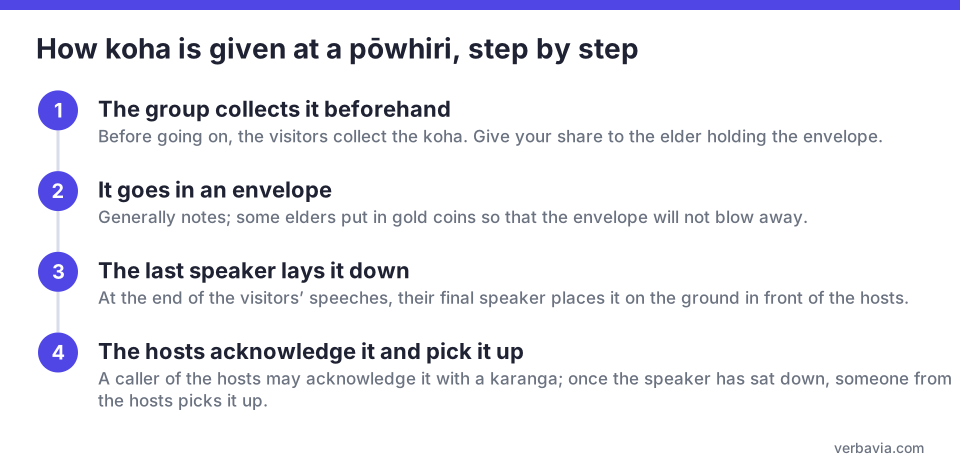
This is the occasion where koha is most visible. Te Ara’s account of the pōwhiri, by Basil Keane, and the guides that universities give their own visitors describe the same core:
- The group collects it beforehand. Before going on, the visitors organise their caller and speakers and collect the koha (Te Ara); LIANZA’s guide says it is collected before the karanga. If you are one of the group, Te Ara’s advice is to give your share to the kaumātua ‘elder’ holding the envelope.
- It goes in an envelope. Generally notes, Te Ara says, though some kaumātua put in gold coins so that the envelope will not blow away in a gust of wind.
- The last speaker lays it down. At the end of the visitors’ speeches, their final speaker places it on the ground in front of the hosts (Te Ara, Otago, Massey, LIANZA). The University of Auckland adds that a song follows; the songs sung in support of a speaker are in waiata tautoko.
- The hosts acknowledge it and pick it up. A caller of the hosts may acknowledge the koha with a karanga (Massey, Otago, LIANZA), and once the speaker has sat down someone from the hosts picks it up (Te Ara).
Te Ara’s caption to a photograph of a koha being picked up suggests why it is done this way: placing the gift on the ground between the two sides may recall the days when the koha was food and other bulky goods, and it makes the giving public and open, in keeping with the ceremony. The rest of the pōwhiri, step by step, is in pōwhiri explained.
| Point | What the sources say |
|---|---|
| Laying it on the marae | In many tribes, but not all tribes agree with the practice (Te Aka). |
| Who picks it up | Someone from the hosts (Te Ara); one of the hosts’ speakers (Otago); a man of the mana whenua (Massey); a nominated person, who thanks the visitors (LIANZA). |
| What follows | A karanga acknowledging it (Massey, Otago, LIANZA); a waiata (University of Auckland). |
| What it is called | Koha or takoha; some tribes prefer whakaaro or kohi (Te Aka). |
Koha at a tangihanga
At a tangihanga ‘funeral, rites for the dead’, often shortened to tangi, koha can go two ways, and Te Aka keeps them apart. A koha laid down on the marae is for the marae. A koha given quietly, in person, to a member of the bereaved family is kōkuhu ‘to give quietly, unobtrusively’, or kōkohu, and Te Aka’s example sentence for kōkuhu spells out whose it is: a gift taken secretly to the place where the body lies is for the bereaved family, and the marae has no claim on it.
The family itself gives too. Te Ara’s account of marae management says most marae do not charge for a tangihanga, but the whānau ‘extended family’ gives a koha. The University of Auckland’s policy lists both tangihanga and koha to the whānau pani ‘bereaved family’ among the occasions where koha is appropriate. What to say, wear and do at a tangi is in condolences in Māori, and the headstone unveiling a year later in hura kōhatu.
Koha at a hui, and at work
A hui ‘gathering, meeting’ has costs: food, power, a place to sleep. Te Aka says a koha given in person to the leader, the kōkuhu again, is meant to help meet the costs of the hui, while the koha laid down on the marae is for the marae. Its example, from a Māori-language source, puts it in one line: koha presented on the marae is for that marae’s needs, and koha given in person to whoever holds the gathering helps defray its costs.
Public organisations and universities give koha too, and their policies list when. The Auditor-General’s guide names tangihanga, attendance at an event or meeting, use on or for a marae, and kaumātua support for a pōwhiri or mihi whakatau. The University of Auckland adds hui with Māori organisations and iwi, and an expert who has led a tikanga process on the university’s behalf. A workplace welcome is explained in what is a mihi whakatau?
How much koha should you give?
There is no standard amount, and the sources say so rather than leaving it to guesswork. Te Ara’s Mark Derby says the amount is determined by the donor’s ability and willingness to show their appreciation of the hospitality received. The University of Auckland’s policy says no fixed amount is stated or expected, and asks that the amount have regard to Māori custom, be appropriate to the circumstances, and be moderate and conservative; for advice on a particular occasion it points staff to its Pro Vice-Chancellor (Māori). The Auditor-General asks only that a koha reflect the occasion.
The University of Auckland’s policy does contain dollar figures, and they are easy to misread. A koha of up to $100 needs approval from someone with financial authority, $101 to $250 a manager at Level 3 or higher, $251 to $500 a member of the University Executive Committee, and over $500 the Vice-Chancellor. Those bands say who signs off a koha of that size from university funds. They are not a recommendation of what anyone should give.
What decides the amount
- Your means. Te Ara puts the giver’s ability first.
- What you are thanking them for. The same Te Ara sentence ties the amount to appreciation of the hospitality received: a cup of tea after a short welcome is not a night on the marae with every meal.
- The relationship. A koha maintains a relationship and is reciprocated in time (Te Aka), so it belongs to an exchange that runs both ways over time, not to a single bill.
- The occasion. Both the Auditor-General and the University of Auckland ask that it reflect the occasion.
- Whether you are one person or a group. A visiting group collects one envelope (Te Ara), so its koha comes from everyone in it; no source sets a share per person.
- Who it is for. A koha on the marae supports the marae; one given quietly supports the people holding the hui or, at a tangi, the bereaved family (Te Aka).
If you are giving on behalf of an organisation, check its own rules first: the Auditor-General expects public organisations to have a koha policy that specifies how the amount is decided. If you are giving as yourself, give what you can afford and what reflects the welcome you were given, put it in an envelope, and hand it to whoever is collecting for your group.
Koha and a present: not the same gift
A birthday or Christmas present is a perehana, not a koha; the difference is explained in happy birthday in Māori and Merry Christmas in Māori. And because koha belongs to tikanga ‘custom, correct procedure’, the wider set of customs it sits in is in what does tikanga mean? The word is also common in New Zealand English: see Māori words in New Zealand English.
The words of koha, in one place
| Māori | Te Aka’s meaning |
|---|---|
| koha | gift, present, offering, donation, contribution, especially one maintaining social relationships, with connotations of reciprocity |
| takoha | to gift, donate, pledge; gift, token, pledge, donation |
| kōkuhu, kōkohu | to give quietly, in person, to the rangatira or a member of the bereaved family at a hui or tangihanga |
| utu | to repay, pay, respond |
| manaakitanga | hospitality, kindness, generosity, support |
| whānau pani | chief mourners, bereaved family |
| kaumātua | elder |
| hui | gathering, meeting, assembly, conference |
| tangihanga | weeping, funeral, rites for the dead |
These words, and the grammar to use them, are part of our own free te reo Māori course, one lesson a day.
Learn te reo Māori with Verbavia
Verbavia’s free te reo Māori course starts with the most common words, explains the grammar properly, and plays every example in Papa Reo’s native te reo voice. One lesson a day, from your first word to B1.
Quick questions
What does koha mean?
A gift, present, offering, donation or contribution, in Te Aka’s words, especially one that maintains a relationship and carries a sense of reciprocity. Today it is usually money.
How much koha should you give?
None of the published guidance sets a figure, and the University of Auckland says no fixed amount is stated or expected. Te Ara ties the amount to your means and to the hospitality you received.
How is koha given at a pōwhiri?
It is collected beforehand in an envelope, and the visitors’ last speaker places it on the ground in front of the hosts, who pick it up once the speaker has sat down.
Is koha a payment?
No. It answers hospitality rather than buying it; the Auditor-General describes it as discretionary and usually un-receipted. A booked marae may still charge a fee.
Sources
- Te Aka Māori Dictionary: koha
- Te Aka Māori Dictionary: takoha
- Te Aka Māori Dictionary: kōkuhu (sense 2, giving koha quietly; the TWK 39:16 example)
- Te Aka Māori Dictionary: kōkohu
- Te Aka Māori Dictionary: utu
- Te Aka Māori Dictionary: manaakitanga
- Te Aka Māori Dictionary: whānau pani
- Te Aka Māori Dictionary: tangihanga
- Te Aka Māori Dictionary: tangi (shortened form of tangihanga)
- Te Aka Māori Dictionary: hui
- Te Aka Māori Dictionary: kaumātua
- Te Ara: Mark Derby, Māori manners and social behaviour – Welcome and hospitality (the koha)
- Te Ara: photograph caption, Koha (Waipapa marae, 1988)
- Te Ara: Basil Keane, Te kawa o te marae – Pōwhiri process (gold coin koha)
- Te Ara: Basil Keane, Te kawa o te marae – Basic marae etiquette
- Te Ara: Basil Keane, Te Māori i te ohanga – Māori in the economy (gift exchange)
- Te Ara: Manuka Henare, Te mahi kai – food production economics – Roles and mana (utu)
- Te Ara: Mere Whaanga, Marae management – te whakahaere marae (fees and koha)
- Te Ara: Paying tax on koha, 1991 (video and note)
- Massey University: Māori Cultural Guidelines Handbook for Pōwhiri and Mihi Whakatau (PDF)
- University of Otago: Pōwhiri (koha)
- University of Auckland: What is a pōwhiri?
- LIANZA Council Guide to Tikanga Māori (Te Rōpū Whakahau, revised 2013, PDF)
- University of Auckland: Koha Policy (approved August 2022)
- Office of the Auditor-General: Controlling sensitive expenditure (2020), Part 9: koha