Noho marae: what to expect and what to bring
A noho marae is a stay of one night or more at a marae, sleeping in the wharenui ‘meeting house’ with the rest of your group. It begins with a pōwhiri ‘welcome ceremony’, continues with meals in the wharekai ‘dining hall’, speeches and karakia, and work in the kitchen, and ends with farewell speeches, the poroporoaki ‘farewell’. Below is what happens in order, the rules marae publish for the guests who stay with them, the te reo word for each part of the stay, and a packing checklist that schools, teams and workplaces can copy, built from the lists marae and organisations have published for their own noho.
Tap 🔊 to hear an example. Māori examples play Papa Reo, the te reo Māori voice made by Te Hiku Media from recordings of native speakers. Every sentence in the free course is spoken like this.
On this page
What is a noho marae?
Te Aka Māori Dictionary gives noho as to sit, stay, remain, settle, dwell, live and reside, so a noho marae is simply a marae stay. Mark Revington, writing for the consultancy NAIA, defines it as staying overnight or for several nights at a marae, and the novelist Airana Ngarewa, in The Spinoff, as a stay of one or more nights. People go for many reasons. Ngarewa lists preparing for the stage, learning te reo and connecting or reconnecting; the University of Canterbury holds one for its trainee teachers, the Royal Australian and New Zealand College of Psychiatrists runs one, and the Ministry of Education suggests a noho in its NCEA visual arts resources for teachers.
The first thing every source says is that marae differ. Te Ara, the Encyclopedia of New Zealand, says all marae have their own kawa ‘marae protocol’ and tikanga ‘customs, rules’, and that the best advice is to ask the local people what they expect. Ngarewa says even neighbouring marae have their own customs, and that you leave your own at home. So read what follows as what marae commonly publish, and follow your hosts where theirs is different. Why the rules differ is explained in what does tikanga mean?
A noho marae, step by step
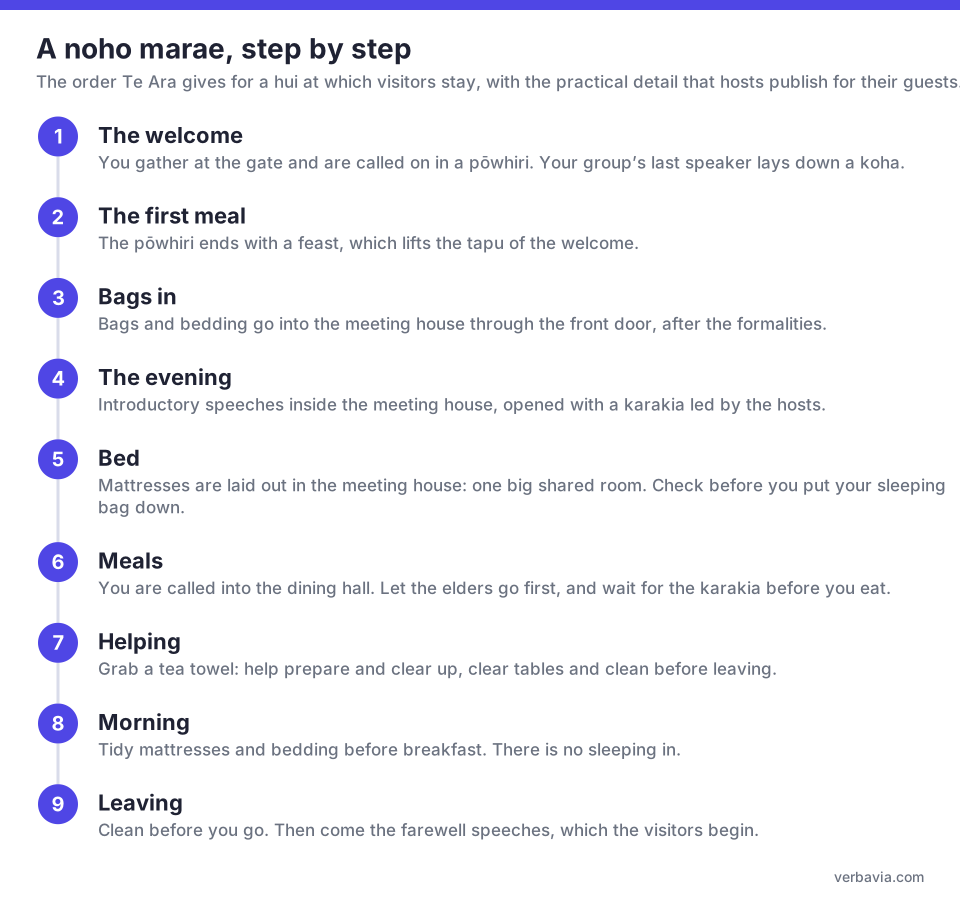
This is the order Te Ara gives for a hui at which visitors stay, with the practical detail that Te Rūnanga o Moeraki and other hosts publish for their guests.
- The welcome. You gather at the gate and are called on in a pōwhiri. Your group usually collects a koha ‘gift, donation’ beforehand, which its last speaker lays down (Te Ara). What happens and what to do is in pōwhiri explained; some groups are welcomed with a shorter mihi whakatau instead, as the University of Canterbury does for its students.
- The first meal. Te Ara says the pōwhiri ends with a hākari ‘feast’, which lifts the tapu ‘restriction, sacredness’ of the welcome.
- Bags in. Moeraki asks that bags and bedding go into the meeting house through the front door after the formalities, not before, and not through the kitchen or dining room.
- The evening. Te Ara says the mihimihi ‘introductory speeches’ begin in the evening inside the meeting house, opened with a karakia ‘prayer, ritual chant’ led by the hosts, and go round from the hosts to the visitors, each person introducing themselves through their ancestry; a pepeha is one way to do it. These speeches are less formal than the ones outside.
- Bed. Mattresses are laid out in the meeting house. Moeraki says they usually go along the walls, that visitors may prefer the mattresses on the right-hand side as you look in from the entrance, and that at big events some go down the middle. Te Ara: check before you put your sleeping bag down, because some places are kept for particular people. Expect to share one big room: the ANZSSA conference told its guests the sleeping was open and unisex, on the floor.
- Meals. You are called into the dining hall. Te Ara says to let the elders go first and to wait for the karakia before you eat.
- Helping. Ngarewa’s advice is to grab a tea towel: the dishes are yours, and the marae kitchen runs like a machine. The Rāpaki hui asked its guests to help prepare and clear up kai, clear tables and help clean before leaving. Moeraki adds a kindness: offering is good manners, but if a large group of hosts is caring for you, they may decline, and you should not be offended.
- Morning. Moeraki asks that mattresses and bedding be tidied before breakfast. Ngarewa’s advice is that there is no sleeping in, and that you will sleep better the second night.
- Leaving. Clean before you go: Ngarewa calls a spotless meeting house and toilet your last gift to your hosts. Then come the poroporoaki ‘farewell speeches’. Te Ara says the visitors begin them, because it would be impolite for the hosts to tell them to leave, and that they generally happen in the meeting house at the end of a meal. Moeraki says a formal welcome usually means a formal farewell. What is said is in poroporoaki.
The rules of a marae stay
These are the rules that published sources give, each with who gives it. Your marae may have others, or may not ask all of these; when the hosts tell you something different, theirs is the rule.
| Where | The rule | Who says so |
|---|---|---|
| The meeting house | Take your shoes off before you go in. | Te Ara; the Rāpaki hui |
| The meeting house | No eating or drinking inside. | Te Ara |
| The meeting house | Do not step over people, or walk on mattresses. | Te Ara; Moeraki |
| The meeting house | Do not sit on pillows. | Te Ara; Moeraki |
| The meeting house | No jumping on mattresses; beds are not chairs during meetings. | Moeraki |
| The meeting house | Keep clothes in your bag or folded on it; nothing drying on the heaters; nothing hung on the walls unless pegs are provided. | Moeraki |
| The meeting house | Change babies’ nappies in the changing room, not in the meeting house. | Moeraki |
| Outside | No food on the marae ātea (the courtyard) or the mahau ‘porch’. | The Rāpaki hui |
| The dining hall | Let elders go first, wait for the karakia, do not pass food over anyone’s head, do not sit on tables. | Te Ara; tables also Moeraki and the Rāpaki hui |
| Everywhere | Ask before taking photographs, filming or recording. | Te Ara; the Ministry of Education advises schools to find out first |
| Everywhere | Keep children supervised; no playing in front of the meeting house during a pōwhiri or a tangi. | Moeraki |
None of these sources gives a reason for most of these rules, and this page does not invent one. Where a reason exists in a source, it is in what does tikanga mean?, and where each building and space is, with a labelled diagram, is in parts of a marae.
Noho marae packing list
Marae differ in what they provide, so the first job for a school, team or workplace is to ask. Most of the lists below say mattresses and pillows are there already: Te Ara says so in general, Moeraki and the Rāpaki hui also provide sheets and pillowcases, Te Hana Te Ao Marama a fitted sheet, pillow and pillowcase, and the University of Canterbury a pillow and a sheet. What every list asks you to bring is your own bedding to sleep under. The Ministry of Education’s advice to teachers planning a noho is to find out the sleeping, washing and eating arrangements beforehand.
| Bring | Listed by |
|---|---|
| Sleeping bag, duvet or blankets | Te Ara, Moeraki, the Rāpaki hui, University of Canterbury, RANZCP, ANZSSA, Te Hana |
| Towel | The Rāpaki hui, RANZCP |
| Toiletries (toothbrush, soap, shampoo, hairbrush, period products) | Moeraki, the Rāpaki hui, University of Canterbury, RANZCP |
| Medication, and a list of it kept just inside your bag | Moeraki, the Rāpaki hui, University of Canterbury |
| Formal clothes to arrive in, for the welcome | Moeraki; ANZSSA asked for long trousers, or a skirt below the knee |
| Changes of clothes for what you will be doing | Moeraki, University of Canterbury |
| A warm jumper, even if the forecast is warm | Moeraki; warm clothes, the Rāpaki hui |
| Pyjamas you are happy to sleep in in a shared room, such as a baggy T-shirt and shorts | Moeraki, the Rāpaki hui |
| Socks or slippers for inside the meeting house | Moeraki, the Rāpaki hui |
| Earplugs (and an eye mask) | Moeraki, the Rāpaki hui, and Ngarewa in The Spinoff |
| Jandals for the communal showers | Moeraki (optional) |
| A pillow of your own, if you want one | Moeraki and the Rāpaki hui (optional; pillows are provided); RANZCP lists a pillow |
| Raincoat and sturdy shoes for anything outdoors | Moeraki |
| A multiplug to share sockets | Moeraki (optional) |
| Your contribution to the koha | The Rāpaki hui asked for a small koha; RANZCP collected $20 a person for the marae |
| Food for a special diet, after checking with the organisers | Moeraki, University of Canterbury |
The koha is the group’s gift to the marae, usually collected before the welcome and given as one. What it is and how it is given is explained in koha.
The te reo for each part of the stay
| Māori | Te Aka’s meaning | When you meet it |
|---|---|---|
| noho | to sit, stay, remain, dwell | the stay itself |
| manuhiri | visitor, guest | you |
| haukāinga | home, local people of a marae, home people | your hosts |
| tangata whenua | local people, hosts | your hosts, in the welcome |
| pōwhiri | welcome ceremony on a marae | arrival |
| koha | gift, present, offering, donation | laid down in the welcome |
| hākari | feast | the meal after the welcome |
| wharenui | meeting house, where guests are accommodated | where you sleep |
| moenga | bed, sleeping place | your mattress |
| mihimihi | speech of greeting; introductory speeches | the evening introductions |
| wharekai | dining hall | every meal |
| kai | food, meal; to eat | every meal |
| karakia | to recite ritual chants, say grace, pray | before meals and speeches |
| ringawera | kitchen worker, kitchen hand | the people feeding you, and you when you help |
| tauera | towel | your packing list |
| wharepaku | toilet | the ablutions block |
| poroporoaki | to take leave of, farewell; leave-taking | the end |
A stay often includes a hāngī, the earth-oven meal explained in what is a hāngī?, and the food words you will hear at the table are in Māori food words. Most of the words on this page, and the grammar to put them together, are in the free te reo Māori course, one lesson a day.
A farewell song you may hear at the end is Pō Atarau (Now Is the Hour).
Learn te reo Māori with Verbavia
Verbavia’s free te reo Māori course starts with the most common words, explains the grammar properly, and plays every example in Papa Reo’s native te reo voice. One lesson a day, from your first word to B1.
Sources
- Te Ara: Basil Keane, Te kawa o te marae – Pōwhiri process (the hākari lifts the tapu; mihimihi in the evening, opened by the hosts’ karakia; poroporoaki begun by the visitors)
- Te Ara: Basil Keane, Te kawa o te marae – Basic marae etiquette (mattresses and pillows provided, bring blankets or a sleeping bag; the meeting house and dining hall rules)
- Te Rūnanga o Moeraki: Overnight stays (beds, bags, rules, what to bring, helping, the poroporoaki)
- Hei Whakapiki Mauri: Marae guidelines and packing list, Wheke marae, Rāpaki, 2019 (PDF)
- Te Hana Te Ao Marama: Accommodation (what the marae provides; bring a sleeping bag or blankets)
- University of Canterbury: Key teacher education information – mihi whakatau and noho marae
- RANZCP: Noho marae (packing list; mattresses and sheets provided; koha)
- ANZSSA: Noho marae, 2019 conference (open unisex sleeping; bring a sleeping bag; dress for the pōwhiri)
- Ministry of Education, NCEA: Visual Arts 1.1, Activity B, teacher resources (planning a noho; photography)
- The Spinoff: Airana Ngarewa, Ten tips for your first noho marae, 29 May 2023
- NAIA: Mark Revington, Embracing noho marae, 15 February 2023
- Te Aka Māori Dictionary: noho
- Te Aka Māori Dictionary: manuhiri
- Te Aka Māori Dictionary: haukāinga
- Te Aka Māori Dictionary: tangata whenua
- Te Aka Māori Dictionary: pōwhiri
- Te Aka Māori Dictionary: koha
- Te Aka Māori Dictionary: hākari
- Te Aka Māori Dictionary: wharenui
- Te Aka Māori Dictionary: moenga
- Te Aka Māori Dictionary: mihimihi
- Te Aka Māori Dictionary: wharekai
- Te Aka Māori Dictionary: kai
- Te Aka Māori Dictionary: karakia
- Te Aka Māori Dictionary: ringawera
- Te Aka Māori Dictionary: tauera
- Te Aka Māori Dictionary: wharepaku
- Te Aka Māori Dictionary: poroporoaki
- Te Aka Māori Dictionary: mahau