Māori house blessing: whakawātea and the dawn ceremony
A Māori house blessing is a ceremony held before dawn to clear a new house or other building of tapu ‘restriction, sacredness’, so that everyone can use it freely. The word for that clearing is whakawātea ‘to clear, free; the removal of tapu’, and the formal opening of a new building has its own name, kawanga whare ‘house-opening ceremony’. An expert, a tohunga ‘priest, expert’, or an elder, a kaumātua ‘elder’, leads it with karakia; the people follow them in. This guide explains what the blessing is for, why it happens in the dark, the order Te Aka Māori Dictionary records, and what to do if you are invited. It does not print the karakia: those belong to the people who lead them.
Tap 🔊 to hear an example. Māori examples play Papa Reo, the te reo Māori voice made by Te Hiku Media from recordings of native speakers. Every sentence in the free course is spoken like this.
On this page
What a Māori blessing of a building is for
Te Aka Māori Dictionary explains the reason in its entry for kawanga whare. A new house is built from the timber of the forests of the atua Tāne-mahuta, and a meeting house carries carved figures of ancestors, so there is tapu on it; that tapu has to be lifted so that the building can be used by everybody. Te Ara, the Encyclopedia of New Zealand, adds that a building site was itself treated as a tapu space.
Te Ara defines noa ‘ordinary, free from tapu’ as ordinary, common, free from the restrictions of tapu, and says ceremonies were often carried out to remove tapu from people and things so that people could act without restriction. That is the work of a blessing, and te reo has several words for it:
| Māori | Te Aka’s meaning |
|---|---|
| whakawātea | to clear, free, get rid of; as a noun, clearing, freeing, removal. Te Aka’s example is the removal of tapu from a marae. |
| whakanoa | to remove tapu: to free things that have the extensions of tapu (it does not affect intrinsic tapu) |
| kawanga whare | house-opening ceremony: the formal pre-dawn ceremony to open a new building, especially a meeting house |
| kawa | a ceremony to remove tapu from a new house or canoe; to open a new house |
| tā i te kawa | to strike with a branch of kawakawa, perform the kawa ceremony, when dedicating a new building or canoe |
Te Aka also uses whakawātea for the exit item of a kapa haka bracket, the song a group leaves the stage on; that is a different sense, explained in kapa haka. How kawa went on to mean the protocol of a marae is in what does tikanga mean?
Why the blessing is held before dawn
Te Ara’s account of Māori creation traditions, by Te Ahukaramū Charles Royal, gives the reason: carved meeting houses are opened in dawn ceremonies because the house represents the world created when Ranginui and Papatūānuku were separated, and the arrival of the sun at dawn symbolises the creation of the world of light. Te Ara’s account of marae protocol explains the same picture from inside: the floor of the meeting house represents Papatūānuku, the roof Ranginui, and the building Tāne, who separated them. Te Aka calls the kawanga whare a formal pre-dawn ceremony. The story of the separation is told in Māori gods, and how a house stands for an ancestor in parts of a marae.
The same timing is used for new buildings that are not meeting houses. The University of Auckland opened a renovated 1910 cottage for its Centre for Co-Created Ageing Research with a dawn blessing ceremony on 4 November 2026. Te Papa opened its marae, Rongomaraeroa, in November 1997, three months before the rest of the museum, and says this was an important tikanga step in preparing and opening the wider building; its Māori co-leader Arapata Hakiwai recalls the tohunga reciting karakia at the marae’s ritual opening.
Who leads a house blessing
Traditionally, a tohunga. Te Aka defines the word as a skilled person, chosen expert, priest or healer, and Te Ara says that among the work of tohunga was lifting the tapu on newly built houses and canoes. Te Ara’s history of kaumātua ‘elders’ records that since the mid-1980s many public institutions have called on kaumātua to perform karakia, blessings and welcomes, and that some people question the cultural integrity of such performances where they look tokenistic. Where the ceremony is for a home after a death, Te Ara says it may be a minister or a tohunga.
Women have a part too. Te Ara says that ruahine ‘elderly women’ and puhi, whom it describes as young virgins, had a role in removing tapu from canoes and buildings, and Te Aka defines ruahine in this sense as a woman of importance used in ceremonies for the removal of tapu, for example at house openings, normally the eldest woman of a family of rank. Their part comes at the threshold, described below.
What happens at a kawanga whare
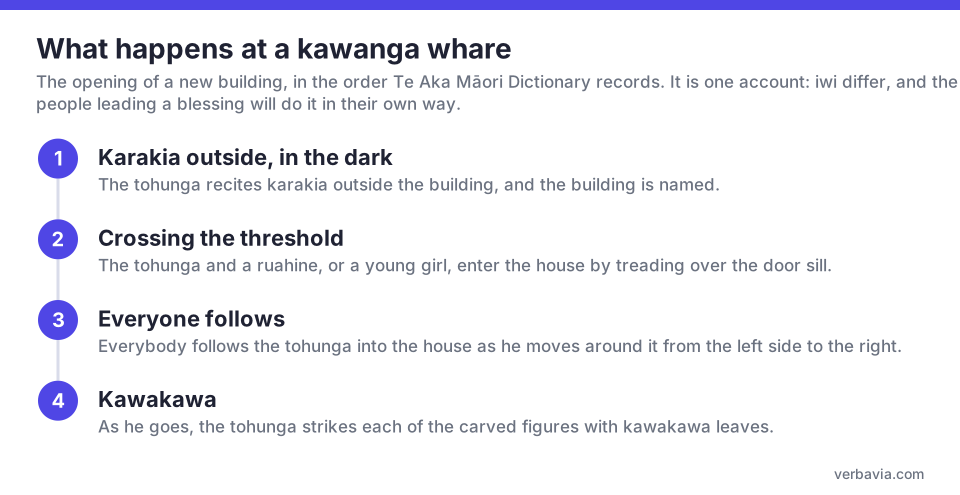
This is the order Te Aka Māori Dictionary records for the opening of a new building, especially a carved meeting house. It is one account: iwi differ, and the people leading a blessing for a home or an office will do it in their own way.
- Karakia outside, in the dark. The tohunga recites karakia outside the building, and the building is named. Te Aka says three karakia are used: the first about Rātā, an early ancestor who carved and built canoes, and the birds of the forest, who have to be appeased; the second to lift the tapu from the building and from the tools used to build it; the third an appeal to the atua to make the house stable and firm, to avert accidents and to make it a pleasant place to live.
- Crossing the threshold. The tohunga and a ruahine, or a young girl, enter the house by treading over the door sill, which Te Aka calls takahi i te paepae tapu ‘treading over the sacred threshold’. Traditionally they carried a cooked kūmara as well.
- Everyone follows. Everybody follows the tohunga into the house as he moves around it from the left side (facing out) to the right.
- Kawakawa. As he goes, the tohunga strikes each of the carved figures with kawakawa ‘pepper tree’ leaves. Te Aka says kawakawa is used for ceremonies including removing tapu, and Te Ara that it is used in the opening of houses; striking with a branch of it is what tā i te kawa means.
Food has a place in lifting tapu. Te Ara explains that food is noa, and that the feast at the end of a pōwhiri is what lifts its tapu. Te Aka does not say why the kūmara is carried across the threshold, and this guide does not guess.
Clearing a home after a death: takahi whare
A different ceremony clears a house that someone has died in or lived in. Te Aka defines takahi whare ‘tramping the house’ as the ceremony performed after a burial to clear the house of the spirit of the deceased and of the tapu on the house and possessions: a tohunga or a religious leader recites karakia and sprinkles water while walking through the rooms. Te Ara places it straight after the burial, and lists water among the old ways of lifting tapu from people. What follows a year later is in hura kōhatu, and words for the family in condolences in Māori.
If you are invited: what guests do
- Be there before it starts. A dawn ceremony begins in the dark, and the karakia outside come first, before anyone goes in.
- Follow. Te Aka’s account has one instruction for everyone who is not leading: follow the tohunga into the house.
- Ask about photographs first. Te Ara notes that some marae do not allow photographs, filming or recording without permission; ask the people leading the blessing the same question.
- Ask what the hosts expect. Te Ara’s advice for any marae occasion is to ask the local people, and the same holds here, because practice differs between iwi.
Opening and closing a meeting with karakia, and the karakia that workplaces use, is in karakia for meetings; the words for the rooms of the house you have just blessed are in Māori words around the house. Most of the words on this page are in the free te reo Māori course, one lesson a day.
The words of one well-known prayer are in the Lord’s Prayer in Māori.
Learn te reo Māori with Verbavia
Verbavia’s free te reo Māori course starts with the most common words, explains the grammar properly, and plays every example in Papa Reo’s native te reo voice. One lesson a day, from your first word to B1.
Sources
- Te Aka Māori Dictionary: kawanga whare (house-opening ceremony)
- Te Aka Māori Dictionary: whakawātea
- Te Aka Māori Dictionary: whakanoa
- Te Aka Māori Dictionary: kawa (ceremony to remove tapu from a new house or canoe)
- Te Aka Māori Dictionary: tā i te kawa
- Te Aka Māori Dictionary: takahi whare
- Te Aka Māori Dictionary: tapu
- Te Aka Māori Dictionary: noa
- Te Aka Māori Dictionary: tohunga
- Te Aka Māori Dictionary: kaumātua
- Te Aka Māori Dictionary: ruahine
- Te Aka Māori Dictionary: kawakawa
- Te Ara: Te Ahukaramū Charles Royal, Māori creation traditions – Creation and the Māori world view (the dawn of creation)
- Te Ara: Basil Keane, Traditional Māori religion – ngā karakia a te Māori – Tohunga
- Te Ara: Basil Keane, Traditional Māori religion – ngā karakia a te Māori – Spiritual concepts (tapu and noa)
- Te Ara: Basil Keane, Traditional Māori religion – ngā karakia a te Māori – Rituals and ceremonies (tā i te kawa, whakanoa, water)
- Te Ara: Basil Keane, Te kawa o te marae – Kawa of the marae (tā i te kawa)
- Te Ara: Basil Keane, Te kawa o te marae – Pōwhiri process (the hākari lifts the tapu)
- Te Ara: Basil Keane, Te kawa o te marae – Basic marae etiquette (ask the local people; photographs)
- Te Ara: Basil Keane, Māori feasts and ceremonial eating – hākari – Food in Māori tradition (food is noa)
- Te Ara: Rawinia Higgins, Tangihanga – death customs – Understanding tangihanga (takahi whare)
- Te Ara: Rawinia Higgins, Tangihanga – death customs – The tangihanga process (kawakawa in the opening of houses)
- Te Ara: Rawinia Higgins and Paul Meredith, Kaumātua – Māori elders – Kaumātua in modern times
- Te Ara: Basil Keane, Te kawa o te marae – Mythology and history of marae protocol (floor, roof and Tāne whakapiripiri)
- Te Ara: Deidre Brown, Māori architecture – whare Māori – Revival of the whare whakairo (building sites as tapu spaces)
- Te Papa: Reflections on Rongomaraeroa, Te Papa’s marae, from Arapata Hakiwai
- University of Auckland: Cottage offers showcase of dementia-friendly design (dawn blessing, 4 November 2026)