What is a mihi whakatau? What happens and what to do
What is a mihi whakatau? It is a Māori welcome made with speeches, usually held somewhere other than a marae: an office, a school hall, a lecture theatre, the opening of a conference. Te Aka Māori Dictionary defines mihi whakatau ‘official welcome speech’ as a speech of greeting, acknowledging those present at a gathering, and explains that where formal speeches of welcome in Māori are made off a marae and outside the meeting house, this is the term used. New Zealand workplaces, universities and schools hold one to welcome new staff, students and guests. This guide sets out how it differs from a pōwhiri, the order of events, what you will be expected to do at your first one, and what to say if you are the one being welcomed.
Tap 🔊 to hear an example. Māori examples play Papa Reo, the te reo Māori voice made by Te Hiku Media from recordings of native speakers. Every sentence in the free course is spoken like this.
On this page
- What is a mihi whakatau?
- Mihi whakatau or pōwhiri: what is the difference?
- The order of events at a mihi whakatau
- Who speaks, and in which language
- Your first mihi whakatau: what you will be expected to do
- What to say when you are the one being welcomed at work
- Is there a koha at a mihi whakatau?
- The words of a mihi whakatau, in one place
- Quick questions
What is a mihi whakatau?
The two words explain the event. Mihi, in Te Aka, is to greet, pay tribute, acknowledge or thank. Whakatau has several meanings, among them to decide or settle, and the one used here: to welcome officially, to welcome formally. A mihi whakatau is therefore the formal greeting a host side gives to people arriving, and it is made up of speeches, each followed by a song, a greeting in person and shared food.
Massey University calls it a general welcome in Māori and says it is less formal than a pōwhiri ‘welcome ceremony’. Massey’s cultural guidelines handbook adds that although the welcome is traditionally held on a marae, at Massey it is frequently used in the workplace to welcome new staff and important guests. The University of Otago describes it in the same terms: a speech or speeches of greeting made during an official welcome, reserved for a welcome conducted off the marae, for example to open an event or conference at the university.
Mihi whakatau or pōwhiri: what is the difference?
A pōwhiri is the full ritual of encounter on a marae, with a woman’s call, sometimes a challenge, speeches, songs, a gift and a meal; each step is explained in pōwhiri explained. A mihi whakatau keeps the speeches, the songs, the greeting and the food, and usually drops the rest. The sources compare them like this:
| Pōwhiri | Mihi whakatau | |
|---|---|---|
| Where | On a marae, and for some tribes only there (Te Aka, Otago). | Usually off the marae: a workplace, a campus, a conference (Te Aka, Otago, Massey). |
| Who is welcomed | Visitors to the marae; Te Ara adds that the pōwhiri process is now also used for a new employee. | New staff and important guests (Massey), or the guests at an event or conference (Otago). |
| The karanga ‘ceremonial call’ | Usually opens it: a woman of the hosts calls and a woman of the visitors answers (Te Ara, Otago). | Generally none; everyone is gathered together and it starts with a speech (Massey). |
| The wero ‘challenge at a pōwhiri’ | Only for esteemed or prestigious guests (Otago). | Not part of any mihi whakatau described in the sources. |
| A reply from the visitors | Expected: both sides make speeches. | Not required, unless someone in the visiting group can respond appropriately (Massey). |
| Formality | The most formal welcome. | Less formal, with fewer protocols observed (Massey; Tipene-Matua and others, 2009). |
| The gift | The visitors lay down a koha. | In the workplace guidance, the koha is the organisation’s, to the kaumātua or experts who lead it (Auditor-General, University of Auckland). |
| What both keep | Speeches, each followed by a song; the harirū and hongi; a karakia and food to complete it (Massey). | The same (Massey). |
The line is not sharp, and the sources say so. A 2009 research paper by Bevan Tipene-Matua and colleagues describes a whakatau as less formal and often conducted away from a marae, then notes Hirini Moko Mead’s observation that many pōwhiri are themselves low-key and friendly occasions, and concludes that the line between pōwhiri and whakatau is “somewhat blurred”. Te Ara, for its part, says that in recent years the pōwhiri process has also been used to welcome a new employee to a workplace, so some organisations call their welcome a pōwhiri even when it is not on a marae.
Which word a place uses can be a matter of agreement with the local people. Otago says there is an understanding between the university and the three local Papatipu Rūnanga that a welcome for guests off the marae will be a mihi whakatau, and that in the South the pōwhiri remains the ritual of encounter kept for the marae only. Elsewhere practice differs again: Victoria University of Wellington’s marae lists the mihi whakatau among the formal rituals held on that marae. If you are not sure which you are going to, the invitation or the organiser will tell you.
The order of events at a mihi whakatau
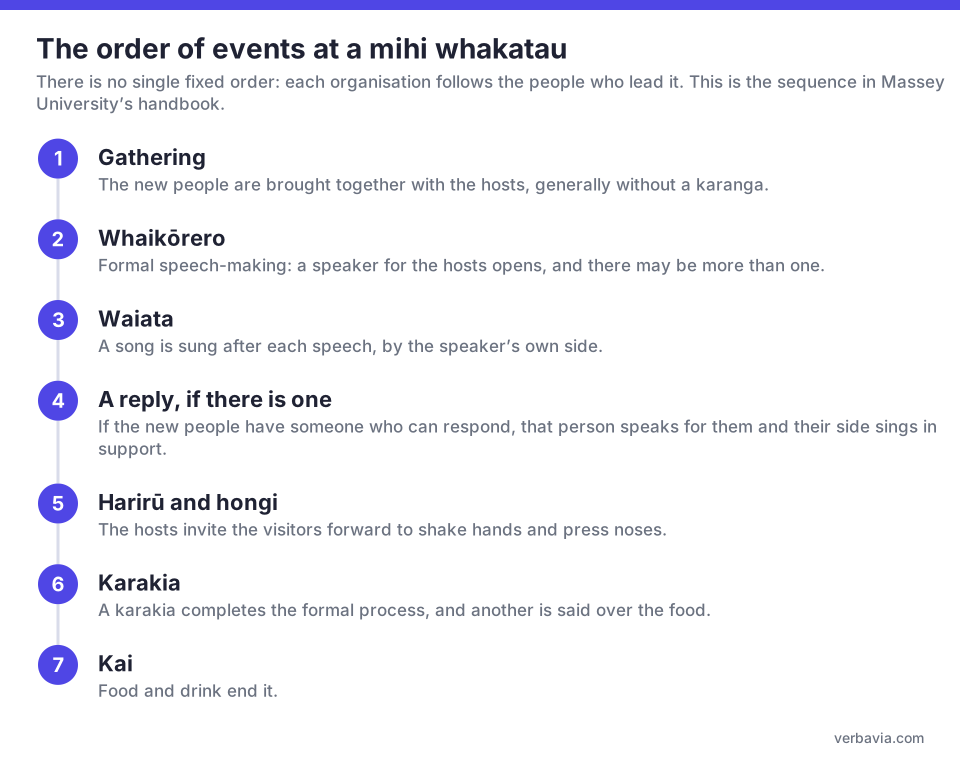
There is no single fixed order, because each organisation follows the guidance of the people who lead it. This is the sequence Massey’s handbook gives for the stages of a welcome, without the call that a mihi whakatau usually leaves out, and with the koha left to its own section below:
- Gathering. The manuhiri ‘visitors, guests’, here the new people, are brought together with the tangata whenua ‘local people, hosts’, the people already there. Massey says a mihi whakatau generally gathers everyone together without a karanga.
- Whaikōrero ‘formal speech-making’. A speaker for the hosts opens with a formal speech, and there may be more than one. Massey’s handbook says the speeches link the ancestors to the people present, draw out the genealogical links between hosts and visitors, and set out the purpose of the occasion.
- Waiata ‘song’. A song is sung after each speech by the speaker’s own side. Massey and Otago both stress that the quality and intent of the song matter, because it upholds the mana of the group singing it.
- A reply, if there is one. If the new people have someone who can respond appropriately, that person speaks for them and their side sings in support (Massey).
- Harirū ‘handshake’ and hongi ‘pressing noses’. The hosts invite the visitors forward to shake hands and press noses, which Massey says signifies the unification of hosts and visitors.
- Karakia ‘prayer, incantation’. Massey says a karakia is used to complete the formal process of a pōwhiri or mihi whakatau, and another is said over the food.
- Kai. Food and drink end it. Massey calls the hākari ‘feast’ the feast that completes the procedure, removing the restrictions of the ceremony. Otago, describing its own pōwhiri, says it is kai and a cup of tea, and that the visitors are fed first.
Some workplaces follow the welcome with mihimihi ‘introductory speeches’, in which everyone present introduces themselves. Massey describes this as whakawhanaungatanga ‘process of establishing relationships’, establishing links with each other, and it is the place for a pepeha: see how to write a pepeha.
Who speaks, and in which language
The speeches are made by kaikōrero ‘speakers’ chosen beforehand, usually men, as Massey’s handbook puts it. Te Aka’s definition is of speeches of welcome in Māori, and some places keep to that strictly: Victoria University of Wellington’s marae permits only te reo Māori in its formal rituals, the mihi whakatau included. Others add English. At AUT’s pōwhiri the speeches start in te reo Māori and are followed by speeches in English, and AUT says the Māori speeches are not translated, because they preserve the sacredness of tikanga and Māori knowledge. So do not expect a translation, and do not worry if you understand little of the first speech: you are not expected to.
An organisation does not usually run its welcome alone. Massey’s handbook speaks of acknowledging the mana whenua ‘people with authority over the land’, the tribal group of the region, and both the Office of the Auditor-General’s guide for public organisations and the University of Auckland’s koha policy name support from kaumātua or other experts for a pōwhiri or mihi whakatau as an occasion when an organisation gives a koha.
Your first mihi whakatau: what you will be expected to do
If you are the one being welcomed, very little is asked of you. Drawn from Massey, Otago and the LIANZA guide to tikanga Māori:
- Arrive on time and wait with the other new people. LIANZA’s guide says that whether an event is held on a marae or in a function centre, the space is treated like a marae once Māori protocol is being followed. If you arrive while someone is speaking, wait and come in quietly when they have finished.
- Phone off, and listen. LIANZA asks for phones to be switched off, and its rule of thumb is to follow the actions of more knowledgeable participants: stand when they stand, sit when they sit.
- You will not have to make the formal reply. Massey says the visitors do not need to respond unless someone in the group can respond appropriately, and Te Ara says a visiting group chooses its speakers beforehand. If there is a round of introductions afterwards, Massey’s advice is to start with a simple mihimihi and add to it as your language grows.
- Sing with your side. When your speaker sits down, stand and join the song. Songs that suit, and why workplaces adopt songs of their own, are in waiata tautoko.
- Harirū and hongi. When invited, walk along the line of hosts. LIANZA describes the hongi: grasp the other person’s hand as for a handshake, lean in and gently press noses and foreheads together. It adds that a hongi is often followed by a handshake, that some people also kiss women on the cheek, and that on some marae the hongi comes before the speeches rather than after. Follow the person in front of you.
- Stay for the food. The kai is part of the welcome, not an extra: Massey and Otago both describe it as what completes the process.
If you are on the host side instead, your part is to sing after your own speaker and to greet the new people in the line. The karakia many workplaces use to open and close a meeting are in karakia for meetings, and the rest of the vocabulary of a hui is in Māori words at work.
What to say when you are the one being welcomed at work
During the welcome itself, usually nothing: the formal reply, if there is one, comes from someone in your group who can respond appropriately (Massey). Where you may be asked to speak is the round of mihimihi that some workplaces hold straight afterwards. Massey’s advice is to start with a simple mihimihi and add to it as your language grows, choosing lines from the examples it gives. A short one, using only Massey’s lines:
| Māori | English | Where it goes |
|---|---|---|
| Tēnā koutou katoa. | Greetings to you all. | The opening |
| Ki a tātou e tau nei, kia ora. | To all of us gathered here, greetings. | To everyone present |
| Ko … ahau. | I am … (your name). | Your introduction |
| Tēnā koutou, tēnā koutou, tēnā tātou katoa. | Greetings, greetings, greetings to us all. | The close |
Massey’s fuller mihimihi also farewells those who have died and greets the local iwi, and its introduction can name your waka, mountain, river and marae. Whether and how someone who is not Māori says those lines is set out in how to write a pepeha. As you go along the line for the harirū and hongi, kia ora is enough: Te Aka notes that it can mean hello and thank you, to any number of people. Other ways to say hello are in Māori greetings, and the openings and closings for the emails of your first week are in Māori email sign-offs.
Is there a koha at a mihi whakatau?
Sometimes. At a pōwhiri the visitors lay down a gift, and Massey’s handbook lists the koha among the stages of a pōwhiri or mihi whakatau. In the workplace guidance found for this page, though, the koha that comes up is the organisation’s gift to the kaumātua or experts who lead the welcome, not something a new employee brings. If you are unsure, ask the organiser. What a koha is, how it is given and how the amount is decided are explained in koha: meaning, how to give it, and how much koha to give.
The words of a mihi whakatau, in one place
| Māori | Te Aka’s meaning |
|---|---|
| mihi whakatau | speech of greeting, official welcome speech |
| whakatau | to welcome officially, welcome formally; also to decide, settle |
| mihi | to greet, pay tribute, acknowledge, thank |
| manuhiri | visitor, guest |
| tangata whenua | local people, hosts |
| whaikōrero | to make a formal speech; formal speech-making |
| kaikōrero | speaker |
| waiata | song, chant |
| harirū | to shake hands; handshake |
| hongi | to press noses in greeting |
| karakia | to recite ritual chants, say grace, pray |
| mihimihi | to greet, pay tribute; the speeches of introduction |
| whakawhanaungatanga | process of establishing relationships |
The farewell at the other end of someone’s time in a workplace is covered in poroporoaki. Most of the words above, and the grammar to use them, are taught in our own free te reo Māori course, one lesson a day.
Learn te reo Māori with Verbavia
Verbavia’s free te reo Māori course starts with the most common words, explains the grammar properly, and plays every example in Papa Reo’s native te reo voice. One lesson a day, from your first word to B1.
Quick questions
What is the difference between a mihi whakatau and a pōwhiri?
A pōwhiri is the full welcome on a marae, usually opened by a karanga; a mihi whakatau is a less formal welcome of speeches, usually off the marae, with generally no karanga and no reply required from the visitors.
What do I say at my mihi whakatau at work?
Nothing formal during the speeches. If there is a round of introductions afterwards, a short mihimihi such as Tēnā koutou katoa followed by Ko … ahau is a good start.
Do I need to bring a koha to a mihi whakatau?
No source found says a new employee should; the koha in workplace guidance is the organisation’s, to the people who lead the welcome. Ask the organiser if unsure.
Is there a karanga at a mihi whakatau?
Generally not: Massey says everyone is gathered together without a karanga and the welcome starts with a speech.
Sources
- Te Aka Māori Dictionary: mihi whakatau
- Te Aka Māori Dictionary: whakatau (to welcome officially; to decide, settle)
- Te Aka Māori Dictionary: mihi
- Te Aka Māori Dictionary: mihimihi
- Te Aka Māori Dictionary: whaikōrero
- Te Aka Māori Dictionary: kaikōrero
- Te Aka Māori Dictionary: karanga
- Te Aka Māori Dictionary: wero
- Te Aka Māori Dictionary: manuhiri
- Te Aka Māori Dictionary: tangata whenua
- Te Aka Māori Dictionary: mana whenua
- Te Aka Māori Dictionary: waiata
- Te Aka Māori Dictionary: harirū
- Te Aka Māori Dictionary: hongi
- Te Aka Māori Dictionary: karakia
- Te Aka Māori Dictionary: hākari
- Te Aka Māori Dictionary: whakawhanaungatanga
- Te Aka Māori Dictionary: pōwhiri
- Te Aka Māori Dictionary: kia ora (hello; thank you; to any number of people)
- Massey University: Mihi whakatau and mihimihi
- Massey University: Māori Cultural Guidelines Handbook for Pōwhiri and Mihi Whakatau (PDF)
- University of Otago: Mihi Whakatau
- University of Otago: Pōwhiri
- Victoria University of Wellington: Tikanga (Te Herenga Waka Marae)
- AUT: Pōwhiri, a traditional Māori welcome ceremony
- Te Ara: Basil Keane, Te kawa o te marae – Pōwhiri process
- LIANZA Council Guide to Tikanga Māori (Te Rōpū Whakahau, revised 2013, PDF)
- Tipene-Matua, Phillips, Cram, Parsons and Taupo (2009): Old ways of having new conversations: basing qualitative research within tikanga Māori (PDF)
- Office of the Auditor-General: Controlling sensitive expenditure, Part 9 (koha)
- University of Auckland: Koha Policy