Health words in Māori: hospital, doctor, nurse
Health words in Māori start with four that any visit to a clinic needs: hospital in Māori is hōhipera, a doctor is a tākuta, a nurse is a tapuhi, and sick is māuiui. Medicine is rongoā, a word that also names traditional Māori healing. Below are those words and the others for the doctor, the chemist and the hospital, the words for common symptoms such as fever, cough and headache, and short sentences for saying you are unwell. Every word is spelt as Te Aka Māori Dictionary spells it, and every sentence is one the course teaches. This page is about the language; it gives no medical advice.
Tap 🔊 to hear an example. Māori examples play Papa Reo, the te reo Māori voice made by Te Hiku Media from recordings of native speakers. Every sentence in the free course is spoken like this.
On this page
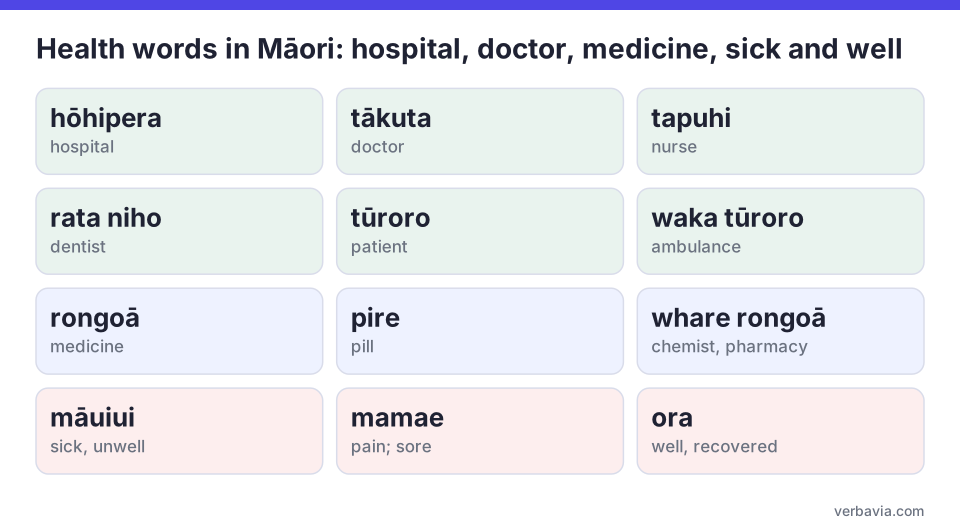
Hospital, doctor and nurse in Māori
The first column is the word most people use; the second gives the other words Te Aka lists for the same thing.
| English | Māori | Also (Te Aka) | Say it |
|---|---|---|---|
| hospital | hōhipera | hōhipere, ōhipera | HAW-hee-peh-rah |
| doctor | tākuta | rata | TAA-koo-tah |
| nurse | tapuhi | nēhi, nāhi | tah-poo-hee |
| dentist | rata niho | rah-tah nee-haw | |
| surgeon | tākuta poka | TAA-koo-tah paw-kah | |
| clinic | whare haumanu | fah-reh how-mah-noo | |
| patient, sick person | tūroro | TOO-raw-raw | |
| ambulance | waka tūroro | waka harihari tūroro | wah-kah TOO-raw-raw |
| emergency | ohotata | aw-haw-tah-tah | |
| hospital ward | mātūtū | MAA-TOO-TOO | |
| medicine | rongoā | raw-ngaw-AA | |
| pill, tablet | pire | pee-reh | |
| chemist, pharmacy | whare rongoā | toa rongoā | fah-reh raw-ngaw-AA |
| prescription | whakahau rongoā | fah-kah-hoe raw-ngaw-AA | |
| vaccine, vaccination | rongoā āraimate | raw-ngaw-AA AA-rye-mah-teh | |
| antibiotic | rongoā paturopi | raw-ngaw-AA pah-too-raw-pee | |
| injection | wero | weh-raw | |
| health | hauora | how-aw-rah |
Wh is said close to an English f, ng is the sound in the middle of singer, and a vowel with a macron is held about twice as long; the sounds are set out in the Māori pronunciation guide.
Which words are borrowed
Hōhipera and tākuta are loanwords, which Te Aka marks “(loan)”: hospital and doctor reshaped to Māori sounds, so that s becomes h and d becomes t. Te Aka also records two other spellings of the hospital word, hōhipere, with an example from 1857, and ōhipera, with one from 1877. Nēhi and nāhi are loans from nurse. How English words were rebuilt this way is in English words in Māori.
Tapuhi is not a loan. Its first sense in Te Aka is a verb, “to nurse, carry in the arms, tend in sickness or distress”, and as a noun it means both a nurse and a midwife. Rata is Te Aka’s other word for a doctor, and it points from there to tākuta; the same spelling is also an everyday word for friendly or tame, so the doctor sense is clearest in a compound such as rata niho ‘dentist’, literally a tooth doctor. As a title, Te Aka gives Tākuta in front of a name, the way English writes Doctor.
Tūroro is both the patient and, as a verb, being ill, and it sits inside several hospital words: waka tūroro, the ambulance, is a vehicle for the sick, and Te Aka lists tūroro noho hōhipera ‘inpatient’ and tūroro noho kāinga ‘outpatient’, a patient who stays in the hospital and one who stays at home. Mātūtū has two entries: a hospital ward, and, as a verb, to convalesce or recover from an illness.
Sick, hurt and better
| English | Māori | Also (Te Aka) | Say it |
|---|---|---|---|
| sick, unwell, weary | māuiui | mate, tūroro | MAA-oo-ee-oo-ee |
| illness | māuiui | MAA-oo-ee-oo-ee | |
| pain, ache; sore, hurting | mamae | mah-my | |
| injured; an injury | whara | fah-rah | |
| symptom | tohu māuiui | taw-hoo MAA-oo-ee-oo-ee | |
| to rest | okioki | aw-kee-aw-kee | |
| to cure, heal, restore to health | whakaora | fah-kah-aw-rah | |
| well, recovered | ora | aw-rah |
Mate needs care. Te Aka’s senses run from “be dead” and “be sick, ill” to “be overcome, defeated” and “be extinguished”, as a fire is, and which one is meant comes from the sentence. That is why the course teaches māuiui for “I’m unwell” and keeps mate for the question a doctor asks, He aha te mate? ‘What’s wrong?’. Te Aka’s own example for tohu māuiui is a doctor’s question: Kāore e kore ka pātaihia koe e te rata he aha ngā tohu māuiui o tō mate. “No doubt you will be questioned by the doctor as to what the symptoms of your illness are.” What to say when someone has died is a separate subject, in condolences in Māori.
Ora, well, is the word in the greeting kia ora (see Māori greetings), and it is the root of whakaora, to heal, and of hauora, health.
Symptoms: fever, cough, headache
| English | Māori | Also (Te Aka) | Say it |
|---|---|---|---|
| fever; feverish | kirikā | pīwa | kee-ree-KAA |
| cough; to cough | maremare | mare, wharo | mah-reh-mah-reh |
| headache | ngāhoahoa | kotiuru; ānini te māhunga | NGAA-haw-ah-haw-ah |
| stomach ache | ngaupuku | ngow-poo-koo | |
| to vomit; vomiting | ruaki | roo-ah-kee | |
| to feel nauseous; nausea | paipairuaki | pie-pie-roo-ah-kee | |
| diarrhoea | tikotiko | kohī | tee-kaw-tee-kaw |
| influenza, flu | rewharewha | reh-fah-reh-fah | |
| to sneeze; a sneeze | tihe | tee-heh | |
| toothache | niho tunga | nee-haw too-ngah | |
| throat | korokoro | kaw-raw-kaw-raw |
Several of these come together in one example Te Aka quotes, dated 1925, listing the signs of an illness: te ngāhoahoa o te māhunga, te ruaki, te kirikā me te ngaupuku, “a headache, vomiting, fever and stomach-ache”. Ngaupuku contains ngau ‘to bite’ and puku ‘stomach’, the same two words as the body-parts phrase Kua ngau taku puku. ‘I have a stomach ache.’ Ānini te māhunga is the head, māhunga, aching; Te Aka notes that ānini by itself means dizzy or aching, and is said of the head only. Pīwa is a loan from fever, and paipairuaki contains ruaki, to vomit.
Te Aka’s entry for a sore throat, katirehe, is a particular one: quinsy, an abscess beside the tonsil. The course says it with the throat and mamae, as in the next section. The rest of the body, from upoko ‘head’ to waewae ‘leg, foot’, is in Māori body parts.
How do you say I’m sick in Māori? Sentences for the doctor
These are the sentences Verbavia’s course teaches for a visit to the doctor or the chemist. Two of them change a single word in a course sentence, and the note says which.
| Māori | English |
|---|---|
| Kei te māuiui au. | I’m unwell. I’m sick. |
| He aha te mate? | What’s wrong? What’s the matter? |
| Kei te mamae taku upoko. | My head hurts. |
| Kei te mamae taku korokoro. | My throat hurts. |
| Kua maremare au, ā, kua kirikā hoki au. | I have a cough, and a fever too. |
| Kei te mamae taku upoko mai i inanahi. | My head has been hurting since yesterday. |
| Kei hea te hōhipera? | Where is the hospital? |
| Me haere koe ki te tākuta. | You should go to the doctor. |
| Me haere au ki te tākuta. | I should go to the doctor. I need to see a doctor. |
| Ka taea e koe te āwhina i a au? | Can you help me? |
| Kei te mahi au i te hōhipera. | I work at the hospital. |
Kei hea te hōhipera? is the course’s Kei hea te whare pukapuka? ‘Where’s the library?’ with hōhipera in place of the library. Me haere au ki te tākuta. is the course’s advice turned on yourself: me before a verb means should, and the course uses it with au in me okioki au ‘I should rest’. It is the natural way to say you need a doctor; Te Aka glosses hiahia as both “want” and “need”, but the course does not build that sentence with it, so this page does not either.
In Kei te mamae taku upoko the body part is the subject: the head is what is hurting. Kei te marks a state that is true now, and kua in kua maremare au marks one that has set in. Saying that other parts hurt, and why body parts take tōku and ōku, is covered on the body-parts page. The everyday questions around these, from how are you to thank you, are in common Māori phrases.
At the chemist
| Māori | English |
|---|---|
| He rongoā māu mō te korokoro mamae? | Have you anything for a sore throat? |
| Me pēhea te inu i tēnei? | How do I take this? |
| E hia ngā pire ia rā? | How many pills a day? |
| Kotahi i te ata, kotahi i te pō. | One in the morning, one at night. |
The numbers for a dose, and how to tell the time, are in Māori numbers, days and months.
Getting better
| Māori | English |
|---|---|
| Me okioki koe. | You should rest. |
| Kei te pai ake au. | I’m getting better. |
| Kua ora ia. | He’s better. She’s better. |
| Kia kaha! | Take care! Be strong! |
What kia kaha means, and when it is said, is in what kia kaha means.
An emergency
| Māori | English |
|---|---|
| He ohotata tēnei! | This is an emergency! |
| Kua whara tētahi. | Somebody is hurt. |
The course teaches these alongside New Zealand’s emergency number, 111.
Rongoā: medicine, and Māori healing
Rongoā is the word on a pharmacy shelf and the word for traditional Māori medicine. Te Aka gives it as a verb, “to treat, apply medicines” (and, separately, “to preserve”), and as a noun, “remedy, medicine, drug, cure, medication, treatment, solution (to a problem), tonic”. It lists a separate noun rongoā, “medicinal plant”, and the phrase rongoā māori, “natural remedy, traditional treatment, Māori medicine”.
Te Ara, the Encyclopedia of New Zealand, describes rongoā as traditional Māori medicine, “a system of healing that was passed on orally”, which includes herbal remedies, physical therapies such as massage, and spiritual healing. In 1907 a law, the Tohunga Suppression Act, was passed to stop tohunga, the priestly experts, working; from the later twentieth century, Te Ara says, there was renewed Māori interest in rongoā, and many modern healers work in urban clinics, some alongside mainstream health professionals. Te Aka’s example for rongoā māori is taken from Te Ara: Ka tahuri ētahi ki ngā rongoā Māori hei whakaora i ngā taumahatanga, “Some people have turned to these traditional treatments to heal serious illnesses.”
So the one word covers two different conversations, as the course points out: asking for rongoā at a chemist’s counter is not the same as asking about rongoā māori. The word māori inside that phrase means ordinary or natural, a sense explained in what the word Māori means.
Health, wellbeing and the words beyond the clinic
Hauora, health, is also the name of Manatū Hauora, the Ministry of Health, and the word schools use for wellbeing. How it is built, and the Māori health models that use tinana ‘body’, hinengaro ‘mind’, wairua ‘spirit’ and whānau ‘family’, are in Te Whare Tapa Whā and Māori health models. For a word made for the disability sector rather than the hospital, see takiwātanga, the Māori word for autism, and for how people feel, Māori words for feelings.
Nearly every word in the tables, from hōhipera and tākuta to kirikā and rongoā, is in Verbavia’s free te reo Māori course, where the sentences above are taught in its lessons on the doctor and the chemist. To test yourself on everyday words afterwards, try the te reo Māori quiz.
Te Whatu Ora and Manatū Hauora, the two health agencies, are taken apart word by word in Māori names of NZ government agencies.
Learn te reo Māori with Verbavia
Verbavia’s free te reo Māori course starts with the most common words, explains the grammar properly, and plays every example in Papa Reo’s native te reo voice. One lesson a day, from your first word to B1.
Quick questions
What is hospital in Māori?
Hospital in Māori is hōhipera, a loanword from English. Where is the hospital? is Kei hea te hōhipera?
What are doctor and nurse in Māori?
A doctor is a tākuta, and Te Aka also gives rata. A nurse is a tapuhi, a word that also means a midwife.
How do you say I’m sick in Māori?
Say Kei te māuiui au., I’m unwell. To say where it hurts, use mamae: Kei te mamae taku upoko. is my head hurts.
What does rongoā mean?
Rongoā means medicine, a remedy or a treatment, and it also names traditional Māori healing, which Te Aka lists as rongoā māori.
Sources
- Te Aka Māori Dictionary: hōhipera, hōhipere and ōhipera — (loan) hospital; tūroro noho hōhipera — inpatient.
- Te Aka Māori Dictionary: tākuta — (loan) doctor; to practise medicine; title; tākuta poka — surgeon.
- Te Aka Māori Dictionary: rata — doctor (see also tākuta); also friendly, tame.
- Te Aka Māori Dictionary: tapuhi — to nurse, tend in sickness; nurse, midwife.
- Te Aka Māori Dictionary: nēhi and nāhi — (loan) nurse.
- Te Aka Māori Dictionary: rata niho — dentist.
- Te Aka Māori Dictionary: whare haumanu — clinic.
- Te Aka Māori Dictionary: tūroro — sick person, patient; to be sick; waka tūroro and waka harihari tūroro — ambulance; tūroro noho kāinga — outpatient.
- Te Aka Māori Dictionary: mātūtū — (hospital) ward; to convalesce.
- Te Aka Māori Dictionary: ohotata — emergency.
- Te Aka Māori Dictionary: rongoā — to treat; remedy, medicine; medicinal plant; rongoā māori; whare rongoā; toa rongoā; whakahau rongoā; rongoā āraimate; rongoā paturopi.
- Te Aka Māori Dictionary: pire — (loan) pill, tablet.
- Te Aka Māori Dictionary: wero — among its senses, injection.
- Te Aka Māori Dictionary: māuiui — sick, weary; illness; tohu māuiui — symptom.
- Te Aka Māori Dictionary: mate — be dead; be sick, ill; be overcome; be extinguished.
- Te Aka Māori Dictionary: mamae — painful, sore, hurt; ache, pain.
- Te Aka Māori Dictionary: whara — injured, hurt; injury.
- Te Aka Māori Dictionary: okioki — to rest; whakaora — to restore to health, cure, heal.
- Te Aka Māori Dictionary: kirikā — feverish; fever; pīwa — (loan) fever.
- Te Aka Māori Dictionary: maremare — to cough; cough (synonyms mare, wharo).
- Te Aka Māori Dictionary: ngāhoahoa and kotiuru — headache.
- Te Aka Māori Dictionary: ānini, and ānini [te] māhunga — to have a headache; headache.
- Te Aka Māori Dictionary: ngaupuku — stomach-ache (with the 1925 example listing symptoms).
- Te Aka Māori Dictionary: ruaki — to vomit; paipairuaki — to feel nauseous, nausea.
- Te Aka Māori Dictionary: tikotiko and kohī — diarrhoea.
- Te Aka Māori Dictionary: rewharewha — influenza.
- Te Aka Māori Dictionary: tihe — to sneeze; sneeze.
- Te Aka Māori Dictionary: niho tunga — toothache, decayed tooth.
- Te Aka Māori Dictionary: korokoro — throat; katirehe — sore throat, quinsy.
- Te Aka Māori Dictionary: hiahia — to desire, want, need.
- Jones, R. Rongoā – medicinal use of plants. Te Ara – the Encyclopedia of New Zealand.
- Jones, R. Rongoā – medicinal use of plants: the impact of colonisation (the Tohunga Suppression Act, 1907). Te Ara.
- Jones, R. Rongoā – medicinal use of plants: rongoā today. Te Ara.