Māori names of NZ government agencies and what they mean
The Māori names of government agencies in New Zealand include Oranga Tamariki ‘the wellbeing of children’ (Ministry for Children), Te Whatu Ora ‘the weaving of wellness’ (Health New Zealand), Kāinga Ora (Homes and Communities), Waka Kotahi (NZ Transport Agency), Ara Poutama Aotearoa (Corrections) and Te Tari Taake (Inland Revenue). Most are built from a few plain words, such as manatū ‘ministry’, tari ‘office, department’ and ora ‘life, health’, and a few were gifted with a meaning the agency explains itself. Below are the main agencies grouped by area, each name exactly as the agency or the Public Service Commission prints it, what it means word by word in Te Aka Māori Dictionary, what the agency says where it says anything, and what has changed since the government asked for English names first.
Tap 🔊 to hear an example. Māori examples play Papa Reo, the te reo Māori voice made by Te Hiku Media from recordings of native speakers. Every sentence in the free course is spoken like this.
On this page
- What does Te Whatu Ora mean?
- What does Oranga Tamariki mean?
- What does Kāinga Ora mean?
- What does Waka Kotahi mean?
- Education: Te Tāhuhu o te Mātauranga
- Justice: Corrections, Police and the Ministry of Justice
- Money and work: Te Tari Taake and Hīkina Whakatutuki
- Land, culture and Māori development
- How are the names built? Te Tari, Manatū and Ora
- Why do agencies now use English names first?
- Quick questions
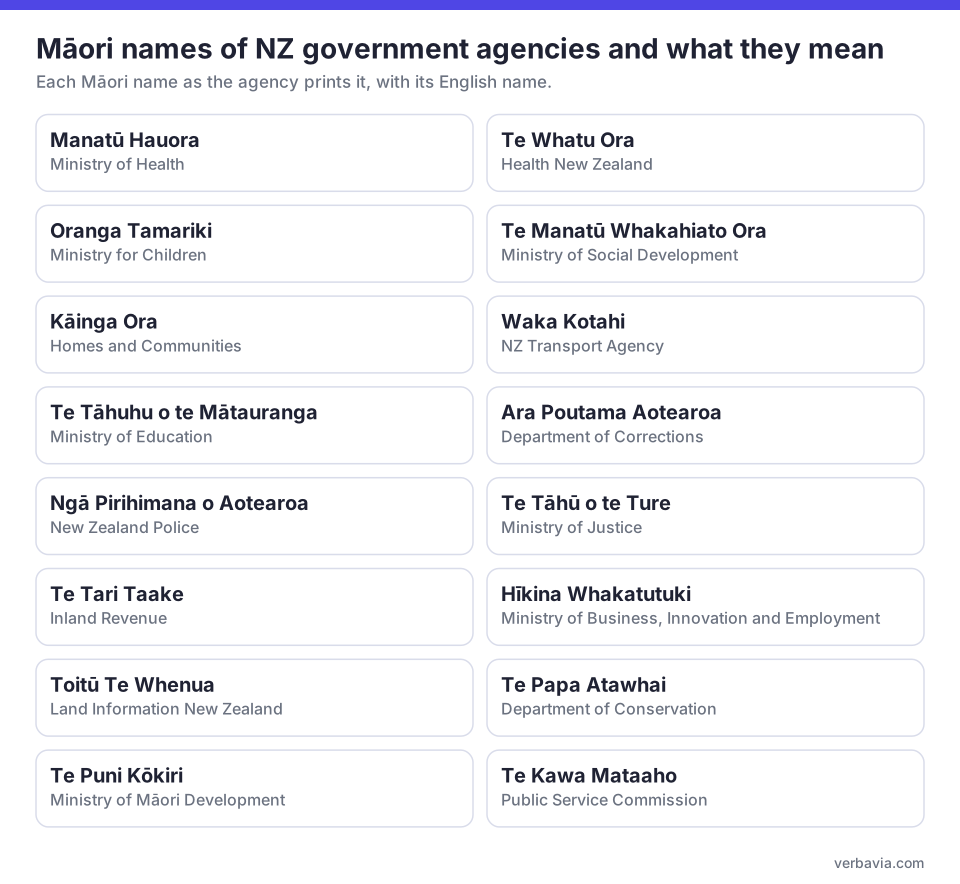
| Agency (English) | Māori name | Word by word |
|---|---|---|
| Ministry of Health | Manatū Hauora | ministry + health |
| Health New Zealand | Te Whatu Ora | the + weaving (or pupil of the eye) + life, health |
| Ministry for Children | Oranga Tamariki | welfare, health, living + children |
| Ministry of Social Development | Te Manatū Whakahiato Ora | the + ministry + to collect together, develop + life, health |
| Homes and Communities | Kāinga Ora | home, settlement + life, health |
| NZ Transport Agency | Waka Kotahi | vehicle, canoe + one, united |
| Ministry of Education | Te Tāhuhu o te Mātauranga | the ridge pole of knowledge |
| Department of Corrections | Ara Poutama Aotearoa | path + stepped pattern + New Zealand |
| New Zealand Police | Ngā Pirihimana o Aotearoa | the police officers of New Zealand |
| Ministry of Justice | Te Tāhū o te Ture | the ridge pole of the law |
| Inland Revenue | Te Tari Taake | the office of tax |
| Ministry of Business, Innovation and Employment | Hīkina Whakatutuki | be lifted + to accomplish, fulfil |
| Land Information New Zealand | Toitū Te Whenua | the land remains |
| Department of Conservation | Te Papa Atawhai | the + papa + caring, kindly |
| Ministry of Māori Development | Te Puni Kōkiri | the + group, company + moving forward, championing |
| Public Service Commission | Te Kawa Mataaho | the + protocol + clear, window |
The meanings in the right-hand column are Te Aka’s glosses for each word, not translations of the whole name; where the agency explains its own name, that explanation is in the sections below and it comes first. Only Te Aka is used for the words, so where the dictionary gives several senses the column shows the ones that fit, and says so where nobody has said which sense is meant.
What does Te Whatu Ora mean?
Te Whatu Ora is the Māori name of Health New Zealand, the national health service set up in 2022 from the twenty district health boards. In a 2023 reply to an Official Information Act request, the agency described its name as “the weaving of wellness”, and explained that whatu “has both a meaning of weaving and is also a direct reference to the pupil of the eye”. It said the name was developed by an expert advisory group initiated by Sir Mason Durie and led by Rahui Papa.
Te Aka backs both halves of whatu: one entry is to weave (garments, baskets), knit and finger-weaving, and a separate entry is eye, pupil of the eye. Ora as a verb is to be alive, well, safe, healthy, and as a noun life, health, vitality. Te Aka has no entry for the whole name. The everyday health vocabulary around it, from hauora to the doctor’s surgery, is in health words in Māori.
Manatū Hauora: the Ministry of Health
The ministry, which sets health policy, is Manatū Hauora: Te Aka gives manatū ‘ministry, authority’ and hauora ‘health, vigour; to be fit, well’. The ministry told an information request in 2023 that its te reo name had been in use since the Department of Health became the Ministry of Health on 1 July 1993. Hauora is also the word behind the best-known Māori model of health, explained in Te Whare Tapa Whā.
What does Oranga Tamariki mean?
Oranga Tamariki is the Ministry for Children. It explains the two words itself: “‘Oranga’ is the wellbeing we want to help the children we work with to have. ‘Tamariki’ reminds us that children are descended from greatness.” Its full name, as it prints it, is Oranga Tamariki—Ministry for Children.
In Te Aka, oranga is a noun, welfare, health, living, livelihood (and also food and survivor), built on ora. Tamariki is children, normally used only in the plural; as a verb it means to be young. Read in order, the name is children’s welfare: in Māori the main word comes first and the word describing it follows, the order set out in Māori sentence structure.
Te Manatū Whakahiato Ora: Social Development
The Ministry of Social Development writes its name “Ministry of Social Development / Te Manatū Whakahiato Ora”. Te Aka lists the whole name as the ministry’s, and glosses whakahiato as to collect together and, in newer use, develop, formulate, aggregate. With ora at the end, that is the ministry for developing wellbeing word by word; the ministry’s site does not explain the name.
What does Kāinga Ora mean?
Kāinga Ora is the social housing agency. Its legal name, in the Act that set it up in 2019, is “Kāinga Ora–Homes and Communities”. Te Aka gives kāinga as home, address, residence, village, settlement, dwelling, and ora as life, health, wellbeing, so word by word the name is home + wellbeing. The everyday word for a house or building, whare, is among the words in Māori words around the house. Te Aka has no entry for the agency’s name, and the explanation here is the dictionary’s, word by word.
What does Waka Kotahi mean?
Waka Kotahi is the NZ Transport Agency. Te Aka lists the name for the agency and glosses the words: waka ‘canoe, vehicle, conveyance’ and kotahi ‘one, single’, which as a verb also means to be united. So the name is one vehicle, or a vehicle shared by all. How waka stretched from the canoe to the car and the bus is in transport in Māori, and the noun-then-describer pattern of the name is one of those in Māori team and business names.
The agency’s legal name has always been New Zealand Transport Agency. In a 2023 reply to an information request it called Waka Kotahi a trading name, and said the name “Waka Kotahi NZ Transport Agency” was trademarked in 2019. Since December 2023 it has called itself NZ Transport Agency Waka Kotahi, English first (see the section on the English-first policy below).
Te Manatū Waka, the Ministry of Transport
Te Aka lists Te Manatū Waka, the ministry of vehicles, as the Ministry of Transport. The government announced on 16 December 2025 that the ministry would be merged with the Ministry for the Environment, the Ministry of Housing and Urban Development and the local government functions of Internal Affairs into one ministry, fully running by July 2026. The Public Service Commission’s list of departments now names the Ministry for Cities, Environment, Regions and Transport and gives it no Māori name.
Education: Te Tāhuhu o te Mātauranga
The Ministry of Education is Te Tāhuhu o te Mātauranga. The image is a house: Te Aka defines tāhuhu as the ridge pole of a house, and also as a main theme and a direct line of ancestry. Mātauranga is knowledge, wisdom, understanding, skill, and o ‘of’ joins the two, so the name is the ridge pole of knowledge. Te Aka lists the whole name as the ministry’s. The ridge pole runs the length of a meeting house, which is shown part by part in parts of a marae. The schools the ministry funds that teach in te reo are explained in kōhanga reo and kura kaupapa Māori, and the universities’ own Māori names in Māori names of NZ universities.
Te Pūkenga
Te Pūkenga was the national institute that merged the polytechnics. In Te Aka, pūkenga means skilled, versed in, and as a noun skill, expertise, repository, lecturer or expert; no source read for this guide says which sense the name meant. The institute’s site now calls it the New Zealand Institute of Skills and Technology (NZIST), “formerly Te Pūkenga”: some of its divisions became independent on 1 January 2026, four more leave on 1 January 2027, and it is to be disestablished by early 2027.
Justice: Corrections, Police and the Ministry of Justice
Ara Poutama Aotearoa is the Department of Corrections. Unusually, its name is not a translation. The department says the name was gifted “after extensive consultation with Māori communities and iwi” and that it “refers to a pathway of excellence for those who are in the Department’s care and under our management”. Te Aka’s words agree with that reading: ara ‘way, path, route’ and poutama, the stepped pattern of tukutuku panels and woven mats, which symbolises genealogies and the various levels of learning and intellectual achievement. Te Aka adds that some say the steps stand for Tāne’s climb to the highest realm in search of knowledge, the story told in the three baskets of knowledge. Te Aka also lists Te Ara Poutama for a different body, AUT’s Faculty of Māori and Indigenous Development.
The police are Ngā Pirihimana o Aotearoa: pirihimana is Te Aka’s loanword for a police officer, so the name is the police officers of New Zealand, plural, with ngā ‘the’. Aotearoa began as a name for the North Island and is now the Māori name for the whole country, Te Aka says.
The Ministry of Justice is printed Te Tāhū o te Ture by the Public Service Commission. Te Aka’s headword for the ministry is Te Manatū Ture, with Tāhū o te Ture given as its synonym. Tāhū is another word for the ridge pole, like tāhuhu in Education’s name, and ture is a loanword: law, rule, statute, and also the justice system.
Money and work: Te Tari Taake and Hīkina Whakatutuki
Inland Revenue prints its Māori name Te Tari Taake, with a double a, and so does the Public Service Commission. Te Aka spells the same name Te Tari Tāke, with a macron. Both are the same long vowel written two ways, the convention explained in how to type Māori macrons. Te Aka marks both words as loans: tari ‘office, department’ and tāke ‘tax’, so the name is the tax office. The same tari turns up in workplace te reo, in Māori words at work.
The Ministry of Business, Innovation and Employment is Hīkina Whakatutuki. Te Aka has no entry for the name, but has both words. Hīkina is the passive of hiki ‘to lift up, raise’, and Te Aka notes that with this ending the first i is lengthened. Whakatutuki is to complete, accomplish, fulfil, and as a noun achievement. Word by word, then: be lifted + to accomplish.
Land, culture and Māori development
Land Information New Zealand is Toitū Te Whenua. LINZ says the name “means ‘the land remains’”, and that in 2021 it decided to lead with its te reo name. It is the first half of a saying that Te Aka lists in full, Toitū te whenua, whatungarongaro te tangata ‘the land remains while people are lost from sight’, a reminder that a life is not forever; the saying is explained in whakataukī. On its own, toitū is undisturbed, permanent, entire, and now also sustainable; whenua is land.
The Department of Conservation is Te Papa Atawhai, a name Te Aka lists for it. Atawhai is to show kindness to, care for, or kindly. Papa has many senses in Te Aka, among them board, floor, ground and the Earth, and no source read for this guide says which the name uses.
Te Puni Kōkiri is the Ministry of Māori Development, set up in 1992. Its pages do not explain the name, so here are Te Aka’s senses that fit: puni ‘a company of people, contingent, group’ (it is also a camp) and kōkiri ‘to thrust forward; to champion a cause, promote, lead’, which as a noun is also the forward movement of a kapa haka. The Ministry for Culture and Heritage is Manatū Taonga, taonga being property and also treasure, anything prized. Statistics New Zealand is Tatauranga Aotearoa, from tatauranga ‘statistics, census’.
The Public Service Commission is Te Kawa Mataaho. It says the name “speaks to being an authority for maintaining kawa | protocols and practices”. Te Aka’s kawa began as the ceremony that opens a new house or canoe; marae protocol is, it notes, a modern extension of the word. Mataaho in Te Aka is clear, evident and window; the Commission does not say which it means.
How are the names built? Te Tari, Manatū and Ora
Most of these names are built from a handful of words. Knowing them is enough to guess what most agencies do.
| Element | Te Aka’s meaning | In these names |
|---|---|---|
| te | the (one) | Te Puni Kōkiri, Te Whatu Ora |
| ngā | the (more than one) | Ngā Pirihimana o Aotearoa |
| tari | office, department (loan) | Te Tari Taake |
| manatū | ministry, authority | Manatū Hauora, Manatū Taonga |
| ora | alive, well; life, health, vitality | Kāinga Ora, Te Whatu Ora |
| oranga | welfare, health, living | Oranga Tamariki |
| o | of | Te Tāhuhu o te Mātauranga |
| Aotearoa | New Zealand (first the North Island) | Ara Poutama Aotearoa, Tatauranga Aotearoa |
| kāhui | flock, cluster, company | kāhui minita ‘cabinet’, the ministers as a group |
Two patterns cover most of the list. A department is often the office + what it handles, as in Te Tari Taake; a ministry is manatū + its field, as in Manatū Hauora and Te Manatū Waka. The newer gifted names, such as Te Whatu Ora, Ara Poutama Aotearoa and Hīkina Whakatutuki, describe a purpose instead, which is why a dictionary alone does not explain them. How Māori names in general carry meaning, for places as for agencies, is in Māori place names.
To say them: wh is close to an English f, ng is the sound in singer, every vowel is sounded, and a vowel with a macron (or doubled, as in Taake) is held longer. Kāinga has a long first ā, and Kōkiri a long first ō. The Māori pronunciation guide takes each sound in turn.
Why do agencies now use English names first?
The National–NZ First coalition agreement of 2023 asked the government to “ensure all public service departments have their primary name in English, except for those specifically related to Māori”, as RNZ quoted it. What followed, as RNZ and the agencies have reported it:
| Date | What happened | Source |
|---|---|---|
| 8 Dec 2023 | The NZ Transport Agency said it would call itself NZ Transport Agency Waka Kotahi, English first, with a new logo. RNZ later reported the change followed a verbal instruction from Transport Minister Simeon Brown in late November, announced on 4 December, with signs and stationery replaced as they wore out. | RNZ |
| 19 Dec 2023 | Housing Minister Chris Bishop said Kāinga Ora’s name, used since it was created in 2019, would be considered “in due course”. Its name in law remains Kāinga Ora–Homes and Communities. | RNZ; NZ Legislation |
| 16 Dec 2025 | The government announced a merged Ministry for Cities, Environment, Regions and Transport, taking in the Ministry of Transport (Te Manatū Waka). | RNZ; Public Service Commission |
| 20 May 2026 | Under a directive from Public Service Minister Paul Goldsmith, the government’s logo was changed to put “New Zealand Government” above “Te Kāwanatanga o Aotearoa”, and agencies were told to update their websites by the end of June. A commission spokesperson said agencies would continue to use both languages. | RNZ |
| 8 Jun 2026 | Health NZ said it would move staff email from tewhatuora.govt.nz to healthnz.govt.nz in October, to emphasise its English name. Its website footer now reads Health New Zealand | Te Whatu Ora. | RNZ; Health NZ |
In the government’s logo, Te Kāwanatanga o Aotearoa is the government of New Zealand, from Te Aka’s loanword kāwanatanga ‘government, rule, authority’. The Public Service Commission calls itself “Public Service Commission Te Kawa Mataaho” on its own pages. Its list of agencies, read on 13 November 2026, still prints most department names Māori first, as in “Ara Poutama Aotearoa | Department of Corrections” and “Waka Kotahi | New Zealand Transport Agency”, while the agencies’ own sites differ: Health NZ and the transport agency put English first, Inland Revenue’s site title reads “Inland Revenue - Te Tari Taake”, and LINZ’s reads “Toitū Te Whenua - Land Information New Zealand”. Apart from the two bodies merged or wound up, Te Manatū Waka and Te Pūkenga, every name in this guide is still in use; what has changed for some is the order.
If you ring one of these agencies and hear a greeting in te reo first, the usual phrases are in answering the phone in Māori, and the sign-offs on their letters in Māori email sign-offs. To learn the words underneath the names, from whare to whenua, Verbavia’s free te reo Māori course teaches them one lesson a day.
The Māori names Te Tāhuhu o te Mātauranga gives its learning areas, from Pāngarau to Te Waiora, are in school subjects in Māori.
Learn te reo Māori with Verbavia
Verbavia’s free te reo Māori course starts with the most common words, explains the grammar properly, and plays every example in Papa Reo’s native te reo voice. One lesson a day, from your first word to B1.
Quick questions
What does Oranga Tamariki mean?
Children’s welfare: oranga is welfare, health, living and tamariki is children. The ministry says oranga is the wellbeing it wants children to have.
What does Te Whatu Ora mean?
Health New Zealand describes it as “the weaving of wellness”: whatu is weaving and also the pupil of the eye, and ora is life and health.
What is the Maori name for Inland Revenue?
Te Tari Taake, the tax office, as the department prints it; Te Aka spells it Te Tari Tāke.
What does Waka Kotahi mean in English?
Word by word, one vehicle: waka is a canoe or vehicle and kotahi is one, or united. The agency now calls itself NZ Transport Agency Waka Kotahi.
Why did government agencies change to English names first?
The 2023 coalition agreement asked for departments’ primary names to be in English, except those specifically related to Māori. The Māori names are still used alongside the English ones.
Sources
- Te Kawa Mataaho Public Service Commission: Central government organisations (the list of departments and Crown entities with their names)
- Public Service Commission: About us (Our name)
- Oranga Tamariki—Ministry for Children: Vision and values (Our name)
- Health New Zealand | Te Whatu Ora: home page (name as printed)
- Health New Zealand | Te Whatu Ora: Our role and priorities
- Health New Zealand: OIA response HNZ00021859, 10 July 2023 (the meaning of Te Whatu Ora), published on FYI
- Manatū Hauora Ministry of Health: OIA response H2023029057, 9 August 2023, published on FYI
- NZ Transport Agency: OIA-13189, 5 September 2023 (legal and trading names), published on FYI
- Department of Corrections: Hōkai Rangi 2019–2024 (Chief Executive’s foreword on the name Ara Poutama Aotearoa)
- Toitū Te Whenua Land Information New Zealand: Our whakapapa
- Te Puni Kōkiri: Our history
- Ministry of Social Development / Te Manatū Whakahiato Ora: home page
- Inland Revenue - Te Tari Taake: home page
- New Zealand Legislation: Kāinga Ora–Homes and Communities Act 2019
- New Zealand Institute of Skills and Technology (formerly Te Pūkenga): home page
- Ministry for Cities, Environment, Regions and Transport: home page
- RNZ: Waka Kotahi to use its English name first after pressure from government (8 December 2023)
- RNZ: ACT, NZ First hesitant to criticise National over ‘Kāinga Ora’ name (19 December 2023)
- RNZ: Emails reveal concerns within Waka Kotahi about name change (16 February 2024)
- RNZ: New ministry to combine housing, transport and environment (16 December 2025)
- RNZ: Government updates official branding to highlight English over te reo Māori (20 May 2026)
- RNZ: Health NZ staff face second email address change within months (8 June 2026)
- Te Aka Māori Dictionary: Manatū Hauora
- Te Aka Māori Dictionary: manatū
- Te Aka Māori Dictionary: hauora
- Te Aka Māori Dictionary: whatu (to weave)
- Te Aka Māori Dictionary: whatu (eye, pupil of the eye)
- Te Aka Māori Dictionary: ora
- Te Aka Māori Dictionary: oranga
- Te Aka Māori Dictionary: tamariki
- Te Aka Māori Dictionary: Te Manatū Whakahiato Ora
- Te Aka Māori Dictionary: whakahiato (to collect together)
- Te Aka Māori Dictionary: whakahiato (develop, formulate)
- Te Aka Māori Dictionary: kāinga
- Te Aka Māori Dictionary: Waka Kotahi
- Te Aka Māori Dictionary: waka
- Te Aka Māori Dictionary: kotahi
- Te Aka Māori Dictionary: Te Manatū Waka
- Te Aka Māori Dictionary: Te Tāhuhu o te Mātauranga
- Te Aka Māori Dictionary: tāhuhu
- Te Aka Māori Dictionary: mātauranga
- Te Aka Māori Dictionary: pūkenga
- Te Aka Māori Dictionary: Ara Poutama Aotearoa
- Te Aka Māori Dictionary: Te Ara Poutama (AUT)
- Te Aka Māori Dictionary: ara (path)
- Te Aka Māori Dictionary: poutama
- Te Aka Māori Dictionary: Aotearoa
- Te Aka Māori Dictionary: Ngā Pirihimana o Aotearoa
- Te Aka Māori Dictionary: pirihimana
- Te Aka Māori Dictionary: Te Manatū Ture (synonym Tāhū o te Ture)
- Te Aka Māori Dictionary: tāhū
- Te Aka Māori Dictionary: ture
- Te Aka Māori Dictionary: Te Tari Tāke
- Te Aka Māori Dictionary: tari
- Te Aka Māori Dictionary: tāke
- Te Aka Māori Dictionary: hiki (passive hīkina)
- Te Aka Māori Dictionary: whakatutuki
- Te Aka Māori Dictionary: Toitū Te Whenua
- Te Aka Māori Dictionary: Toitū te whenua, whatungarongaro te tangata
- Te Aka Māori Dictionary: toitū
- Te Aka Māori Dictionary: whenua
- Te Aka Māori Dictionary: Te Papa Atawhai
- Te Aka Māori Dictionary: atawhai
- Te Aka Māori Dictionary: papa
- Te Aka Māori Dictionary: Te Puni Kōkiri
- Te Aka Māori Dictionary: puni
- Te Aka Māori Dictionary: kōkiri
- Te Aka Māori Dictionary: Manatū Taonga
- Te Aka Māori Dictionary: taonga
- Te Aka Māori Dictionary: Tatauranga Aotearoa
- Te Aka Māori Dictionary: tatauranga
- Te Aka Māori Dictionary: kawa (ceremony, protocol)
- Te Aka Māori Dictionary: mataaho
- Te Aka Māori Dictionary: kāhui
- Te Aka Māori Dictionary: kāhui minita
- Te Aka Māori Dictionary: kāwanatanga