Transport in Māori: car, bus, plane and more
In Māori, waka is the word for any vehicle: Te Aka Māori Dictionary gives it as canoe, vehicle and conveyance. A car is motokā, a bus pahi, a train tereina, a plane waka rererangi, a bike pahikara, a boat poti and a ship kaipuke, and to go by bus is mā runga pahi. Below are the maori transport words, with sentences from Verbavia’s course, the verbs for getting on, getting off and driving, and the questions to ask at the bus stop.
Tap 🔊 to hear an example. Māori examples play Papa Reo, the te reo Māori voice made by Te Hiku Media from recordings of native speakers. Every sentence in the free course is spoken like this.
On this page
- Transport words in Māori at a glance
- What is the Māori word for car?
- Why is waka the word for every vehicle?
- Buses, trains and planes
- Boats and ships
- Bikes, motorbikes and trucks
- How do you say by bus in Māori?
- Getting on, getting off and driving
- At the bus stop: tickets, stops and roads
- A conversation about a trip
- Quick questions
Transport words in Māori at a glance
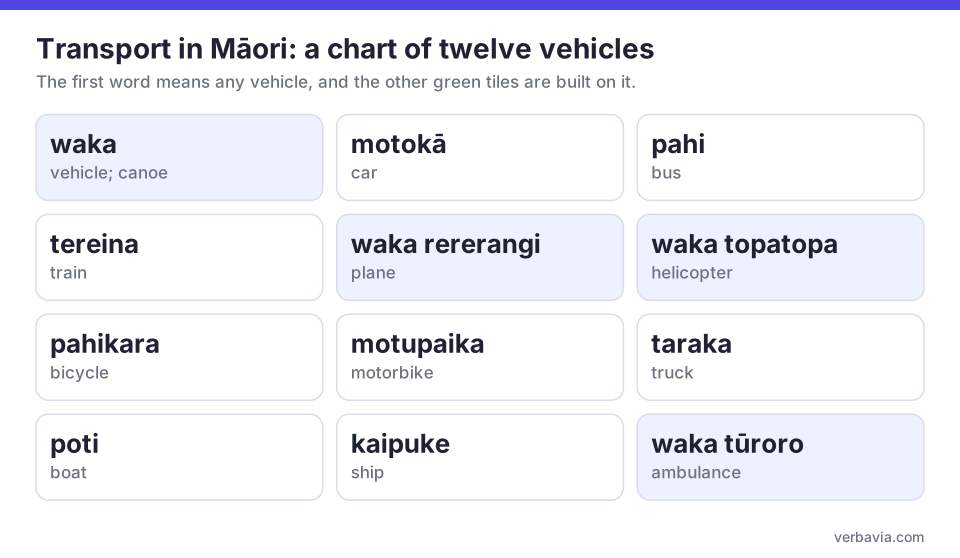
| English | Māori | Note |
|---|---|---|
| vehicle; canoe | waka | Any vehicle, on land, sea or in the air |
| car | motokā | Borrowed; Te Aka also has motukā |
| bus | pahi | Borrowed |
| train | tereina | Borrowed |
| plane | waka rererangi, rererangi | rere is to fly |
| helicopter | waka topatopa | |
| bicycle | pahikara, paihikara | Both spellings are in Te Aka |
| motorbike | motupaika | Borrowed |
| truck | taraka | Also a lorry or a railway wagon |
| boat | poti | Also the word for a cat |
| ship | kaipuke | |
| ambulance | waka tūroro | tūroro: to be sick |
| airport | papa rererangi, taunga rererangi | |
| station | teihana | Borrowed |
| bus stop | tūnga pahi | |
| ticket | tīkiti | Borrowed |
| road | huarahi, rori | rori is borrowed |
| by bus; on foot | mā runga pahi; mā raro |
Every meaning on this page is Te Aka’s, and every word in the table is taught in the course. Many of them are borrowed from English and reshaped to Māori sounds, the way English words in Māori explains: there is no b, s or c in the alphabet, and every word ends in a vowel.
What is the Māori word for car?
A car is motokā, a borrowed word that Te Aka glosses car, automobile, motorcar. Waka, the word for any vehicle, does the same job, and the course uses both:
| Māori | English |
|---|---|
| He motokā tērā. | That’s a car. |
| Kawea ngā pēke ki te waka. | Carry the bags to the car. |
| te motokā pango | the black car |
| Kei te mōhio koe ki te taraiwa? | Can you drive? |
The colour goes after the car, as every describing word does; the rest are in Māori colours. And a car is ō, like a house: anything you travel inside is tōku ‘my’, not tāku, so my car is tōku motokā. Why, is in Māori possessives.
Why is waka the word for every vehicle?
A waka was first a canoe, and the word grew with what people travelled in. Te Aka gives it as canoe, vehicle, conveyance, and its example, from 1909, describes a town’s streets full of every sort of Pākehā waka, from the butcher’s horse to the tramcars. Te Aka also lists Waka Kotahi as the New Zealand Transport Agency.
So most new vehicles are a waka with a word after it saying what kind:
| Māori | English | Built from |
|---|---|---|
| waka rererangi | aeroplane | rere ‘to fly’ |
| waka topatopa | helicopter | |
| waka tūroro | ambulance | tūroro ‘to be sick; a patient’ |
| waka pirihimana | police car | pirihimana ‘police officer’ |
| waka ama | outrigger canoe | |
| waka hourua | double canoe |
The canoes themselves, the voyaging and war canoes and the parts of each, are in Māori waka, and the navigator many traditions name as the first to reach New Zealand is in Kupe.
Buses, trains and planes
A bus is pahi and a train tereina, both borrowed. Te Aka has a second tereina, to train, as in training horses, and a second pahi, an old word for a temporary camp; the sentence tells you which. Te Aka’s own example for a station:
| Māori | English |
|---|---|
| I tae mai te tereina ki te teihana i te wā e tika ana. | The train arrived at the station on time. (Te Aka) |
| Kāore i roa, ka tae mai te pahi. | Before long, the bus arrived. |
| Kia tere, kei mahue koe i te pahi. | Hurry, or you’ll miss the bus. |
A plane is waka rererangi, the flying vehicle, or just rererangi. An airport is a papa rererangi or a taunga rererangi: Te Aka gives both. Te Aka’s example shows two more travel words, tau ‘to land’ and heke ‘to get off’:
| Māori | English |
|---|---|
| Kātahi anō te waka rererangi ka tau mai, engari kāore anō ngā pāhihi kia heke iho. | The plane has landed just now, but the passengers haven’t yet disembarked. (Te Aka) |
Pāhihi is a passenger, borrowed; Te Aka also gives kaieke, a rider or passenger, built from eke, to get on.
Boats and ships
A boat or a dinghy is poti, and a ship is kaipuke. Te Aka has a separate poti that means a cat, also borrowed, so poti on its own needs its sentence around it. The course glosses it both ways.
For the older craft, waka ama is the outrigger canoe and waka hourua the double canoe. To paddle or row is hoe, and to come ashore from the sea is ū.
Bikes, motorbikes and trucks
| Māori | English |
|---|---|
| pahikara, paihikara | bicycle, bike |
| motupaika | motorbike |
| taraka | truck, lorry; railway wagon |
Te Aka lists both spellings of the bicycle word. Pahikara is the example English words in Māori takes apart sound by sound.
How do you say by bus in Māori?
Say mā runga and the vehicle: mā runga pahi is by bus. On foot is mā raro.
| Māori | English |
|---|---|
| Kei te haere au mā runga pahi. | I’m going by bus. |
| Mā raro au e haere ai. | I’m going on foot. |
| I haere au mā runga pahi, mai i Pōneke. | I went by bus, from Wellington. |
| I ētahi wā i mauria rāua mā runga motokā. | Sometimes they were taken by car. (Te Aka) |
| Ka haere koe ki te mahi mā te aha? Mā runga pahi. | How do you get to work? By bus. |
The question is mā te aha?, by what? The other question words for a trip, where to and when, are in Māori question words.
Getting on, getting off and driving
| Māori | Meaning (Te Aka) |
|---|---|
| haere | to go, travel |
| eke | to get on, board, ride |
| heke | to get off, disembark; to descend |
| taraiwa | to drive; a driver |
| tae | to arrive |
| rere | to fly |
| tau | to land, come to rest |
| hoe | to paddle, row |
| hīkoi | to walk |
Like every Māori verb these never change for tense; the small word in front does that, as Māori verbs shows. Taraiwa is a verb and also the person: the driver.
At the bus stop: tickets, stops and roads
| Māori | English |
|---|---|
| Kei hea te tūnga pahi? | Where is the bus stop? |
| Ka haere tēnei pahi ki te tāone? | Does this bus go into town? |
| Āhea te pahi haere ai? Ā te tekau karaka. | When does the bus leave? At ten. |
| Kotahi tīkiti ki Kirikiriroa. | One ticket to Hamilton. |
| Tata ki te tekau meneti mā raro. | About ten minutes on foot. |
A road is huarahi, or the borrowed rori. Te Aka gives huarahi a second meaning, a method or route, the way way works in English. Its example for rori is a road rule:
| Māori | English |
|---|---|
| Haere ai ngā waka mā te taha mauī o te rori i Aotearoa nei. | Here in New Zealand vehicles travel on the left-hand side of the road. (Te Aka) |
A bridge is piriti, which Te Aka also lists as a borrowed word for a priest. Turning left and right, straight on and how far, are in Māori directions, and the clock times in Ā te tekau karaka are in Māori numbers.
A conversation about a trip
This exchange is one of the course’s dialogues. Tāmaki Makaurau is Auckland, whose name is explained in Māori place names.
| Māori | English |
|---|---|
| Kei te haere koe ki hea? | Where are you going? |
| Ki Tāmaki Makaurau. | To Auckland. |
| Mā te aha? | By what? |
| Mā runga pahi. | By bus. |
| Kia pēhea te roa o te haere? | How long is the trip? |
| Tata ki te tekau hāora. | About ten hours. |
| Ka noho koe ki hea? | Where will you stay? |
| Ki te whare o tōku hoa. | At my friend’s house. |
| Mō te aha? | What for? |
| Mō te hui. | For the meeting. |
More everyday phrases, from hurry up to see you later, are in common Māori phrases. Every sentence on this page marked as the course’s is taught in Verbavia’s free te reo Māori course, where you can hear it.
Why the NZ Transport Agency is called Waka Kotahi is explained word by word in Māori names of NZ government agencies.
Learn te reo Māori with Verbavia
Verbavia’s free te reo Māori course starts with the most common words, explains the grammar properly, and plays every example in Papa Reo’s native te reo voice. One lesson a day, from your first word to B1.
Quick questions
What is car in Māori?
Motokā, borrowed from motorcar. In everyday speech a car is often just waka, the word for any vehicle.
What is the Māori word for bus?
Pahi. By bus is mā runga pahi, and the bus stop is the tūnga pahi.
How do you say plane in Māori?
Waka rererangi, or just rererangi. An airport is a papa rererangi or taunga rererangi.
Does waka mean car or canoe?
Both. Te Aka gives waka as canoe, vehicle and conveyance, so it covers a canoe, a car, a bus or a plane.
Sources
- Te Aka Māori Dictionary: waka — canoe, vehicle, conveyance.
- Te Aka Māori Dictionary: Waka Kotahi — New Zealand Transport Agency.
- Te Aka Māori Dictionary: motokā (loan) — car, automobile, motorcar.
- Te Aka Māori Dictionary: pahi (loan) — bus.
- Te Aka Māori Dictionary: tereina (loan) — train (railway); to train.
- Te Aka Māori Dictionary: rererangi and waka rererangi — aeroplane, aircraft.
- Te Aka Māori Dictionary: waka topatopa — helicopter.
- Te Aka Māori Dictionary: pahikara and paihikara (loans) — bicycle.
- Te Aka Māori Dictionary: motupaika (loan) — motorbike; taraka (loan) — truck, lorry.
- Te Aka Māori Dictionary: poti (loan) — boat, dinghy; also cat.
- Te Aka Māori Dictionary: kaipuke — ship; waka ama — outrigger canoe; waka hourua — double canoe.
- Te Aka Māori Dictionary: waka tūroro — ambulance; pirihimana (loan) — police officer.
- Te Aka Māori Dictionary: papa rererangi and taunga rererangi — airport.
- Te Aka Māori Dictionary: teihana (loan) — station; tīkiti (loan) — ticket; tūnga pahi — bus stop.
- Te Aka Māori Dictionary: huarahi — road, street; method, route; rori (loan) — road.
- Te Aka Māori Dictionary: piriti (loan) — bridge; also priest.
- Te Aka Māori Dictionary: mā raro — on foot; hea — mā hea?, by what means?
- Te Aka Māori Dictionary: eke — to get on, board, ride; heke — to get off, disembark.
- Te Aka Māori Dictionary: taraiwa (loan) — to drive; driver.
- Te Aka Māori Dictionary: tau — to land, alight; ū — to land, arrive by water; hoe — to paddle, row.
- Te Aka Māori Dictionary: pāhihi (loan) — passenger; kaieke — rider, passenger.