Sports in Māori: netball, football, cricket and more
Sports in Māori are ngā hākinakina ‘sports’: netball is poitarawhiti ‘netball’ or netipōro ‘netball’, football is poiwhana ‘soccer’, cricket is kirikiti ‘cricket’, basketball is poitūkohu ‘basketball’, hockey is hōkī ‘hockey’, tennis is tēnehi ‘tennis’, swimming is kauhoe ‘to swim’ and rugby is whutupōro ‘rugby’. Below are more than 60 sports by name, each as Te Aka Māori Dictionary, Te Taura Whiri i te Reo Māori (the Māori Language Commission) or New Zealand’s Olympic glossaries print it, then the words around a game, what to shout from the sideline, and how the Olympics are named in te reo.
Tap 🔊 to hear an example. Māori examples play Papa Reo, the te reo Māori voice made by Te Hiku Media from recordings of native speakers. Every sentence in the free course is spoken like this.
On this page
- What is the Māori word for sport?
- A list of sports in Māori
- Why do netball and football have two Māori names?
- Netball in Māori: the court and the positions
- Football and cricket words in Māori
- Team, player, coach, score: the words around a game
- What to shout from the sideline in Māori
- How do you say “I play netball” in Māori?
- The Olympics and the Commonwealth Games in Māori
- Traditional Māori games and waka ama
- Where the sources differ
- Learning the words
- Quick questions
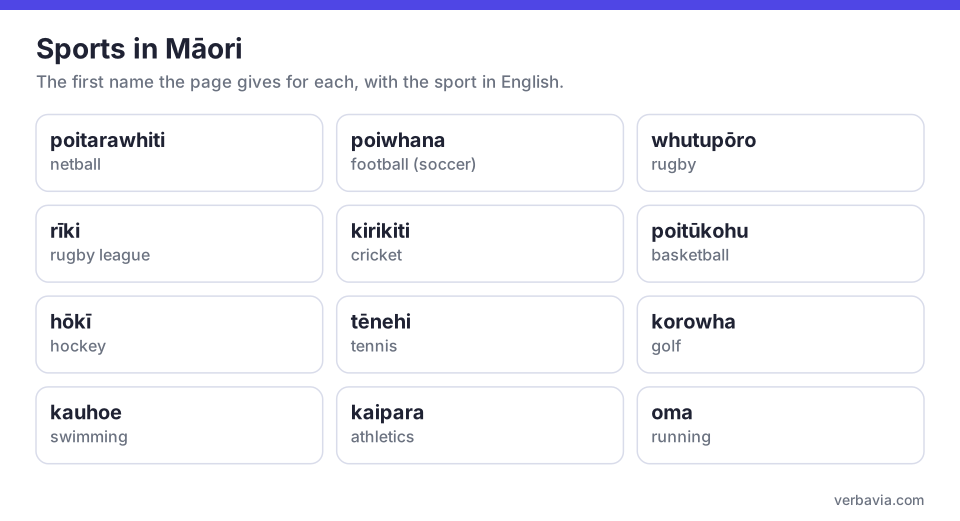
| Sport | Māori | Also printed as |
|---|---|---|
| sport | hākinakina | tākaro |
| netball | poitarawhiti | netipōro |
| football (soccer) | poiwhana | poikiri, hoka |
| rugby | whutupōro | whutupaoro |
| rugby league | rīki | |
| cricket | kirikiti | |
| basketball | poitūkohu | pāhiketepōro |
| hockey | hōkī | haki, hake, haupoi |
| tennis | tēnehi | tēnihi |
| golf | korowha | haupōro |
| swimming | kauhoe | kaukau |
| athletics | kaipara | kaiaka |
| running | oma |
Māori vowels are pure and every one is sounded, wh is said as f, and a macron doubles the length of its vowel: hā-ki-na-ki-na, poi-ta-ra-whi-ti. The Māori pronunciation guide takes each sound in turn.
What is the Māori word for sport?
There are three, and they overlap. Hākinakina is the one Te Taura Whiri’s booklet and the Olympic glossaries use for sport. Te Aka gives it as a verb, to play sport, enjoy oneself, and as a noun, sport, game, with a second entry for recreation. Tākaro is the everyday word: to play, and as a noun sport, game, recreational activity; it is what children do in a playground and what a team does on a field. Kaipara is narrower. Te Aka defines it as athletics, athlete, sporting competition, a term used in connection with athletic contests.
| Māori | Te Aka’s meaning | Note |
|---|---|---|
| hākinakina | to play sport; sport, game; recreation | The general word. Te Taura Whiri’s sport booklet is titled with it. |
| tākaro | to play; sport, game, recreational activity | Also to wrestle, an older sense Te Aka still lists. |
| kaipara | athletics; athlete; sporting competition | The Olympic glossaries use it for athlete. |
| kēmu | game, match | A loan from game. |
| purei | to play (games, sport, cards), compete | A loan from play; it also means to bet. |
| whakataetae | to compete; race, competition, match, tournament | Hākinakina whakataetae is Te Aka’s competition sport. |
Te Aka’s own example shows the general word at work: He hākinakina whakataetae tēnei. ‘This is a competition sport.’ Whakataetae begins with the prefix explained in what whaka means. For sport as a lesson on the timetable, see school subjects in Māori.
A list of sports in Māori
The first Māori column is Te Aka’s entry for the sport. The last column is any other name in print, and who prints it: TTW is Te Taura Whiri’s Hākinakina booklet, Paris, Milan and Glasgow are the official glossaries made for the 2024 Olympics, the 2026 Winter Olympics and the 2026 Commonwealth Games. Where Te Aka has no entry, the first column says so.
Ball and court sports
| Sport | Māori (Te Aka) | Other names, and who prints them |
|---|---|---|
| netball | poitarawhiti | netipōro, netipaoro (loans, Te Aka). TTW and Glasgow: poitarawhiti |
| football, soccer | poiwhana, poikiri | hoka (loan), whanapoikiri (Te Aka). Paris: poiwhana |
| rugby | whutupōro | Several loan spellings, in the rugby guide |
| rugby sevens | no entry | whutupōro takiwhitu (Paris) |
| rugby league | rīki | TTW: rīki |
| touch rugby | pā whutupaoro | pā whutupōro (TTW) |
| cricket | kirikiti | TTW and New Zealand Cricket: kirikiti |
| basketball | poitūkohu | pāhiketepōro, pāhiketepaoro (loans, Te Aka) |
| hockey | hōkī, haki, hake | haupoi (Paris, for field hockey) |
| ice hockey | hōkī hukapapa | |
| tennis | tēnehi, tēnihi | Paris: tēnehi. TTW: tēnihi |
| table tennis | poikōpiko | tēpu tēnehi (loan, Te Aka) |
| badminton | pūkura | pūkuru (TTW) |
| squash | poipātū | |
| volleyball | poirewa | meke pōro (loan, Te Aka) |
| beach volleyball | poirewa one | poirewa onepū (Paris) |
| softball | poiuka | TTW: poiuka |
| baseball | poipapa | peihipaoro (loan, Te Aka) |
| handball | pāringa | |
| golf | korowha, hahaupōro | haupōro (Te Aka as a modifier; TTW for the sport); hahau pōro (Paris) |
| bowls | maita | Glasgow: maita |
| billiards, snooker | piriota | TTW: piriota |
| darts | whiu kōpere | tākaro kōpere: both are verbs, to play darts |
Water sports
| Sport | Māori (Te Aka) | Other names, and who prints them |
|---|---|---|
| swimming | kauhoe | kaukau (to swim, bathe). TTW, Paris and Glasgow: kauhoe |
| diving | ruku | Paris: ruku |
| surfing | eke ngaru, whakaheke ngaru | reti ngaru (Te Aka and Paris) |
| surf lifesaving | kauhauora | |
| waterskiing | retiwai | |
| kayaking | kōreti | Te Aka: a small canoe or kayak, and used as a verb in its example |
| canoeing | hoehoe tāwhai | |
| rowing | hoe (to paddle, row) | hoe waka (TTW and Paris) |
| outrigger canoeing | waka ama | TTW: waka ama |
| sailing, yachting | whakatere waka hēra, pere rua | tere waka (Paris) |
Athletics, cycling and the gym
| Sport | Māori (Te Aka) | Other names, and who prints them |
|---|---|---|
| athletics | kaipara | kaiaka (Paris and Glasgow) |
| running | oma | A sprint is kōpere (Te Aka) or hohoro (Paris) |
| marathon | oma taumano, omaoma-a-Tōhē, oma hauroa | Omaroa-a-Tōhē (TTW); omaroa (Paris) |
| triathlon | tauwhāinga-toru | hākinatoru (Paris) |
| relay | tauoma tānga | Paris: tauoma tānga |
| hurdles | tāepa (a hurdle) | peke taiapa (Paris) |
| long jump | kairērere | pekeroa (Paris) |
| high jump | no entry | peke teitei (Paris) |
| shot put | panga matā | TTW and Paris: panga matā |
| discus | whiu poroāwhio, poroāwhio | TTW: poroāwhio. Paris: whiu poroāwhio |
| javelin | tao | Paris: tao. The word is first of all a spear |
| cycling | eke paihikara | paihikara (Paris) |
| gymnastics | pītakataka | takaporepore (Paris and Glasgow) |
| weightlifting | hiki maitai, mōhiki | Paris and Glasgow: hiki maitai |
| aerobics | no entry for the sport | haukori (TTW) |
Combat, snow, wheels and the rest
| Sport | Māori (Te Aka) | Other names, and who prints them |
|---|---|---|
| boxing | mekemeke | Paris and Glasgow: mekemeke |
| wrestling | mamau | nonoke (Te Aka). Paris: mamau |
| judo | no entry | ruturau (Glasgow) |
| karate | karāti | |
| fencing | whakataetae hoari | |
| skiing | retihuka, retireti hukarere | retihuka heke maunga for alpine skiing (Milan) |
| snowboarding | no entry | eke papahuka (Milan) |
| ice skating | reti kōpaka, retireti hukapapa | reti kōpaka tere for speed skating (Milan) |
| skateboarding | papawīra (a skateboard) | eke papawīra in Te Aka’s example; eke papareti (Paris) |
| rock climbing | piki toka | piki pātū for sport climbing (Paris) |
| horse racing | purei hōiho, reihi hōiho | rērehi hōiho (Te Aka) |
| equestrian | no entry | eke hōiho (Paris) |
| motor racing | whakataetae motokā | |
| shooting | puhipuhi (to shoot, fire a gun) | Paris: puhipuhi |
| kī-o-rahi | kī-o-rahi | A traditional ball game: see below |
A few sports are missing because no source read for this page names them: Te Aka has no entry for water polo, polo, archery, taekwondo, tenpin bowling or mountain biking, and the glossaries do not cover them either.
Why do netball and football have two Māori names?
Because there are two ways to name a new game. The older way borrows the English word and fits it to Māori sounds: netipōro is netball, kirikiti is cricket, hōkī is hockey, tēnehi is tennis and korowha is golf. Te Aka marks each of these as a loan, and they are not new: its example for korowha is dated 1899, and its example for kirikiti and hōkī 1923. How the sounds are swapped, and why ball becomes pōro, is explained in English words in Māori.
The newer way builds a name from Māori words. A whole family starts with poi, which Te Aka lists as ball in sport, beside its entry for the poi swung in kapa haka. Te Aka gives no word histories, but the second halves have entries of their own:
| Sport | Coined name | The second part in Te Aka |
|---|---|---|
| netball | poitarawhiti | tarawhiti: hoop, ring |
| basketball | poitūkohu | tūkohu: the basket in basketball |
| football | poiwhana | whana: to spring back, kick |
| squash | poipātū | pātū: wall, screen |
| volleyball | poirewa | rewa: to float; to be high up |
| table tennis | poikōpiko | kōpiko: to go back and forth |
Both kinds are correct, and both are in use. Te Aka’s main entry for netball is poitarawhiti, with the loans as synonyms; Te Taura Whiri’s booklet and the Glasgow glossary print only poitarawhiti. For football, the booklet prints poiwhana and poikiri side by side, and the Paris glossary chose poiwhana for the sport and kept poikiri for the ball. One caution: Te Aka glosses the loans made from football, such as whutupōro, as rugby football, so soccer has names of its own. Rugby’s spellings, positions and scoring are all in rugby in Māori.
Netball in Māori: the court and the positions
Te Aka labels more than twenty words for netball. These are the ones a team needs first. It has no entry for wing attack or wing defence, so those two bibs are not in the table.
| English | Māori (Te Aka) |
|---|---|
| netball | poitarawhiti, netipōro |
| goal shooter | ringa tītere |
| goal attack | tuki ūhanga |
| centre | takuahi |
| goal defence | maru ūhanga, poupare |
| goalkeep | kāti ūhanga, kaiārai |
| to shoot; a shot | tītere |
| goalpost | pou netipaoro |
| shooting circle | rohe keo |
| obstruction | hōtaetae |
| stepping | hīkoi |
| bib | pari tākaro |
Hīkoi is the ordinary word for a walk or a march, and stepping is one of its listed senses. Te Aka’s example for netball itself comes from Te Ara: Ko te poitarawhiti te hākinakina nui rawa atu ki te hunga wahine. ‘Netball is the most popular women’s sport.’ The national side, the Silver Ferns, has a Māori name in Te Aka too, explained with the Black Caps’ and the Tall Blacks’ in Māori team names.
Football and cricket words in Māori
For football, Te Aka has the ball, poikiri ‘soccer ball’, a corner kick, whana koko ‘corner kick’, a header, tukirae ‘header’, a striker, tairere ‘striker’, and an own goal, paneke ninipa ‘own goal’. The national team, the All Whites, is Ōmā ‘All Whites’; Te Aka marks it as a loan, as it does Ōpango, its name for the All Blacks.
For cricket, Te Aka has epa ‘to bowl’, a bowler, kaiepa ‘bowler’, a bat, whiro ‘bat’, an over, paiepa ‘over’, and a run, paina ‘point, run’. New Zealand Cricket publishes its own glossary, Te Papakupu Kirikiti, and it does not always match: both have kaiepa and paiepa, but New Zealand Cricket’s bat is a patu ‘cricket bat’ and its crease is a pae ‘crease’, where Te Aka has whiro and wī ‘crease’.
Team, player, coach, score: the words around a game
Most of these serve every sport. Where the three sources agree, one word is shown; where they differ, each is named.
| English | Māori (Te Aka) | Te Taura Whiri booklet or Olympic glossary |
|---|---|---|
| team | kapa, tīma | kapa, tira (Paris) |
| player | kaitākaro | the same |
| captain | kāpene, kaiurungi | kaitaki (TTW) |
| coach | kaiwhakaako, kaiwhakawaiwai | kaiwhakaako (TTW); kaiako (Paris) |
| referee, umpire | kaiwawao, rewherī, amapaea | kaiwawao (both) |
| opponent | hoariri | the same (TTW) |
| spectator | kaimātakitaki | the same (Paris) |
| supporter | kaitautoko | the same (TTW, Paris) |
| ball | pōro, paoro, poi | pōro |
| goal | kōura, kōrā, paneke | |
| score | tatau; final score tapeke | tapeke, kaute (TTW); kaute (Paris) |
| to win; winner | toa, wini | toa (both) |
| to lose | hinga | the same (TTW) |
| a draw | haupūrua | rite (TTW); ōrite, taerite (Paris) |
| game, match | kēmu, whakataetae | kēmu (TTW) |
| to start, kick off | tīmata | the same (TTW) |
| half-time | hāwhe-tāima, whakamatuatanga, weheruatanga | hauruatanga (TTW) |
| first half; second half | haurua tuatahi; haurua tuarua (TTW) | |
| field | papa tākaro | the same (Paris) |
| court | papa tākaro; tennis court papa tēnehi | papatākaro (TTW); kōti (Paris) |
| swimming pool | hōpua kaukau (TTW); hōpua, puna kaukau (Paris) | |
| stadium | taiwhanga hākinakina | the same (TTW, Paris) |
| race | tauomaoma, reihi | whakataetae, tauoma (Paris) |
| final; semi-final | whiringa toa; whiringa whāiti | the same (Paris) |
| champion | toa, whakaihuwaka, tiamupiana | |
| sports gear | taputapu hākinakina | |
| uniform | kākahu ōrite |
Toa carries the most: to win, a winner, a champion, and brave. Hinga is literally to fall. Kaiwhakaako is the ordinary word for a teacher, which is why the Paris glossary could shorten coach to kaiako. A score is counted with the numbers in Māori numbers, and the knees, shoulders and ankles that sport is hard on are in Māori body parts. One of Te Aka’s examples is ready for the end of any PE lesson: Whakahokia ngā taputapu hākinakina ki te kāpata. ‘Return the sports equipment to the cupboard, please.’
What to shout from the sideline in Māori
Te Taura Whiri’s Hākinakina booklet has a page of phrases for supporters and players, and the Paris 2024 glossary, made with the New Zealand Olympic Committee and Sky, ends with two pages more. Every line below is printed in one of them, with the English each gives.
| Māori | English (the source’s) | Printed in |
|---|---|---|
| Karawhiua! | Give it heaps! | TTW booklet; Paris has go hard! give it heaps! |
| Kia kaha ake e kare mā! | Let’s go team! | TTW booklet |
| Kia kaha, Aotearoa! | Go, NZ, go! | Paris glossary |
| Kia kaha! Kia toa! | Be strong! Give it your all! | Paris glossary |
| Kia manawanui | Hang in there | TTW booklet |
| Koirā taku kapa! | That’s my team! | Paris glossary |
| Tino pai | Well done | Paris glossary |
| Ka rawe! Ka mutu pea! | How great! Well done! | Paris glossary |
| Ka mau te wehi! | That’s outstanding! | TTW booklet; Paris has that’s amazing |
| Ānana! | That’s it! | TTW booklet |
| Tau kē Aotearoa! | Awesome Aotearoa! | TTW booklet |
| Eke panuku! | Win! Made it! | TTW booklet |
| Eke tangaroa! | Slayed it! | TTW booklet |
| Kua wana ake rātou! | They’re making a comeback! | TTW booklet |
| Waimarie! | Lucky | TTW booklet |
| Tata! | (So) close! | Paris glossary, swimming |
Karawhiua is the all-purpose cheer; Te Aka glosses it give it everything! go for it! give it heaps! Kia kaha is be strong, and the booklet’s frame for any side is Kia kaha te kapa followed by the team’s name; the All Blacks’ version is in the rugby guide, and the phrase itself in what kia kaha means. Te Aka adds a warning about Ka mau te wehi!: it usually praises, but it can also express the opposite. More praise of this kind, with where each expression comes from, is in kīwaha: Māori idioms.
Calls during play
| Māori | English (the source’s) | Printed in |
|---|---|---|
| E oma! | Run! | TTW booklet, rugby |
| Hopukina! | Catch it! | TTW booklet |
| Hāua te pōro! | Hit the ball! | TTW booklet, court sports |
| Patua! | Hit it! | TTW booklet, court sports |
| Maranga! | Get up! | TTW booklet, rugby |
| Kei hea te pōro? | Where is the ball? | TTW booklet |
| Kei te wātea a Hone! | Hone is free! | TTW booklet’s frame, with a name added |
| Kaua e pāhia, whanahia! | Don’t pass it, kick it! | TTW booklet, rugby |
| Ka kuru, tūkohu ana! | She shoots, she scores! | Paris glossary, basketball |
| Kia tere ake | Pick up pace | Paris glossary, swimming |
| Kua kēmu | That’s game | Paris glossary, basketball |
Three things people look for are not printed in any source read for this page: a bare pass it!, a bare shoot! and good game. The words exist. To pass with the hands is maka in Te Aka and in the booklet; to shoot is tītere in Te Aka’s netball list and kuru in the Paris basketball list. But a call is more than a word, so none is made up here. After the whistle, Tino pai is the glossary’s well done. In a class or a junior team, the instructions around the game (sit down, line up, listen) are in te reo Māori for teachers, and first words for small players in te reo Māori for kids.
How do you say “I play netball” in Māori?
The verb is tākaro, or the loan purei. In Te Aka’s examples the sport comes straight after it: tākaro rīki ‘to play league’, tākaro tēnehi ‘to play tennis’, tākaro korowha ‘to play golf’, purei whutupōro ‘to play rugby’. The Māori course on this site teaches the same verb with i before what is played. These are the nearest sentences in print:
| Māori | English | From |
|---|---|---|
| Tākaro hake rāua. | They played hockey. | Te Aka, under hake |
| I tākaro mātou i ngā kēmu. | We played games. | The course |
| I tākaro mātou i te netipōro. | We played netball. | Built: the course’s sentence with the sport in place of ngā kēmu |
| Kei te tākaro rātou. | They are playing. | The course |
| He kaitākaro a Tama. | Tama is a player. | The course |
| Kei te mōhio au ki te kauhoe. | I can swim. | The course |
| Me haere tātou ki te kauhoe. | Let’s go for a swim. | TTW booklet |
| Tino pai ia ki te kauhoe. | He or she is very good at swimming. | TTW booklet |
| Tātou ka tauomaoma ki te kāinga. | Let’s race home. | Te Aka, under tauomaoma |
Only the third line is built for this page, and it changes one noun. Swap mātou ‘we, not you’ for another pronoun and the sentence follows you: the choices are in Māori pronouns. A ready-made question, do you play sport?, is not in Te Aka, the booklet or the glossaries, so none is offered. To talk about how a game went, the describing words, such as tere ‘fast’ and kaha ‘strong’, are in Māori adjectives; for training, kori tinana is Te Aka’s to work out, exercise, and the booklet prints whakapakari tinana for a workout.
The Olympics and the Commonwealth Games in Māori
The Olympic Games are Ngā Taumāhekeheke o Te Ao: that is Te Aka’s entry and the term in the Paris 2024 glossary, which describes itself as the first official Olympic Games glossary in Māori and English. It holds more than 1,000 words and phrases across 30 sporting events, 20 words and 10 phrases for each, and where a sport had no Māori vocabulary, licensed translators coined it and Te Taura Whiri reviewed it. A winter edition followed for Milan and Cortina in 2026, and one for the Commonwealth Games in Glasgow, which that glossary names Ngā Taumāhekeheke Hoa Whenua.
| English | Māori | Source |
|---|---|---|
| Olympic Games | Ngā Taumāhekeheke o Te Ao | Te Aka; Paris glossary |
| Commonwealth Games | Ngā Taumāhekeheke Hoa Whenua | Glasgow glossary |
| World Cup | Ipu o te Ao | Te Aka |
| the New Zealand Team | Te Kapa o Aotearoa | Paris glossary |
| athlete | kaipara | Te Aka; Paris glossary |
| medal | mētara | Te Aka (a loan); Paris glossary. Te Aka also has tohutoa |
| gold, silver, bronze | kōura, hiriwa, parāhi | Paris glossary; all three are loans in Te Aka |
| gold medallist | toa kōura | Paris glossary |
| Olympic champion | toa Taumāhekeheke o Te Ao | Paris glossary |
| final, medal round | whiringa toa | Te Aka; Paris glossary |
Kōura is worth a second look. Te Aka has three separate words with that spelling: the loan for gold, the loan for a goal, and the crayfish. A toa kōura on a podium is a gold medallist; a kōura on a football field is a goal.
Traditional Māori games and waka ama
Sport in te reo is much older than the loanwords. Te Aka’s example for tākaro quotes a 1923 account of the atua themselves at play, whipping tops, throwing darts and making string figures, and its example for kaipara has people watching a canoe-paddling contest between many kinship groups. Wrestling is mamau or nonoke, neither of them a loan. The ball game kī-o-rahi is described by Te Aka as played by two teams on a circular field with a small flax ball: how to play it, and the stick games, string games and knucklebones, is in traditional Māori games. The discipline of handling the taiaha and other weapons has its own guide, Māori weapons.
Waka ama is Te Aka’s outrigger canoe, and the name of the paddling sport. Te Aka’s example, from Te Ara, has Whātonga and his companion Tūrāhui taking part in a whakataetae waka ama ‘outrigger canoe regatta’ in Hawaiki. A paddler is a kaihoe ‘paddler, rower’, and the Paris glossary gives the shouts from the bank: Hoea tō waka! ‘Paddle your canoe! Go hard!’ and Kia hūkere te hoe! ‘Dig deep and paddle hard and fast!’ The canoes themselves, from the war canoe to the voyaging double hull, are in Māori waka.
Where the sources differ
None of these sources calls another wrong, and for a team sheet or a school notice any of them can be cited. These are the places where a reader will meet two words.
| Word | Te Aka Māori Dictionary | Te Taura Whiri booklet | Olympic glossaries |
|---|---|---|---|
| athletics | kaipara | not listed | kaiaka; kaipara is the athlete |
| hockey | hōkī, haki, hake | all three | haupoi |
| gymnastics | pītakataka | not listed | takaporepore |
| triathlon | tauwhāinga-toru | not listed | hākinatoru |
| badminton | pūkura | pūkuru | not listed |
| tennis | tēnehi and tēnihi | tēnihi | tēnehi |
| marathon | omaoma-a-Tōhē, oma taumano | Omaroa-a-Tōhē | omaroa |
| touch rugby | pā whutupaoro | pā whutupōro | not listed |
| captain | kāpene, kaiurungi | kaitaki | not listed |
| coach | kaiwhakaako | kaiwhakaako | kaiako |
| a draw | haupūrua | rite | ōrite, taerite |
| half-time | hāwhe-tāima, whakamatuatanga | hauruatanga | not listed |
| Kei reira! | no entry | He’s in! | Fabulous |
Kaitaki, the booklet’s captain, is in Te Aka as a leader, and the leader of a haka. Kaiaka, the glossaries’ athletics, is in Te Aka as an adjective: adept, skilled, accomplished. And takaporepore, their gymnastics, is Te Aka’s verb to roll over and over. Each new name is an old word given a job.
Learning the words
Tākaro, kapa, toa, oma and kauhoe are all everyday words, and the free te reo Māori course on this site teaches them in sentences, one short lesson a day. For words that belong to the doctor rather than the coach, see health words in Māori.
Learn te reo Māori with Verbavia
Verbavia’s free te reo Māori course starts with the most common words, explains the grammar properly, and plays every example in Papa Reo’s native te reo voice. One lesson a day, from your first word to B1.
Quick questions
What is sport in Maori?
Hākinakina: Te Aka gives it as sport, game and as the verb to play sport. Tākaro also means sport, game and to play.
What is netball in Māori?
Poitarawhiti, the name Te Aka, Te Taura Whiri and the Commonwealth Games glossary all print. The loan netipōro means the same.
What is football in Māori?
Soccer is poiwhana or poikiri, or the loan hoka. Whutupōro, though borrowed from football, means rugby.
What is swimming in Māori?
Kauhoe, to swim, which the Olympic glossaries also use as the name of the sport. A swimming pool is a hōpua kaukau in Te Taura Whiri’s booklet.
How do you say “go team” in Māori?
Te Taura Whiri’s booklet prints Kia kaha ake e kare mā! for let’s go team! and Karawhiua! for give it heaps!
Sources
- Te Taura Whiri i te Reo Māori: Hākinakina Booklet (first published 2006, updated February 2022)
- Te Taura Whiri i te Reo Māori: Hākinakina Booklet, print PDF
- Te Taura Whiri i te Reo Māori, New Zealand Olympic Committee and Sky: Te Reo Māori ki Parī 2024, the Olympic Games glossary
- Te Reo Māori ki Parī 2024 (PDF)
- Te Taura Whiri i te Reo Māori: 2026 Winter Olympics (Te Reo Māori ki Mirano Kotina 2026)
- New Zealand Olympic Committee: Te Reo Māori takes its place in Glasgow (26 June 2026)
- Te Reo Māori ki Karahiko 2026, the Commonwealth Games glossary (PDF)
- New Zealand Cricket: Te Papakupu Kirikiti, glossary of cricket terms (PDF)
- Te Aka Māori Dictionary: hākinakina (to play sport; sport, game)
- Te Aka Māori Dictionary: hākinakina (recreation)
- Te Aka Māori Dictionary: tākaro
- Te Aka Māori Dictionary: kaipara
- Te Aka Māori Dictionary: kēmu
- Te Aka Māori Dictionary: purei
- Te Aka Māori Dictionary: whakataetae
- Te Aka Māori Dictionary: hākinakina whakataetae (competition sport)
- Te Aka Māori Dictionary: poitarawhiti (netball)
- Te Aka Māori Dictionary: netipōro
- Te Aka Māori Dictionary: netipaoro
- Te Aka Māori Dictionary: poiwhana (soccer)
- Te Aka Māori Dictionary: poikiri (soccer)
- Te Aka Māori Dictionary: poikiri (soccer ball)
- Te Aka Māori Dictionary: hoka (soccer, football)
- Te Aka Māori Dictionary: whanapoikiri
- Te Aka Māori Dictionary: whutupōro
- Te Aka Māori Dictionary: whutupaoro
- Te Aka Māori Dictionary: rīki (rugby league)
- Te Aka Māori Dictionary: pā whutupaoro (touch rugby)
- Te Aka Māori Dictionary: kirikiti (cricket)
- Te Aka Māori Dictionary: poitūkohu (basketball)
- Te Aka Māori Dictionary: pāhiketepōro
- Te Aka Māori Dictionary: pāhiketepaoro
- Te Aka Māori Dictionary: hōkī (hockey)
- Te Aka Māori Dictionary: haki (hockey)
- Te Aka Māori Dictionary: hake (hockey; example)
- Te Aka Māori Dictionary: hōkī hukapapa (ice hockey)
- Te Aka Māori Dictionary: tēnehi (tennis)
- Te Aka Māori Dictionary: tēnihi
- Te Aka Māori Dictionary: poikōpiko (table tennis)
- Te Aka Māori Dictionary: tēpu tēnehi
- Te Aka Māori Dictionary: pūkura (badminton)
- Te Aka Māori Dictionary: poipātū (squash)
- Te Aka Māori Dictionary: poirewa (volleyball)
- Te Aka Māori Dictionary: meke pōro
- Te Aka Māori Dictionary: poirewa one (beach volleyball)
- Te Aka Māori Dictionary: poiuka (softball)
- Te Aka Māori Dictionary: poipapa (baseball)
- Te Aka Māori Dictionary: peihipaoro
- Te Aka Māori Dictionary: pāringa (handball)
- Te Aka Māori Dictionary: korowha (golf)
- Te Aka Māori Dictionary: haupōro (golf; golf club)
- Te Aka Māori Dictionary: hahaupōro (golf)
- Te Aka Māori Dictionary: maita (bowls)
- Te Aka Māori Dictionary: piriota (billiards, snooker)
- Te Aka Māori Dictionary: whiu kōpere (to play darts)
- Te Aka Māori Dictionary: tākaro kōpere
- Te Aka Māori Dictionary: kauhoe (to swim)
- Te Aka Māori Dictionary: kaukau (to swim, bathe)
- Te Aka Māori Dictionary: ruku (to dive)
- Te Aka Māori Dictionary: eke ngaru (to surf; surfing)
- Te Aka Māori Dictionary: whakaheke ngaru
- Te Aka Māori Dictionary: reti ngaru
- Te Aka Māori Dictionary: kauhauora (surf lifesaving)
- Te Aka Māori Dictionary: retiwai (waterskiing)
- Te Aka Māori Dictionary: kōreti (small canoe, kayak)
- Te Aka Māori Dictionary: hoehoe tāwhai (canoeing)
- Te Aka Māori Dictionary: hoe (to paddle, row)
- Te Aka Māori Dictionary: kaihoe (paddler, rower)
- Te Aka Māori Dictionary: waka ama
- Te Aka Māori Dictionary: whakatere waka hēra (to go yachting)
- Te Aka Māori Dictionary: pere rua (yachting)
- Te Aka Māori Dictionary: oma (to run)
- Te Aka Māori Dictionary: kōpere (sprint)
- Te Aka Māori Dictionary: oma taumano (marathon)
- Te Aka Māori Dictionary: omaoma-a-Tōhē (marathon)
- Te Aka Māori Dictionary: oma hauroa (marathon)
- Te Aka Māori Dictionary: tauwhāinga-toru (triathlon)
- Te Aka Māori Dictionary: tauoma tānga (relay race)
- Te Aka Māori Dictionary: tāepa (hurdle)
- Te Aka Māori Dictionary: kairērere (long jump)
- Te Aka Māori Dictionary: panga matā (shotput)
- Te Aka Māori Dictionary: whiu poroāwhio (discus)
- Te Aka Māori Dictionary: poroāwhio (discus)
- Te Aka Māori Dictionary: tao (spear, javelin)
- Te Aka Māori Dictionary: eke paihikara (to cycle; cycling)
- Te Aka Māori Dictionary: paihikara (bicycle)
- Te Aka Māori Dictionary: pītakataka (gymnastics)
- Te Aka Māori Dictionary: takaporepore (to roll over and over)
- Te Aka Māori Dictionary: hiki maitai (weightlifting)
- Te Aka Māori Dictionary: mōhiki (weightlifting)
- Te Aka Māori Dictionary: kori tinana (to work out, exercise)
- Te Aka Māori Dictionary: whakapakari tinana (physical fitness, exercise)
- Te Aka Māori Dictionary: mekemeke (to box; boxing)
- Te Aka Māori Dictionary: mamau (to wrestle; wrestling)
- Te Aka Māori Dictionary: nonoke (to wrestle)
- Te Aka Māori Dictionary: karāti (karate)
- Te Aka Māori Dictionary: whakataetae hoari (fencing)
- Te Aka Māori Dictionary: retihuka (ski; skiing)
- Te Aka Māori Dictionary: retireti hukarere (skiing)
- Te Aka Māori Dictionary: reti kōpaka (ice-skating)
- Te Aka Māori Dictionary: retireti hukapapa (skating)
- Te Aka Māori Dictionary: papawīra (skateboard; example)
- Te Aka Māori Dictionary: piki toka (rock climbing)
- Te Aka Māori Dictionary: purei hōiho (horse racing)
- Te Aka Māori Dictionary: reihi hōiho
- Te Aka Māori Dictionary: rērehi hōiho
- Te Aka Māori Dictionary: whakataetae motokā (motor racing)
- Te Aka Māori Dictionary: puhipuhi (to shoot)
- Te Aka Māori Dictionary: kī-o-rahi
- Te Aka Māori Dictionary: poi (sport: ball)
- Te Aka Māori Dictionary: tarawhiti (hoop, ring)
- Te Aka Māori Dictionary: tūkohu (basketball: basket)
- Te Aka Māori Dictionary: whana (to spring back, kick)
- Te Aka Māori Dictionary: pātū (wall, screen)
- Te Aka Māori Dictionary: rewa (to float; to be elevated)
- Te Aka Māori Dictionary: kōpiko (to go back and forth)
- Te Aka Māori Dictionary: ringa tītere (goal shooter)
- Te Aka Māori Dictionary: tuki ūhanga (goal attack)
- Te Aka Māori Dictionary: takuahi (netball: centre)
- Te Aka Māori Dictionary: maru ūhanga (goal defence)
- Te Aka Māori Dictionary: poupare (goal defence)
- Te Aka Māori Dictionary: kāti ūhanga (goalkeep)
- Te Aka Māori Dictionary: kaiārai (goalkeep; guard)
- Te Aka Māori Dictionary: tītere (shot; to shoot)
- Te Aka Māori Dictionary: pou netipaoro (goalpost)
- Te Aka Māori Dictionary: rohe keo (shooting circle)
- Te Aka Māori Dictionary: hōtaetae (obstruction)
- Te Aka Māori Dictionary: hīkoi (step; stepping)
- Te Aka Māori Dictionary: pari tākaro (bib)
- Te Aka Māori Dictionary: Rau Hiriwā (Silver Ferns)
- Te Aka Māori Dictionary: whana koko (corner kick)
- Te Aka Māori Dictionary: tukirae (header)
- Te Aka Māori Dictionary: tairere (striker)
- Te Aka Māori Dictionary: paneke ninipa (own goal)
- Te Aka Māori Dictionary: Ōmā (All Whites)
- Te Aka Māori Dictionary: epa (to pitch, bowl)
- Te Aka Māori Dictionary: kaiepa (bowler)
- Te Aka Māori Dictionary: whiro (cricket bat)
- Te Aka Māori Dictionary: paiepa (over)
- Te Aka Māori Dictionary: wī (crease)
- Te Aka Māori Dictionary: paina (point, run)
- Te Aka Māori Dictionary: maka (to throw, pass with the hands)
- Te Aka Māori Dictionary: panga (sport: pass)
- Te Aka Māori Dictionary: koirā (that’s)
- Te Aka Māori Dictionary: kapa (team)
- Te Aka Māori Dictionary: tīma (team)
- Te Aka Māori Dictionary: kaitākaro (player)
- Te Aka Māori Dictionary: kāpene (captain)
- Te Aka Māori Dictionary: kaiurungi (captain)
- Te Aka Māori Dictionary: kaitaki (leader)
- Te Aka Māori Dictionary: kaiwhakaako (teacher, coach)
- Te Aka Māori Dictionary: kaiwhakawaiwai (coach)
- Te Aka Māori Dictionary: kaiako (teacher, instructor)
- Te Aka Māori Dictionary: kaiaka (adept, skilled)
- Te Aka Māori Dictionary: kaiwawao (referee, umpire)
- Te Aka Māori Dictionary: rewherī (referee)
- Te Aka Māori Dictionary: amapaea (umpire)
- Te Aka Māori Dictionary: hoariri (opponent)
- Te Aka Māori Dictionary: kaimātakitaki (spectator)
- Te Aka Māori Dictionary: kaitautoko (supporter)
- Te Aka Māori Dictionary: pōro (ball)
- Te Aka Māori Dictionary: paoro (ball)
- Te Aka Māori Dictionary: kōura (goal)
- Te Aka Māori Dictionary: kōrā (goal)
- Te Aka Māori Dictionary: paneke (to score; goal)
- Te Aka Māori Dictionary: tatau (count, tally, score)
- Te Aka Māori Dictionary: kaute (to count; tally)
- Te Aka Māori Dictionary: tapeke (final score)
- Te Aka Māori Dictionary: toa (to win; champion)
- Te Aka Māori Dictionary: wini (to win)
- Te Aka Māori Dictionary: hinga (to fall, lose)
- Te Aka Māori Dictionary: haupūrua (draw, tie)
- Te Aka Māori Dictionary: ōrite (alike, even, equal)
- Te Aka Māori Dictionary: tīmata (to start, kick off)
- Te Aka Māori Dictionary: hāwhe-tāima (half-time)
- Te Aka Māori Dictionary: whakamatuatanga (half time)
- Te Aka Māori Dictionary: weheruatanga (half-time)
- Te Aka Māori Dictionary: haurua (half)
- Te Aka Māori Dictionary: papa tākaro (sports field, court)
- Te Aka Māori Dictionary: papa tēnehi (tennis court)
- Te Aka Māori Dictionary: taiwhanga hākinakina (stadium)
- Te Aka Māori Dictionary: tauomaoma (to race; example)
- Te Aka Māori Dictionary: reihi (to race)
- Te Aka Māori Dictionary: whiringa toa (medal round, play off)
- Te Aka Māori Dictionary: whiringa whāiti (semi-final)
- Te Aka Māori Dictionary: whakaihuwaka (champion, winner)
- Te Aka Māori Dictionary: tiamupiana (champion)
- Te Aka Māori Dictionary: taputapu hākinakina (sports equipment; example)
- Te Aka Māori Dictionary: kākahu ōrite (uniform)
- Te Aka Māori Dictionary: Taumāhekeheke o Te Ao (Olympic Games)
- Te Aka Māori Dictionary: Ipu o te Ao (World Cup)
- Te Aka Māori Dictionary: mētara (metal, medal)
- Te Aka Māori Dictionary: tohutoa (medal)
- Te Aka Māori Dictionary: kōura (gold)
- Te Aka Māori Dictionary: hiriwa (silver)
- Te Aka Māori Dictionary: parāhi (brass, bronze)
- Te Aka Māori Dictionary: karawhiua
- Te Aka Māori Dictionary: ka mau te wehi!
- Te Aka Māori Dictionary: eke panuku (to win, gain victory)
- Te Aka Māori Dictionary: eke tangaroa (to triumph)
- Te Aka Māori Dictionary: manawanui
- Te Aka Māori Dictionary: waimarie (to be lucky)
- Te Aka Māori Dictionary: anana (exclamation of admiration)
- Te Aka Māori Dictionary: hau (to strike, hit, serve)
- Te Aka Māori Dictionary: hopu (to catch)
- Te Aka Māori Dictionary: patu (to strike, hit)
- Te Aka Māori Dictionary: maranga (to get up)
- Te Aka Māori Dictionary: wātea (to be free)