Countries in Māori: Japan, England, America and 75 more
Countries in Māori are mostly the English names respelt in Māori sounds: Japan is Hapani ‘Japan’, China Haina ‘China’, Australia Ahitereiria ‘Australia’, England Ingarangi ‘England’, America Amerika ‘America’ and Germany Tiamani ‘Germany’, all as Te Aka Māori Dictionary lists them. Below are 80 countries by region, the older spellings many of them also have, the few names that translate rather than borrow, the continents, the words for nationalities and languages, and how to say where you are from.
Tap 🔊 to hear an example. Māori examples play Papa Reo, the te reo Māori voice made by Te Hiku Media from recordings of native speakers. Every sentence in the free course is spoken like this.
On this page
- Māori names for countries: the full list
- Why does one country have several Māori names?
- How are country names made in Māori?
- Country names that translate instead of borrow
- New Zealand, Australia and the Pacific
- Countries Te Aka does not list
- Continents in Māori
- Nationalities and languages
- How do you say “I am from …” in Māori?
- Going further
- Quick questions
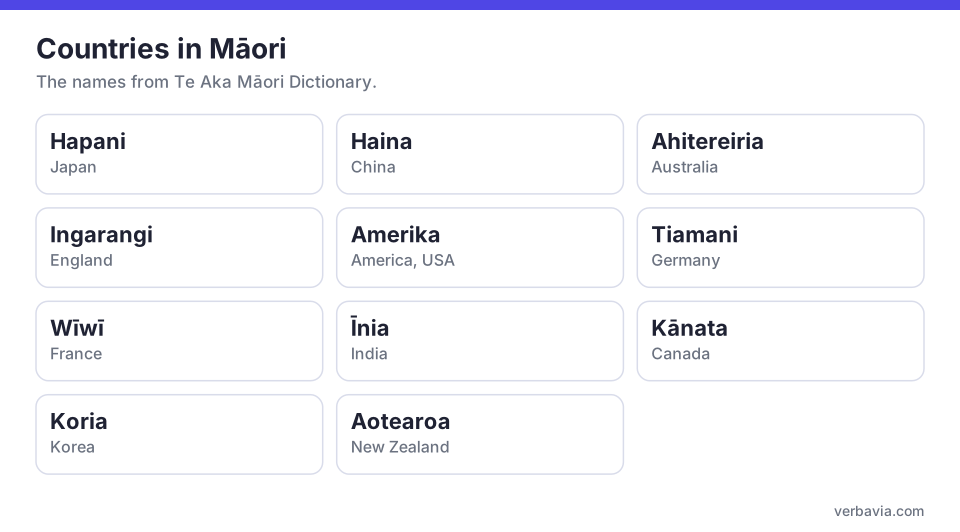
| Country | In Māori | Note |
|---|---|---|
| Japan | Hapani | Also Hapanihi, which also means Japanese. |
| China | Haina | Also Taina and Tiaina, from old newspapers. |
| Australia | Ahitereiria | Also Te Pāpaka-a-Māui. |
| England | Ingarangi | Also Ingarani. |
| America, USA | Amerika | The USA in full: Ngā Whenua Tōpū o Amerika. |
| Germany | Tiamani | Also Tiamana, Hamani, Hāmene. |
| France | Wīwī | Also Parani. |
| India | Īnia | |
| Canada | Kānata | |
| Korea | Koria | Also Kōrea. |
| New Zealand | Aotearoa | Also Niu Tīrani. |
Māori names for countries: the full list
Every name below is a Te Aka entry. Where Te Aka ties a spelling to a page of the Te Pihinga or Te Māhuri textbooks, the modern teaching books it cites, that spelling comes first and the note says “textbook”. The other spellings are Te Aka’s own synonyms, most of them found in Māori-language newspapers from the 1850s to the 1920s. None is marked wrong. Te Taura Whiri i te Reo Māori, the Māori Language Commission, sends people from overseas to the same dictionary to find the Māori name of their country.
Countries a reader will look for and not find here, including Tonga, Hawaiʻi, Ukraine and Saudi Arabia, are not in Te Aka at all. They are covered in the section on missing countries rather than given a made-up name.
Aotearoa and the Pacific
| Country | In Māori | Also in Te Aka |
|---|---|---|
| New Zealand | Aotearoa | Niu Tīrani, Niu Tīreni, Niu Tīrene |
| Australia | Ahitereiria | Te Pāpaka-a-Māui |
| Samoa | Hāmoa | |
| Fiji | Whītī | |
| Cook Islands | Kuki Airani | Kuki Airini |
| Papua New Guinea | Papua Nūkini | |
| New Caledonia | Niu Karetōnia |
Asia
| Country | In Māori | Also in Te Aka |
|---|---|---|
| China | Haina (textbook) | Taina, Tiaina |
| Japan | Hapani, Hapanihi (textbook) | Tiapana, Tiapani |
| Korea | Koria (textbook) | Kōrea, Kōria |
| Taiwan | Taiwana (textbook) | |
| Mongolia | Mongōria (textbook) | |
| Vietnam | Whitināma (textbook) | Witināma, Whitināmu |
| Thailand | Tairana (textbook) | |
| Myanmar (Burma) | Pēma (textbook) | |
| Malaysia | Marēhia (textbook) | Mareihia |
| Singapore | Hingapoa | |
| Indonesia | Initonīhia (textbook) | |
| Philippines | Piripīni (textbook) | Piripaina |
| India | Īnia (textbook) | |
| Pakistan | Pakitāne (textbook) | |
| Bangladesh | Pākaratēhi (textbook) | |
| Nepal | Nepōra (textbook) | |
| Sri Lanka | Hiri Rānaka (textbook) | Hīraka, Hīroni |
| Afghanistan | Āwhekenetāna (textbook) |
Britain and Ireland
| Country | In Māori | Also in Te Aka |
|---|---|---|
| England | Ingarangi | Ingarani |
| Scotland | Kōtirana, Kōtirangi (both textbook) | Kōtarania, Kōtarani, Kōtarana, Koterangi |
| Wales | Wēra (textbook) | Wēri, Weiri, Weira |
| Ireland | Airangi, Airani (both textbook) | Aerana, Aerani |
| United Kingdom | Peretānia | Piritānia |
| Great Britain | Piritana Nui | Piritini Nui, Kereiti Piritana; Britain: Piritene |
Europe
| Country | In Māori | Also in Te Aka |
|---|---|---|
| France | Wīwī (textbook) | Parani, Paranihi |
| Germany | Tiamani (textbook) | Tiamana, Hamani, Hāmene |
| Netherlands | Hōrana (textbook) | Since 2026 also Te Kīngitanga o Ngā Whenua Tapotu, for the Kingdom |
| Belgium | Paratiamu | Peretiama, Peratiamu, Pehiamu |
| Switzerland | Huiterangi (textbook) | Whitirana, Witirana |
| Austria | Ateria | Ataria |
| Italy | Itāria, Itari (both textbook) | |
| Spain | Peina (textbook) | Pāniora |
| Portugal | Potukara | |
| Greece | Kirihi (textbook) | Kariki |
| Denmark | Tenemāka (textbook) | |
| Norway | Nōwei (textbook) | |
| Sweden | Huītene (textbook) | Wītana, Wīreni |
| Finland | Whinarana (textbook) | Whinirana |
| Iceland | Tiorangi (textbook) | |
| Poland | Pōrana (textbook) | |
| Czech Republic | Te Whenua Tīeke | |
| Hungary | Hanekari (textbook) | |
| Russia | Rūhia (textbook) |
The Middle East and Africa
| Country | In Māori | Also in Te Aka |
|---|---|---|
| Turkey | Tāke (textbook) | Tākei, Whenua Korukoru |
| Israel | Iharaira (textbook) | |
| Palestine | Parihitini | Pirihitia |
| Lebanon | Repanona (textbook) | |
| Syria | Hiria (textbook) | |
| Iraq | Irāki (textbook) | Īrāki |
| Iran | Irāna (textbook) | Īrāna |
| United Arab Emirates | Te Kotahitanga o ngā Whenua Ārapi | |
| Egypt | Īhipa (textbook) | Ihipa |
| Algeria | Aratiria (textbook) | |
| Morocco | Marako, Moroko (both textbook) | |
| Sudan | Hūtāne (textbook) | |
| Ethiopia | Etiopia (textbook) | |
| Kenya | Kēnia (textbook) | |
| Uganda | Ukānga (textbook) | Ukāna, Ukanata |
| Tanzania | Tānahia (textbook) | |
| Nigeria | Ngāitiria (textbook) | |
| Ghana | Kāna (textbook) | |
| Zimbabwe | Timuwawe (textbook) | |
| South Africa | Āwherika ki te Tonga (textbook) |
The Americas
| Country | In Māori | Also in Te Aka |
|---|---|---|
| America, USA | Amerika (textbook) | Merika, Marikena, Marika |
| United States | Ngā Whenua Tōpū o Amerika | Te Hononga o Amerika, Te Unaititi Teiti |
| Canada | Kānata (textbook) | |
| Mexico | Mēhiko | |
| Cuba | Kiupa | Kūpā |
| Jamaica | Hemeika | |
| Brazil | Parīhi (textbook) | |
| Argentina | Āketina (textbook) | |
| Chile | Hiri (textbook) | |
| Peru | Perū (textbook) | |
| Colombia | Koromōpia (textbook) | |
| Venezuela | Wenehūera | Penehūera |
Te Aka has more countries than these, among them Laos, Bhutan, Cambodia, Cyprus, Croatia, Bulgaria, Jordan, Qatar, Libya, Madagascar, Bolivia and Uruguay. Search the English name there and the Māori entries come up with their sources.
Why does one country have several Māori names?
Because the names were made by many people over nearly two centuries, and the dictionary keeps the record. Japan is the clearest case. Te Aka lists Hapani, meaning only Japan; Hapanihi, which means Japanese and also, citing Te Pihinga, Japan; and two spellings from the newspapers, Tiapana and Tiapani. One newspaper of 1907 reports that Kua tae a Taft, hekeretari o Amerika, ki Tiapana ‘Taft, secretary of America, has arrived in Japan’.
Germany has four. Tiamani is the textbook spelling and Tiamana doubles as the word for German; Hamani appears in an 1882 sentence saying that Ingarani, Wīwī, Rūhia and Hamani, England, France, Russia and Germany, each have such songs; and Hāmene, which Te Aka does not mark as a loan, comes from an 1873 newspaper: Neke atu whakaterāwhiti ko Hāmene ‘Moving eastward is Germany’.
Ingarangi or Ingarani?
Both mean England and both are in Te Aka, which cross-refers them; it cites no textbook for either. Its example for Ingarani is that sentence of 1882; its example for Ingarangi is from 1998, about the swimmer who crossed te hawai o Ingarangi ‘the English Channel’. Ingarangi is the spelling Verbavia’s course teaches in its pepeha lesson, and both are correct.
How many names are there in all? In 2004 Philip Matthews, writing from Te Taura Whiri, counted the country names in the four largest dictionaries of the day, including the Commission’s own list in Te Matatiki (2003). Between them they gave 304 names for 230 countries. He thought it likely that only a few were in common use.
How are country names made in Māori?
Almost all are transliterations: Matthews found that just over 83 per cent of the 304 names respell the English name in Māori sounds, and only about one in eight translates any of it, wholly or in part. The sound changes are the ones the guide to English words in Māori sets out for every loanword; country names show them clearly:
- b becomes p and z becomes h: Brazil is Parīhi.
- c and g become k, d becomes t: Canada is Kānata, Argentina Āketina.
- j becomes h: Japan is Hapani, Jamaica Hemeika.
- s becomes h: Samoa is Hāmoa, Singapore Hingapoa, Sudan Hūtāne.
- f becomes wh: Fiji is Whītī, Finland Whinarana.
- l becomes r, and vowels break up the clusters: Poland is Pōrana, Nepal Nepōra.
Two English endings recur. Matthews lists the forms -land takes: Te Aka has rana in Pōrana, Tairana and Kōtirana, rangi in Airangi, Huiterangi and Ingarangi, and rani in Niu Tīrani. -stan becomes tāne in Pakitāne and tāna in Āwhekenetāna. Some names barely change: Matthews gives Tonga and Panama as names the dictionaries keep as they are, and Te Aka spells Panama Panama. How each sound is said is in the Māori pronunciation guide.
Not every name follows English. Wīwī, France, is not the word France at all: the guide to English words in Māori gives the account that it comes from French oui oui.
Country names that translate instead of borrow
A handful of names use Māori words for part or all of the name. These are the ones in Te Aka, with what the Māori words mean in Te Aka’s own entries:
| Māori | Country | How it is built |
|---|---|---|
| Āwherika ki te Tonga | South Africa | Āwherika, Africa, with ki te tonga, to the south. |
| Amerika ki te Raki | North America | Raki is northern. |
| Ngā Whenua Tōpū o Amerika | United States | Whenua is country, land; tōpū is united, combined. |
| Te Kotahitanga o ngā Whenua Ārapi | United Arab Emirates | Kotahitanga is unity; Ārapi is Arabia. |
| Te Kūrae Matomato | Cape Verde | Kūrae is headland; matomato is green, lush. |
| Te Whenua Tīeke | Czech Republic | Whenua, land, with a respelling of Czech. |
| Whenua Korukoru | Turkey | Korukoru is the turkey, the bird. |
| Tiorangi | Iceland | Its first part is tio, ice; rangi is one of the -land endings. |
Whenua Korukoru is a real usage, not a joke: Te Aka quotes it from Te Ara, where the soldiers who fell at Karipori, Whenua Korukoru, Gallipoli, are remembered on Anzac Day. Matthews, though, gave it as his example of an inappropriate translation, since it names the bird rather than the Turks. The transliteration Tāke is the textbook form.
A new name for the Netherlands, 2026
Matthews argued that Māori could stop borrowing the English name and instead translate what a country calls itself; for Iceland, he suggested, a name meaning ice land. That has now happened for one country. In January 2026 the Embassy of the Kingdom of the Netherlands in New Zealand made public a Māori name created with Te Taura Whiri: Te Kīngitanga o Ngā Whenua Tapotu ‘the Kingdom of the Low-Lying Lands’. The embassy explains that tapotu describes a low-lying area and ngā whenua means several lands, a translation of Netherlands, “Low-Lands”, and that the old Hōrana, from Holland, covered only two of its provinces. Te Aka confirms tapotu as low-lying, and kīngitanga is its word for a kingdom.
New Zealand, Australia and the Pacific
Aotearoa was first the name of the North Island, Te Aka notes, and is now used for the whole of New Zealand; its meaning and the stories behind it are in Māori place names, and the voyager credited with the name is in Kupe: who discovered New Zealand? The transliteration Niu Tīrani is older and still in Te Aka, with the variants Niu Tīreni and Niu Tīrene.
Australia has two names. Ahitereiria is the loan; Te Pāpaka-a-Māui is not marked as one, and Te Aka’s example for it is a sentence from 2012: Ko Te Pāpaka-a-Māui te whenua i tanumia ai tērā koroua ōku ‘Australia is the country where that grandfather of mine is buried’. Te Aka does not explain the name, so neither does this page.
For Pacific neighbours Te Aka has Hāmoa, Whītī, Kuki Airani and Papua Nūkini. An example from 1903 shows the name in use: I runga i te tima ka tūtaki ahau ki ētahi māori nō ngā motu, nō Hāmoa ‘On the ship I met some indigenous people from the islands, from Samoa’. How close the languages of those islands are to Māori is the subject of three other guides: Māori vs Samoan and Tongan, Māori vs Cook Islands Māori and Māori vs Hawaiian.
The ocean they share is Te Moana-nui-a-Kiwa ‘the Pacific Ocean’. A trap for the unwary: Te Aka’s Rarotonga entry is Mount Smart in Auckland, not the island.
Countries Te Aka does not list
Searched on 13 November 2026, Te Aka has no entry for Tonga, Hawaiʻi, Tahiti, Niue, Tokelau, Tuvalu, Kiribati, Vanuatu, the Solomon Islands or Easter Island, nor for Ukraine, Saudi Arabia, Kuwait, Yemen, Serbia, Slovakia, Estonia, Latvia, Malta, Luxembourg, Kazakhstan, Uzbekistan or Cameroon. Searching for Tonga finds only tonga, south, and Tahiti only tahiti, distant.
Some of these do have Māori forms in print dictionaries. Matthews says Tonga keeps its own name unchanged, and that one dictionary name, Hawai‘i, keeps the Hawaiian glottal stop, the only one of 304 to use a letter Māori does not have. For the rest, Te Aka has no entry and no other official list could be found online, so the page offers no name for them. Te Taura Whiri’s lists of 2001 and 2003 covered 214 countries between them, Matthews reports, so a printed name may exist; it is not online to check.
Continents in Māori
| Māori | English | Note |
|---|---|---|
| Āhia | Asia | Te Pihinga textbook. |
| Ūropi | Europe | Textbook; also Ōropi, Iuropi, Ūrapi. |
| Āwherika | Africa | Textbook; also Wherika. |
| Amerika ki te Raki | North America | |
| Amerika ki te Tonga | South America | Te Māhuri textbook. |
| Ahitereiria | Australia | No entry for Oceania. |
| Te Tiri o Te Moana | Antarctica | Also Te Kōpakatanga ki te Tonga and Te Kōpaka Runga. |
Raki and tonga in the two Americas are the ordinary words for north and south, the ones in Māori directions.
Nationalities and languages
Many country names double as the nationality: Te Aka gives Hāmoa as Samoan as well as Samoa, and Whītī as Fijian. Others have a separate form:
| Māori | English | Also in Te Aka |
|---|---|---|
| Hapanihi | Japanese | Tiapani, Tiapanihi |
| Hainamana | Chinese | Tainamana, Tiainamana |
| Ingarihi | English, Englishman | |
| Kōtimana | Scottish, Scotsman | Kōtarani |
| Airihi | Irish | |
| Tiamana | German | Tiamani |
| Wīwī | French, Frenchman | |
| Pāniora | Spanish, Spaniard | |
| Itāriana | Italian | Itāria, Itari, Itariana |
| Tatimana | Dutch, Dutchman | Tati |
| Kariki | Greek | Kiriki |
| Rūhia | Russian | |
| Īniana | Indian | Īnia |
| Amerikana | American | Merikana, Marikena |
| Kānata | Canadian | |
| Ahitereiriana | Australian | |
| Whītīana | Fijian | Whītī |
A language is the same word after reo. Te Aka’s examples include a man who kāore ia i mōhio ki te reo Pāniora ‘didn’t know the Spanish language’ (1901), the two words i te reo Kariki ‘in Greek’ for love (1998), and Awatere teaching himself ki te kōrero Hapanihi ‘to speak Japanese’ (2000). As a modifier, Pākehā can also mean English or foreign, one of the senses set out in What does Pākehā mean?, and how Māori itself came to name a people is in What does Māori mean?
How do you say “I am from …” in Māori?
Use nō, from, belonging to, with the country’s name. Verbavia’s course teaches Nō Ingarangi ahau. ‘I am from England.’ in its pepeha lesson, and the pepeha guide explains why it is nō and not nā. Te Taura Whiri’s short mihi uses two more frames: Nō … ōku tīpuna ‘my ancestors are from …’ and Kei te noho au ki … ‘I live in …’. It adds that several places are joined with me, and, before the last one.
The lines below put a Te Aka country name into those printed frames, with nothing else changed:
| Māori | English |
|---|---|
| Nō Hapani ahau. | I am from Japan. |
| Nō Amerika ahau. | I am from America. |
| Nō Ingarangi me Airangi ōku tīpuna. | My ancestors are from England and Ireland. |
| Kei te noho au ki Ahitereiria. | I live in Australia. |
Either tīpuna or tūpuna is right in that line: Te Taura Whiri gives the first as the eastern spelling and the second as the western. The split is explained in Māori dialects. For a whole introduction at a hui, see mihi whakatau.
Overseas, abroad and foreign
The everyday word for overseas is tāwāhi, the other side of the sea, so ki tāwāhi is to overseas. Te Aka also has tauwhenua, a strange land, a foreign country, and whenua itself, which means country, nation as well as land. Getting there is in transport in Māori.
Going further
The free te reo Māori course teaches nō, the pepeha and the everyday words around them one short lesson a day. For a quick test of the words on this page and others, try the Māori quiz.
Learn te reo Māori with Verbavia
Verbavia’s free te reo Māori course starts with the most common words, explains the grammar properly, and plays every example in Papa Reo’s native te reo voice. One lesson a day, from your first word to B1.
Quick questions
What is Japan in Maori?
Te Aka gives Hapani, and also Hapanihi, the form its textbook reference uses, which also means Japanese.
What is England in Māori?
Ingarangi, also spelt Ingarani; both are in Te Aka. The United Kingdom is Peretānia.
What is America in Māori?
Amerika. The United States in full is Ngā Whenua Tōpū o Amerika.
What is Australia in Māori?
Ahitereiria, the loan from English; Te Aka also lists Te Pāpaka-a-Māui.
What is Germany in Māori?
Tiamani in the textbook spelling; Te Aka also has Tiamana, Hamani and Hāmene.
Sources
- Te Aka Māori Dictionary: Hapani (Japan)
- Te Aka Māori Dictionary: Hapanihi
- Te Aka Māori Dictionary: Tiapana
- Te Aka Māori Dictionary: Tiapani
- Te Aka Māori Dictionary: Haina (China)
- Te Aka Māori Dictionary: Ahitereiria (Australia)
- Te Aka Māori Dictionary: Te Pāpaka-a-Māui (Australia)
- Te Aka Māori Dictionary: Ingarangi (England)
- Te Aka Māori Dictionary: Ingarani (England)
- Te Aka Māori Dictionary: Amerika
- Te Aka Māori Dictionary: Ngā Whenua Tōpū o Amerika
- Te Aka Māori Dictionary: Tiamani (Germany)
- Te Aka Māori Dictionary: Tiamana (Germany, German)
- Te Aka Māori Dictionary: Hamani (Germany)
- Te Aka Māori Dictionary: Hāmene (Germany)
- Te Aka Māori Dictionary: Wīwī (France, French)
- Te Aka Māori Dictionary: Aotearoa
- Te Aka Māori Dictionary: Niu Tīrani
- Te Aka Māori Dictionary: Hāmoa (Samoa, Samoan)
- Te Aka Māori Dictionary: Whītī (Fiji, Fijian)
- Te Aka Māori Dictionary: Kuki Airani (Cook Islands)
- Te Aka Māori Dictionary: Rarotonga (Mount Smart)
- Te Aka Māori Dictionary: Peretānia (United Kingdom)
- Te Aka Māori Dictionary: Hōrana (Netherlands)
- Te Aka Māori Dictionary: tapotu (low-lying)
- Te Aka Māori Dictionary: Tāke (Turkey)
- Te Aka Māori Dictionary: Whenua Korukoru (Turkey)
- Te Aka Māori Dictionary: Tiorangi (Iceland)
- Te Aka Māori Dictionary: tio (ice)
- Te Aka Māori Dictionary: Āwherika ki te Tonga (South Africa)
- Te Aka Māori Dictionary: Te Kūrae Matomato (Cape Verde)
- Te Aka Māori Dictionary: Āhia (Asia)
- Te Aka Māori Dictionary: Ūropi (Europe)
- Te Aka Māori Dictionary: Āwherika (Africa)
- Te Aka Māori Dictionary: Amerika ki te Raki (North America)
- Te Aka Māori Dictionary: Amerika ki te Tonga (South America)
- Te Aka Māori Dictionary: Te Tiri o Te Moana (Antarctica)
- Te Aka Māori Dictionary: Pāniora (Spain, Spanish)
- Te Aka Māori Dictionary: Kariki (Greek)
- Te Aka Māori Dictionary: nō
- Te Aka Māori Dictionary: tāwāhi (overseas)
- Te Aka Māori Dictionary: tauwhenua (foreign country)
- Te Aka Māori Dictionary: whenua
- Philip W. Matthews (Te Taura Whiri i te Reo Māori), Decolonizing the Dictionary: A Preliminary Investigation into Country Names in Maori, EURALEX 2004 Proceedings
- Embassy of the Kingdom of the Netherlands in New Zealand: a new office, a new name (15 January 2026)
- Te Taura Whiri i te Reo Māori: Learn your mihi