Māori question words: who, what, where, when
The main Māori question words are wai ‘who’, aha ‘what’, hea ‘where’, āhea ‘when, of the future’ and inahea ‘when, of the past’, pēhea ‘how’, hia ‘how many’ and tēhea ‘which’, and to ask why you put he aha in front of the sentence and ai after the verb. Each one usually comes with a small word in front of it, so the phrase to learn is kei hea ‘where is’ or ko wai ‘who is’, not the bare word. Below is each of these maori question words with the questions it makes, all from Verbavia’s course, and the one rule that makes them easy: the question word goes where the answer will go.
Tap 🔊 to hear an example. Māori examples play Papa Reo, the te reo Māori voice made by Te Hiku Media from recordings of native speakers. Every sentence in the free course is spoken like this.
On this page
- Māori question words at a glance
- Where does the question word go in a Māori sentence?
- How do you say who in Māori?
- How do you say what in Māori?
- How do you say where in Māori?
- When: āhea or inahea?
- How do you ask why in Māori?
- How and how many: pēhea, e hia and tokohia
- Which: tēhea and ēhea
- Whose, who for, and what for
- How do you ask a yes-or-no question in Māori?
- Practising the question words
- Quick questions
Māori question words at a glance
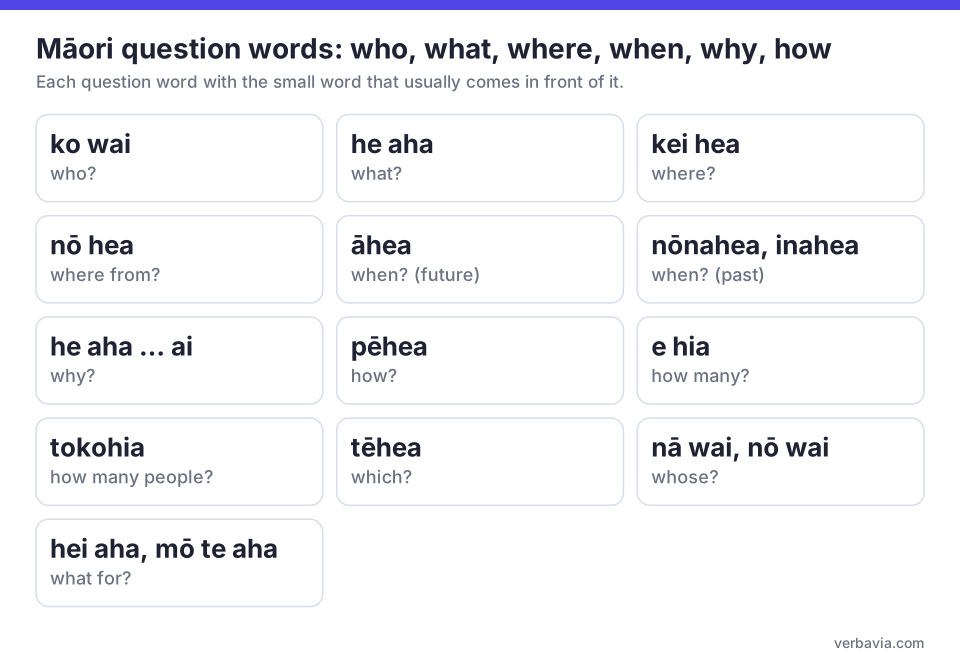
| English | Māori | Example |
|---|---|---|
| who? | ko wai | Ko wai koe? ‘Who are you?’ |
| what? | he aha | He aha tēnei? ‘What is this?’ |
| where? | kei hea | Kei hea koe? ‘Where are you?’ |
| where from? | nō hea | Nō hea koe? ‘Where are you from?’ |
| when? (future) | āhea | Āhea te hui? ‘When is the meeting?’ |
| when? (past) | nōnahea, inahea | Nōnahea te hui? ‘When was the meeting?’ |
| why? | he aha … ai | He aha koe i haere ai? ‘Why did you go?’ |
| how? | pēhea | Kei te pēhea koe? ‘How are you?’ |
| how many? | e hia | E hia ngā pukapuka? ‘How many books?’ |
| how many people? | tokohia | Tokohia ngā tamariki? ‘How many children?’ |
| which? | tēhea | Ko tēhea tāu? ‘Which one is yours?’ |
| whose? | nā wai, nō wai | Nā wai tēnei? ‘Whose is this?’ |
| what for? | hei aha, mō te aha | Hei aha? ‘What for?’ |
Every meaning here is Te Aka Māori Dictionary’s. The sections below take the words one at a time.
Where does the question word go in a Māori sentence?
English moves the question word to the front and rearranges the verb: you went to town becomes where did you go? Māori leaves the sentence alone and puts the question word in the place the answer will fill. Ask the question, swap in the answer, and you have your reply:
| Question | Answer |
|---|---|
| He aha tēnei? ‘What is this?’ | He pukapuka tēnei. ‘This is a book.’ |
| Kei hea koe? ‘Where are you?’ | Kei te kura au. ‘I’m at school.’ |
| Tokohia ngā tamariki? ‘How many children?’ | Tokotoru ngā tamariki. ‘Three children.’ |
| Nā wai tēnei pukapuka? ‘Whose is this book?’ | Nāku. ‘Mine.’ |
This is why Kei te kai koe i te aha? ‘What are you eating?’ keeps aha at the end, where the food would be. The whole of a Māori sentence, marker first and verb second, is laid out in Māori sentence structure.
How do you say who in Māori?
Who is wai, and it nearly always follows ko: ko wai is who is. Māori also uses it to ask a name, where English says what.
| Māori | English |
|---|---|
| Ko wai tōu ingoa? | What is your name? |
| Ko wai tēnā? | Who’s that? |
| Ko wai i haere ki te toa? | Who went to the shop? |
| I kite koe i a wai? | Whom did you see? |
| I haere kōrua ko wai? | Who did you go with? |
| Ko wai tō maunga? | Which is your mountain? |
The last one asks for a line of a pepeha: the course asks Ko wai tō maunga? and Ko wai tō iwi? with ko wai, where English would say which. The whole speech is in how to write a pepeha, and asking a name and where someone is from, with the replies, is also in common Māori phrases.
How do you say what in Māori?
What is aha. To ask what something is, use he aha; to ask what someone is doing, put aha where the verb would be.
| Māori | English |
|---|---|
| He aha tēnei? | What is this? |
| He aha tāu mahi? | What do you do? (your work) |
| He aha te tikanga o tēnā kupu? | What does that word mean? |
| He aha te mate? | What’s wrong? |
| Kei te aha koe? | What are you doing? |
| Me aha tāua? | What should you and I do? |
| He aha te tāima? | What’s the time? |
Te Aka lists aha as a noun, what?, and as a verb, to do what?, which is how Kei te aha koe? works: it is you are doing what? The doctor’s He aha te mate? and the replies to it are in health words in Māori.
How do you say where in Māori?
Where is hea, and the small word in front of it sets the time and the direction, just as it does for any place.
| Māori | English | The small word |
|---|---|---|
| Kei hea te tūnga pahi? | Where is the bus stop? | kei: where is, now |
| I hea koe inanahi? | Where were you yesterday? | i: where was |
| Hei hea tātou āpōpō? | Where will we be tomorrow? | hei: where will be |
| Kei te haere koe ki hea? | Where are you going? | ki: where to |
| Nō hea koe? | Where are you from? | nō: where from |
| Kei hea koe e noho ana? | Where do you live? |
The answer to Nō hea koe? keeps the nō: Nō Pōneke mātou. ‘We are from Wellington.’ Place words such as inside, beside and under, which answer kei hea, are in Māori directions.
When: āhea or inahea?
Māori has one word for when about the future and another about the past. Te Aka gives āhea as “when? (of future time)” and inahea and nōnahea as when, in the past. The course’s lessons use nōnahea.
| Māori | English |
|---|---|
| Āhea koe haere ai? | When will you go? |
| Āhea tōu huritau? | When is your birthday? |
| Āhea te pahi haere ai? | When does the bus leave? |
| Nōnahea koe i tae mai ai? | When did you arrive? |
| Nōnahea te hui? | When was the meeting? |
When there is a verb, it is followed by ai, as in Āhea koe haere ai?. To ask the time on the clock, ask with e hia: E hia karaka? ‘What o’clock?’ The days and months that answer these are in Māori numbers, days and months, and Āhea tōu huritau? leads naturally to happy birthday in Māori.
How do you ask why in Māori?
There is no single word for why. You ask what, with he aha at the front and ai after the verb. Te Aka records the pattern as he aha … i … ai, why did.
| Māori | English |
|---|---|
| He aha koe i haere ai? | Why did you go? |
| He aha i pērā ai? | Why was that? |
| He aha ai? | Why? |
Te Aka also lists nā te aha … i … ai with the same meaning. The reply can begin nō te mea ‘because’.
How and how many: pēhea, e hia and tokohia
Pēhea is how, and it is in the first question most learners ask: Kei te pēhea koe? ‘How are you?’ Change the small word in front and it asks how something was or how to do it.
| Māori | English |
|---|---|
| Kei te pēhea koe? | How are you? |
| I pēhea te hui? | How was the meeting? |
| Me pēhea te inu i tēnei? | How do I take this? (medicine) |
| Kei te pēhea te āhua o te rangi? | What’s the weather like? |
| Kia pēhea te roa o te hui? | How long is the meeting? |
How many is hia. For things and for money say e hia; for people say tokohia, because Māori counts people with their own prefix, toko-.
| Māori | English |
|---|---|
| E hia ngā whare? | How many houses? |
| E hia te utu? | How much is it? |
| E hia ōu tau? | How old are you? |
| Tokohia āu tamariki? | How many children have you got? |
| Tokohia koutou? | How many of you are there? |
Counting people and counting things are set side by side in Māori numbers, and the price questions in a shop are in shopping in Māori.
Which: tēhea and ēhea
Which is tēhea for one thing and ēhea for more than one; the t drops off for the plural, the same way tēnei ‘this’ becomes ēnei ‘these’.
| Māori | English |
|---|---|
| Ko tēhea tāu? | Which one is yours? |
| Ko tēhea? Ko tērā, te mea whero. | Which one? That one, the red one. |
| Nō ēhea hapū kōrua? | Which hapū are you two from? (Te Aka’s example) |
Te mea whero, the red one, is the kind of answer Māori colours sets up.
Whose, who for, and what for
Wai and aha combine with the possessive words nā, nō, mā and mō. Whether it is nā or nō depends on the thing owned, by the same a-or-o choice as tāku and tōku.
| Māori | English |
|---|---|
| Nā wai tēnei pukapuka? Nāku. | Whose is this book? Mine. |
| Nō wai tēnei whare? Nō Mere. | Whose is this house? Mere’s. |
| Nā wai i tuhi? | Who wrote it? |
| Mā wai e mahi? Māku e mahi. | Who will do it? I will. |
| Mā wai tēnei kai? Māu. | Who is this food for? For you. |
| Hei aha? | What for? |
| Mō te aha? Mō te hui. | What for? For the meeting. |
| Mā te aha? Mā runga pahi. | By what? By bus. |
Mā te aha? as a question, by what means?, is how the course asks how you travel, and the answer is in transport in Māori. Said on its own as a comment, Te Aka records mā te aha as an idiom: “well it was alright, better than nothing”.
How do you ask a yes-or-no question in Māori?
With no question word at all. Say the statement with a rising voice, and it is a question. Add nē for isn’t it?, or rānei to offer a choice.
| Māori | English |
|---|---|
| Kei te haere koe? | Are you going? |
| Kei te haere koe, nē? | You’re going, aren’t you? |
| Kei te haere koe, kāore rānei? | Are you going, or not? |
| He kawhe rānei, he tī rānei? | Coffee, or tea? |
| Kua kai koe? Kāore anō. | Have you eaten? Not yet. |
The short answers are āe ‘yes’ and kāo ‘no’. Kāo only answers a question; to make a sentence negative you need kāore, as the sentence structure guide shows. The verbs inside these questions are listed in Māori verbs.
Practising the question words
Every question on this page is taught in Verbavia’s free te reo Māori course, where you can hear it. A 30-day plan whose second week is who you are and where you are from is in learn Māori for beginners. For a pen-and-paper test of the basics, try our te reo Māori quiz.
Learn te reo Māori with Verbavia
Verbavia’s free te reo Māori course starts with the most common words, explains the grammar properly, and plays every example in Papa Reo’s native te reo voice. One lesson a day, from your first word to B1.
Quick questions
How do you say why in Māori?
Put he aha at the front and ai after the verb: He aha koe i haere ai? ‘Why did you go?’ On its own, He aha ai? means why?
What is the difference between āhea and inahea?
Āhea asks when about the future, and inahea or nōnahea asks when about the past: Āhea te hui? ‘When is the meeting?’ but Nōnahea te hui? ‘When was the meeting?’
How do you ask someone’s name in Māori?
Ko wai tōu ingoa? Māori asks who is your name, not what. The answer is Ko Mere tōku ingoa. ‘My name is Mere.’
How do you say where are you from in Māori?
Nō hea koe? The answer keeps the nō: Nō Pōneke mātou. ‘We are from Wellington.’
Sources
- Te Aka Māori Dictionary: wai — who? whom?; what? (for people’s names).
- Te Aka Māori Dictionary: aha — what?; to do what?
- Te Aka Māori Dictionary: hea — where? what place?, after kei, ki, i, nō, mā.
- Te Aka Māori Dictionary: āhea — when? (of future time).
- Te Aka Māori Dictionary: inahea — when? (past time).
- Te Aka Māori Dictionary: nōnahea — when? at what time? (past tense).
- Te Aka Māori Dictionary: pēhea — how? of what sort?
- Te Aka Māori Dictionary: hia — how many? (e hia, tokohia).
- Te Aka Māori Dictionary: tokohia — how many (people)?
- Te Aka Māori Dictionary: tēhea — which? (one thing).
- Te Aka Māori Dictionary: ēhea — which? (plural); example Nō ēhea hapū kōrua?
- Te Aka Māori Dictionary: he aha … i … ai — why did? why were?
- Te Aka Māori Dictionary: nā te aha … i … ai? — why did? why are?
- Te Aka Māori Dictionary: hei aha — what for?
- Te Aka Māori Dictionary: mā te aha — idiom, well it was alright, better than nothing.