What does whaka mean? The Māori prefix whaka- explained
The short answer to “what does whaka mean” is to cause something to happen: whaka- is not a word on its own in Māori but a prefix, joined to the front of another word to make a verb of causing or becoming, so that ako ‘to learn’ gives whakaako ‘to teach’ and oti ‘finished’ gives whakaoti ‘to finish’. That definition is Te Aka Māori Dictionary’s, and the same entry records a second job for the prefix, towards, as in whakamua ‘forwards’. Below are both meanings with the dictionary’s own examples, 28 everyday whaka- words beside the words they are built on, the ones that are not what they seem (whakaaro, whakapapa, whakamā), how to say it, and what it is doing at the front of Whakatāne and other place names.
Tap 🔊 to hear an example. Māori examples play Papa Reo, the te reo Māori voice made by Te Hiku Media from recordings of native speakers. Every sentence in the free course is spoken like this.
On this page
- What does whaka- mean in Māori?
- 28 everyday whaka- words, and the word inside each
- Which whaka- words do not simply mean ‘cause to’?
- Whaka as a direction: towards
- How do you pronounce whaka?
- What does Whaka mean in place names?
- How do whaka- words behave in a sentence?
- Whā-, whā and whāka: the lookalikes
- How to guess the meaning of a new whaka- word
- Quick questions
| What you see | What it means | Example |
|---|---|---|
| whaka- on a describing word or a state | to make it so | pai ‘good’ → whakapai ‘to make good, improve’ |
| whaka- on an action | to cause it, or to get someone to do it | inu ‘to drink’ → whakainu ‘to give drink to’ |
| whaka- on a noun, or the name of a language | to become one; to translate into it | ingoa ‘name’ → whakaingoa ‘to name’ |
| whaka- on a place or direction word, after a verb | towards | huri whakatemauī ‘turn left’ |
| Whaka- at the start of a place name | usually the same prefix inside a longer word; in some South Island names, a form of whanga ‘harbour, bay’ | Whakatāne; Whakaraupō |
| whā-, whā, whāka | lookalikes: a short form of the prefix; four; a fork | whāngote ‘to breastfeed’ |
What does whaka- mean in Māori?
Te Aka files whaka- as a particle and gives it seven numbered uses, most of them credited to the textbook Te Kākano. The first is the definition in the dictionary’s own words: “to cause something to happen, cause to be”. Its word for a prefix is pīmua, and whaka- is one of the eight it names there. Five of the seven uses are that one idea applied to different kinds of word, each with a sentence of Te Aka’s:
| Te Aka’s example | Its translation | What whaka- is joined to |
|---|---|---|
| E whakatikatika ana te kaiako i ngā mahi a Hirini. | The teacher is correcting Sydney’s work. | Adjectives, statives and verbs that take no direct object, doubled forms included. Here it is tika ‘correct’, said twice. |
| E whakakite ana ia i tana pūtōrino ki ngā whakaminenga. | She is showing her pūtōrino flute to the audience. | A few verbs of perception that do take an object. Te Aka names five: kite, mōhio, rongo, inu and ako. |
| Kua whakapaua aku moni e taku tama. | My son has spent my money. | A stative. The new word is a verb that takes an object, and a passive ending in a passive sentence. |
| I mōhio iho au ki ngā tāngata i whakaingoatia. | I knew the people named. | Some nouns: to become a, or, with the name of a language, to translate. |
| Kīhai rāua i whakaae kia haere au ki te pakanga i Irāki. | They did not agree that I should go to the war in Iraq. | A few words of other kinds. Te Aka lists āe ‘yes’, atu ‘away’, kāhore ‘no, not’ and kore ‘not, none’. |
One more use is rare: with a numeral, the prefix makes a fraction. Te Aka’s example is whakatekau ‘a tenth part, a tithe’, and it adds that this is “uncommon in modern Māori”. The last is the meaning towards, which has a section of its own below.
What all of this has in common is that whaka- turns a word into something a person does. A word for how a thing is, such as mahana ‘warm’, becomes the act of getting it that way, whakamahana ‘to warm, heat up’. How describing words work before the prefix is added is in Māori adjectives.
28 everyday whaka- words, and the word inside each
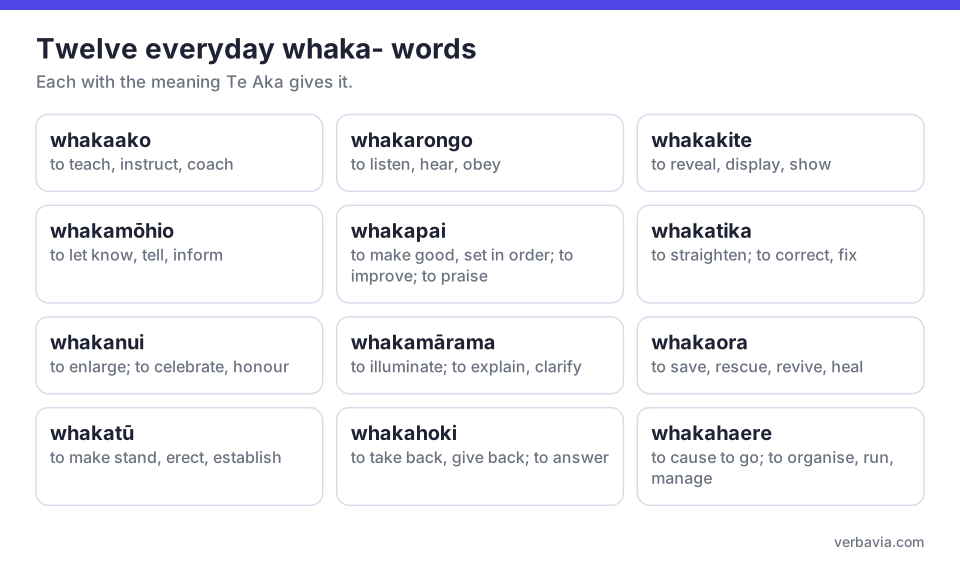
Every meaning in this table is from that word’s own entry in Te Aka, shortened. Nothing on the right was worked out from the left: each whaka- word is a headword in its own right.
| Word | Meaning | With whaka- | Meaning |
|---|---|---|---|
| ako | to learn, study | whakaako | to teach, instruct, coach |
| rongo | to hear, feel, smell, taste | whakarongo | to listen, hear, obey |
| kite | to see, perceive | whakakite | to reveal, display, show |
| mōhio | to know, understand | whakamōhio | to let know, tell, inform |
| inu | to drink | whakainu | to give drink to, serve drink |
| pai | to be good | whakapai | to make good, set in order; to improve; to praise |
| tika | to be correct; to be straight | whakatika | to straighten; to correct, fix |
| nui | to be big, great, many | whakanui | to enlarge; to celebrate, honour |
| iti | to be small | whakaiti | to make small, lessen; to belittle |
| mārama | to be clear, light | whakamārama | to illuminate; to explain, clarify |
| mahana | to be warm | whakamahana | to warm, heat up |
| mutu | to be ended, finished | whakamutu | to cause to cease, stop, conclude |
| oti | to be finished, complete | whakaoti | to complete, finish |
| pau | to be used up, spent | whakapau | to use up, spend, exhaust |
| kī | to be full | whakakī | to fill |
| ora | to be alive, well, healthy | whakaora | to save, rescue, revive, heal |
| mate | to be dead; to be sick | whakamate | to put to death; to cause to be sick |
| noho | to sit, stay, live | whakanoho | to place, cause to sit, settle, establish |
| tū | to stand | whakatū | to make stand, erect, establish |
| hoki | to go back, return | whakahoki | to take back, give back; to answer |
| haere | to go | whakahaere | to cause to go; to organise, run, manage |
| oho | to wake up | whakaoho | to startle, awaken, rouse |
| tipu | to grow | whakatipu | to cause to grow, raise, bring up |
| mahi | to work, do | whakamahi | to set to work, operate, use |
| ingoa | name | whakaingoa | to name, nominate |
| Māori | Māori | whakamāori | to translate into Māori; to interpret, explain |
| Pākehā | English, European | whakapākehā | to translate into English |
| āe | yes; to agree | whakaae | to agree, consent, say yes |
Read across any row and the prefix is doing one job. Read down the last column and you can see how far some of the meanings have travelled since. Whakanui is to make big, and so to celebrate; its opposite, whakaiti, is to make small, and so to run someone down. Whakahoki is to give something back, an answer included. Whakahaere, to make go, is the word for organising, running and managing things. The first two rows are taken further in Māori verbs, which sets hearing beside listening and notes that ako on its own already covers both learning and teaching.
The prefix is still at work on new words. The guide to English words in Māori has it making a verb out of a borrowed noun, and friend in Māori shows it turning hoa ‘friend’ into the verb for making friends.
Which whaka- words do not simply mean ‘cause to’?
Some of the commonest whaka- words cannot be read off their parts. Te Aka gives no word histories, so the last column below is only what the dictionary says about the rest of the word, set beside it for you to judge:
| Word | Te Aka’s meaning | What is left without whaka- |
|---|---|---|
| whakaaro | to think, plan, consider, decide; a thought, opinion, idea | aro: to face, turn towards, take heed, pay attention to, consider |
| whakapapa | to lie flat; to place in layers; to recite in proper order; genealogy, lineage, descent | papa: anything broad, flat and hard, such as a board, a floor, the Earth |
| whakapono | to believe, trust; faith, belief | pono: true, valid, honest, genuine, sincere |
| whakamā | to be ashamed, shy, bashful, embarrassed; shame | mā: white, clean. Te Aka has a second, separate whakamā: to whiten |
| whakaata | to exhibit, display, reflect, simulate, act | ata: form, shape; reflected image; shadow |
| whakairo | to carve, ornament with a pattern; a carving | Nothing that helps: Te Aka’s two entries for iro are a maggot and to be submissive, and it links neither to carving |
| whakawhetai | to give thanks, be grateful | Te Aka has no whetai. It says the word is “reputed to have been adopted from Tahitian in post European contact times” |
| whakahīhī | to be proud; to be vain, arrogant; to sneer | Te Aka has no headword hīhī |
What does whakapapa mean?
Whakapapa is genealogy: Te Aka’s noun is genealogy, genealogical table, lineage, descent. The same entry begins with three verbs, and they explain the noun better than a translation does: to lie flat; to place in layers, lay one upon another; and to recite in proper order, of genealogies, legends or the months. Te Aka’s example sentence is He mea nui ki a tātau ō tātau whakapapa. ‘Our genealogies are important to us.’ Why the idea reaches further than a family tree is in Māori words with no English equivalent, and how a person states their own in a few lines is in pepeha.
Whakamā, whakaaro and whakapono
Whakamā is the clearest warning against guessing. Te Aka has two entries spelt this way. One is the regular kind, to whiten, from mā ‘white, clean’. The other is the one people use every day, to be ashamed, shy, bashful, embarrassed, and it is not something done to anything: the dictionary lists no passive ending for it. Verbavia’s course reads the feeling as the same two parts, to be made pale; Te Aka keeps the entries apart and does not say. The feeling itself, and when to say Kaua e whakamā ‘Don’t be shy’, is in Māori words for feelings.
Whakaaro and whakapono sit closer to their parts. Turning towards a thing and taking heed of it is not far from thinking about it, and holding something as true is believing it. Both are also nouns, which a plain causative verb is not: Ki tāku whakaaro, he tika tērā. ‘In my opinion, that’s right.’ is a sentence from the course, and whakapono is faith as well as to believe.
Whakaata and whakairo
Whakaata is regular once you know that ata is a reflected image: it is to reflect, and so to display. It is the second half of pouaka whakaata ‘television’, and Whakaata Māori is Te Aka’s entry for Māori Television. Whakairo is carving, both the act and the finished work, and has to be learned whole. Carved houses are described in the parts of a marae. A proverb is a whakataukī, another word best learned as it stands; the sayings themselves are in whakataukī: Māori proverbs.
Whaka as a direction: towards
The same prefix has a second meaning in Te Aka: towards, in the direction of. It is joined to the location words, and to nouns with te ‘the’ in between, and the dictionary notes that the three parts are sometimes written with hyphens. These words normally follow another word and qualify it, most often a verb of moving, turning or looking.
| Māori | Te Aka’s meaning |
|---|---|
| whakamua | forward, ahead, towards the front |
| whakamuri | backwards, behind, towards the rear |
| whakaroto | inwards, in, inland |
| whakawaho | outwards, out, seawards |
| whakauta | inland, towards the interior |
| whakatemoana | towards the sea, seaward |
| whakatemauī | towards the left |
Te Aka’s examples show them at work: Huri whakatemauī! ‘Turn left, please!’; people leaving a pā before dawn who, in a text of 1899, ka ahu whaka-Waikato ‘headed towards Waikato’; and Ka titiro whakatemoana te iwi rā ‘The people all looked towards the sea’. The pattern is the same with a place name as with a direction. North and south are said this way too, with a twist that Māori directions explains.
How do you pronounce whaka?
Say fah-kah: two short syllables, wha-ka. Te Taura Whiri i te Reo Māori, the Māori Language Commission, puts the first sound in one line: the wh “is usually pronounced as an English ‘f’ sound”. Te Herenga Waka Victoria University of Wellington adds that it once sounded like the wh of whisper and has become more like f in most dialects, and it gives the short Māori a as the a of aloud. Both vowels in whaka- are that short one. The long ā, held for longer, belongs to different words, whā ‘four’ among them.
English speakers sometimes hear a rude English word in that first syllable; the likeness is an accident of the f sound, and the words Māori really does curse with are a different set, covered in Māori swear words.
Not everyone says f. Te Ara, the Encyclopedia of New Zealand, records that in some parts of Northland “the ‘wh’ in ‘whaka’ is pronounced as ‘h’, so ‘whakahaere’ sounds like ‘hakahaere’”, and that among the Whanganui and Taranaki tribes wh is a w followed by a glottal stop. Neither is a mistake, and neither changes the spelling. The regional sounds are set out in Māori dialects, and every letter of the alphabet in the Māori pronunciation guide.
One spelling point follows from the prefix. When the word it joins begins with a, the two vowels stay separate letters: whakaako, whakaaro, whakaae, whakaata. A doubled a there is the seam between two parts, not a long vowel, which is why how to type Māori macrons warns against writing it with a macron.
What does Whaka mean in place names?
Usually it is the prefix again, at the front of a verb or a longer phrase that has become a name. The New Zealand Gazetteer’s index of names held 313 beginning with Whaka when it was counted for this guide in November 2026, 116 of them official. The name as a whole has a story, and the story is what the sources give:
| Name | Where | What the sources say |
|---|---|---|
| Whakatāne | Town and river, Bay of Plenty | Te Aka has the verb whakatāne, to show manly qualities, act like a man, and quotes the cry the town is named for. NZ History: “Lit: To play the man.” |
| Whakaari / White Island | Bay of Plenty | NZ History: to show or expose to view. Te Aka’s verb whakaari is to show, display, expose to view. Te Aka also lists a second Whakaari, a ridge near Dunedin known as Flagstaff, “misspelt as Wakari”. |
| Whakarewarewa | Rotorua | NZ History gives the full name as Te Whakarewarewatanga-o-te-ope-a-Wahiao, “the uprising of the army of Wahiao”, a war party that gathered there and performed a war dance before battle. Te Aka’s whakarewarewa is a haka as a show of force before an attack. |
| Whakatū | Nelson | Te Aka lists it as the Māori name for Nelson, and Te Ara says Māori knew the area by this name. Neither gives a meaning, so none is offered here. |
| Whakaoriori | Masterton | Te Aka’s name for Masterton. It also has a common noun spelt the same way, a lullaby, but does not connect the two. |
| Whakapapa | Village and ski area, Tongariro National Park | Spelt like the word for genealogy. No source reached for this guide explains the place name. |
| Whakaraupō | Lyttelton Harbour | Christchurch City Libraries: “Harbour of the Raupō Reed”. A different whaka: see below. |
What does Whakatāne mean?
Whakatāne is the prefix on tāne ‘man’: Te Aka’s verb whakatāne is to show manly qualities, act like a man, and its whakawahine ‘to become a woman’ is built the same way. Tradition ties the name to the arrival of the Mataatua canoe. The captain and his men had gone ashore, the canoe began to drift out on the tide, and a woman on board saved it, crying out as she did so that she would act as a man. The sources tell it with different women and slightly different words:
| Source | Who | The words, as printed |
|---|---|---|
| Te Ara, the Ngāti Awa story | Wairaka, daughter of the captain, Toroa | Kia whakatāne au i ahau! “I will act like a man” |
| Te Ara, the Te Whakatōhea story | Muriwai, an ancestor of Te Whakatōhea | Ka whakatāne au i ahau! “I shall acquit myself like a man!” |
| NZ History | Wairaka | Me whakatane au i au “I shall act like a man” |
| Te Aka, quoting Te Ara’s Māori text | not named in the example | Kia whakatāne ahau i ahau! “I will act like a man!” |
All four agree on the verb, and the verb is the name. More names taken apart this way, including the 85-letter hill with a whaka- word in the middle of it, are in Māori place names and what they mean.
The South Island whaka that means harbour
In some southern names whaka is not the prefix at all. NZ History’s list of place names glosses it as the “South Island form of whanga”, a harbour or bay, and explains Akaroa as a South Island variant of Whangaroa, long harbour, “originally spelt ‘Hakaroa’”; Te Aka still lists Hakaroa as its headword for Akaroa. That fits Whakaraupō, the Māori half of the official name Lyttelton Harbour/Whakaraupō, which Christchurch City Libraries translates as the harbour of the raupō reed, named for the raupō that once grew thickly at its head. So a Whaka name on a southern coast may be about water, not about causing anything.
How do whaka- words behave in a sentence?
Like any other verb, with one thing to watch. A whaka- verb made from a state takes an object and, in the passive, an ending; Te Aka says so in its third use above. Which ending is listed word by word, and is no more predictable than for other verbs. These six sentences are from Verbavia’s course, and each ending is one Te Aka lists for that verb:
| Māori | English | Verb and ending |
|---|---|---|
| Whakanuia te rā. | Celebrate the day. | whakanui + -a |
| Whakamāramatia mai. | Explain it to me. | whakamārama + -tia |
| Whakamāoritia tēnei. | Translate this into Māori. | whakamāori + -tia |
| Whakahokia te pukapuka ki te whare pukapuka. | Return the book to the library. | whakahoki + -a |
| I whakatipuria au e tōku kuia. | I was raised by my grandmother. | whakatipu + -ria |
| Ka whakatūria te hui ā te Rāpare. | The meeting will be held on Thursday. | whakatū + -ria |
A few passives change the middle of the word as well. Te Aka gives whakarangona as a passive of whakarongo, with an entry of its own, whakanōhia for whakanoho, and whakainumia for whakainu, as in its example Ki te hiainu tōu hoa, whakainumia. ‘If your friend is thirsty, give her drink.’ Why Māori reaches for the passive so often, and why an instruction to do something to a thing is usually passive, is in the passive section of Māori verbs; where the verb sits in the sentence is in Māori sentence structure. Passives of this kind stand in the opening lines of the Lord’s Prayer in Māori.
Longer words with whaka- inside
The prefix stacks with others. Te Aka describes kai- as a prefix that turns an action into the person who does it, so whakaako gives kaiwhakaako ‘teacher, coach, instructor’ and whakahaere gives kaiwhakahaere ‘manager, organiser’. At the other end of the word an ending makes a noun: whakamutunga ‘end, last, final’ from whakamutu, and whakaaturanga ‘exhibition, show, television programme’ from whakaatu ‘to show’. When a word looks too long to read, look for these three pieces first.
Whā-, whā and whāka: the lookalikes
- whā- is a real relative. Te Aka calls it a shortened form of whaka- used on some words, with the example Kua whāngote te wahine i tana pēpi. ‘The woman is breastfeeding her baby.’ Sometimes the short and long forms mean the same, as with whākao and whakakao, both to collect. Sometimes they do not: whāngongo is to feed liquid food to someone, and whakangongo is to neglect or ignore.
- whā, with a long vowel and nothing after it, is the number four, counted with the rest in Māori numbers, days and months. Te Aka has a second whā, a leaf, especially of plants such as harakeke ‘New Zealand flax’.
- whāka, with a macron, is a fork: Te Aka marks it as a loanword. One line over one vowel separates it from the prefix.
There is no headword in Te Aka for whaka standing alone. When it is written by itself, it is the prefix being talked about.
How to guess the meaning of a new whaka- word
- Take the prefix off and look at what is left. It may be doubled, as in whakatikatika, or begin with a, as in whakaae.
- If what is left describes a state, read the whole word as to make it so: kī ‘full’, whakakī ‘to fill’.
- If it is an action, read it as causing that action or getting someone to do it: oho ‘to wake up’, whakaoho ‘to awaken, rouse’.
- If it is a thing or a language, read it as turning something into that: whakapākehā ‘to translate into English’.
- If the word follows a verb and what is left is a place or a direction, read it as towards.
- Then check a dictionary. The guess gives you the oldest sense, and the everyday one may have moved on, as with whakanui and whakahaere. For whakamā, whakairo and whakawhetai the guess fails outright.
The method earns its keep quickly, because the prefix is everywhere: 121 of the 2,002 entries in the word list behind Verbavia’s free te reo Māori course begin with whaka-, and the course teaches the prefix in two of its lessons. It is worth having in hand before reading sports in Māori or school subjects in Māori: whakataetae ‘to compete; a competition’ and whakaako are both whaka- words.
Learn te reo Māori with Verbavia
Verbavia’s free te reo Māori course starts with the most common words, explains the grammar properly, and plays every example in Papa Reo’s native te reo voice. One lesson a day, from your first word to B1.
Quick questions
What does whaka mean in Maori?
It is a prefix, not a word: Te Aka defines whaka- as to cause something to happen, cause to be, so ako ‘to learn’ becomes whakaako ‘to teach’. Joined to a place or direction word it means towards.
How do you pronounce whaka?
Fah-kah, with two short vowels. Te Taura Whiri says wh is usually pronounced as an English f; in parts of Northland it is said as h.
What does whakapapa mean?
Genealogy, lineage, descent. As a verb Te Aka gives it as to place in layers, and to recite in proper order.
What does Whakatāne mean?
To act like a man. Te Aka lists whakatāne as a verb, and tradition names the town for a woman’s cry as she saved the Mataatua canoe: Wairaka in the Ngāti Awa telling, Muriwai in Te Whakatōhea’s.
Is whaka a word on its own?
No. Te Aka lists only the prefix whaka-, its short form whā- and the unrelated loan whāka ‘fork’.
Sources
- Te Aka Māori Dictionary: whaka- (the prefix: seven uses, with examples)
- Te Aka Māori Dictionary: whā- (shortened form of whaka-)
- Te Aka Māori Dictionary: whāka (loan, fork)
- Te Aka Māori Dictionary: whā (four)
- Te Aka Māori Dictionary: whā (leaf)
- Te Aka Māori Dictionary: pīmua (prefix)
- Te Aka Māori Dictionary: kai- (prefix for the doer of an action)
- Te Aka Māori Dictionary: whakatekau (tenth part, tithe)
- Te Aka Māori Dictionary: ako
- Te Aka Māori Dictionary: whakaako
- Te Aka Māori Dictionary: rongo
- Te Aka Māori Dictionary: whakarongo
- Te Aka Māori Dictionary: whakarangona (a passive form of whakarongo)
- Te Aka Māori Dictionary: kite
- Te Aka Māori Dictionary: whakakite
- Te Aka Māori Dictionary: mōhio
- Te Aka Māori Dictionary: whakamōhio
- Te Aka Māori Dictionary: inu
- Te Aka Māori Dictionary: whakainu
- Te Aka Māori Dictionary: pai
- Te Aka Māori Dictionary: whakapai
- Te Aka Māori Dictionary: tika
- Te Aka Māori Dictionary: whakatika
- Te Aka Māori Dictionary: whakatikatika
- Te Aka Māori Dictionary: nui
- Te Aka Māori Dictionary: whakanui
- Te Aka Māori Dictionary: iti
- Te Aka Māori Dictionary: whakaiti
- Te Aka Māori Dictionary: mārama
- Te Aka Māori Dictionary: whakamārama
- Te Aka Māori Dictionary: mahana
- Te Aka Māori Dictionary: whakamahana
- Te Aka Māori Dictionary: mutu
- Te Aka Māori Dictionary: whakamutu
- Te Aka Māori Dictionary: whakamutunga
- Te Aka Māori Dictionary: oti
- Te Aka Māori Dictionary: whakaoti
- Te Aka Māori Dictionary: pau
- Te Aka Māori Dictionary: whakapau
- Te Aka Māori Dictionary: kī (be full)
- Te Aka Māori Dictionary: whakakī
- Te Aka Māori Dictionary: ora
- Te Aka Māori Dictionary: whakaora
- Te Aka Māori Dictionary: mate
- Te Aka Māori Dictionary: whakamate
- Te Aka Māori Dictionary: noho
- Te Aka Māori Dictionary: whakanoho (passive whakanōhia)
- Te Aka Māori Dictionary: tū
- Te Aka Māori Dictionary: whakatū
- Te Aka Māori Dictionary: hoki (to go back)
- Te Aka Māori Dictionary: whakahoki
- Te Aka Māori Dictionary: haere
- Te Aka Māori Dictionary: whakahaere
- Te Aka Māori Dictionary: kaiwhakahaere
- Te Aka Māori Dictionary: kaiwhakaako
- Te Aka Māori Dictionary: oho
- Te Aka Māori Dictionary: whakaoho
- Te Aka Māori Dictionary: tipu
- Te Aka Māori Dictionary: whakatipu
- Te Aka Māori Dictionary: mahi
- Te Aka Māori Dictionary: whakamahi
- Te Aka Māori Dictionary: ingoa
- Te Aka Māori Dictionary: whakaingoa
- Te Aka Māori Dictionary: Māori
- Te Aka Māori Dictionary: whakamāori
- Te Aka Māori Dictionary: Pākehā
- Te Aka Māori Dictionary: whakapākehā
- Te Aka Māori Dictionary: āe
- Te Aka Māori Dictionary: whakaae
- Te Aka Māori Dictionary: kore
- Te Aka Māori Dictionary: kāhore
- Te Aka Māori Dictionary: whakaminenga
- Te Aka Māori Dictionary: whakataetae
- Te Aka Māori Dictionary: harakeke
- Te Aka Māori Dictionary: atu
- Te Aka Māori Dictionary: whakaatu
- Te Aka Māori Dictionary: whakaaturanga
- Te Aka Māori Dictionary: whakaaro
- Te Aka Māori Dictionary: aro
- Te Aka Māori Dictionary: whakapapa
- Te Aka Māori Dictionary: papa (anything broad, flat and hard)
- Te Aka Māori Dictionary: whakapono
- Te Aka Māori Dictionary: pono (true, genuine)
- Te Aka Māori Dictionary: whakamā (to be ashamed, shy, embarrassed)
- Te Aka Māori Dictionary: whakamā (to whiten)
- Te Aka Māori Dictionary: mā (white, clean)
- Te Aka Māori Dictionary: whakaata
- Te Aka Māori Dictionary: ata (form; reflected image; shadow)
- Te Aka Māori Dictionary: Whakaata Māori (Māori Television)
- Te Aka Māori Dictionary: whakairo
- Te Aka Māori Dictionary: iro (maggot)
- Te Aka Māori Dictionary: iro (to be submissive)
- Te Aka Māori Dictionary: whakawhetai
- Te Aka Māori Dictionary: whakahīhī
- Te Aka Māori Dictionary: whakataukī
- Te Aka Māori Dictionary: whakamua
- Te Aka Māori Dictionary: whakamuri
- Te Aka Māori Dictionary: whakaroto
- Te Aka Māori Dictionary: whakawaho
- Te Aka Māori Dictionary: whakauta (inland)
- Te Aka Māori Dictionary: whakatemoana
- Te Aka Māori Dictionary: whakatemauī
- Te Aka Māori Dictionary: whāngote
- Te Aka Māori Dictionary: whākao
- Te Aka Māori Dictionary: whakakao
- Te Aka Māori Dictionary: whāngongo
- Te Aka Māori Dictionary: whakangongo
- Te Aka Māori Dictionary: whakatāne (to act like a man)
- Te Aka Māori Dictionary: tāne
- Te Aka Māori Dictionary: whakawahine
- Te Aka Māori Dictionary: Whakaari (White Island; Flagstaff)
- Te Aka Māori Dictionary: whakaari (to show, display, expose to view)
- Te Aka Māori Dictionary: whakarewarewa
- Te Aka Māori Dictionary: Whakatū (Nelson)
- Te Aka Māori Dictionary: Whakaoriori (Masterton)
- Te Aka Māori Dictionary: whakaoriori (lullaby)
- Te Aka Māori Dictionary: Te Whakaraupō (Lyttelton Harbour)
- Te Aka Māori Dictionary: Hakaroa (Akaroa)
- Te Aka Māori Dictionary: whanga (bay, cove)
- Te Taura Whiri i te Reo Māori (the Māori Language Commission): A guide to pronunciation
- Te Herenga Waka Victoria University of Wellington: Te reo Māori pronunciation guide
- Rawinia Higgins and Basil Keane, Te reo Māori – the Māori language, page 1 (regional and dialectal variation), Te Ara – the Encyclopedia of New Zealand
- Layne Harvey, Ngāti Awa – Early history: Statue of Wairaka and Moutohorā (Whale Island), Te Ara – the Encyclopedia of New Zealand
- Ranginui Walker, Te Whakatōhea – Ancestors (Muriwai), Te Ara – the Encyclopedia of New Zealand
- Carl Walrond, Nelson places – Nelson city, Te Ara – the Encyclopedia of New Zealand
- NZ History (Manatū Taonga): 1000 Māori place names (Whakaari; Whakaroa and the South Island form of whanga)
- NZ History: Whakatane (meaning of place name)
- NZ History: Whakarewarewa (meaning of place name)
- NZ History: Akaroa (meaning of place name)
- Christchurch City Libraries, Tī Kōuka Whenua: Whakaraupō — Lyttelton Harbour
- Department of Conservation: Tongariro National Park (Whakapapa Village and ski area)
- New Zealand Gazetteer (Toitū Te Whenua Land Information New Zealand): index of place names, counted 14 November 2026