Most common Māori adjectives: 60 describing words
The most common Māori adjectives start with pai ‘good’, ora ‘alive, well’, nui ‘big’, iti ‘small’, hou ‘new’, kaha ‘strong’, kino ‘bad’, maha ‘many’, mahana ‘warm’ and māmā ‘light, easy’, and each one goes after the noun it describes: te whare nui ‘the big house’. Te Aka Māori Dictionary’s words for an adjective are kupu āhua and tūāhua. This page lists 60 describing words, each with its place in Verbavia’s Māori word list and the meaning Te Aka gives, and then shows how they work: where they stand, how to say very, too and a bit, the opposites, the few plural forms, and how to say bigger and biggest.
Tap 🔊 to hear an example. Māori examples play Papa Reo, the te reo Māori voice made by Te Hiku Media from recordings of native speakers. Every sentence in the free course is spoken like this.
On this page
- What are the most common Māori adjectives?
- Where does the adjective go in Māori?
- How do you say very, too and a bit in Māori?
- Māori opposites: big and small, good and bad
- Do Māori adjectives have a plural form?
- How do you say bigger and biggest in Māori?
- What is the Māori word for adjective?
- Adjective or stative verb: mate, mutu, oti
- Learning the adjectives
- Quick questions
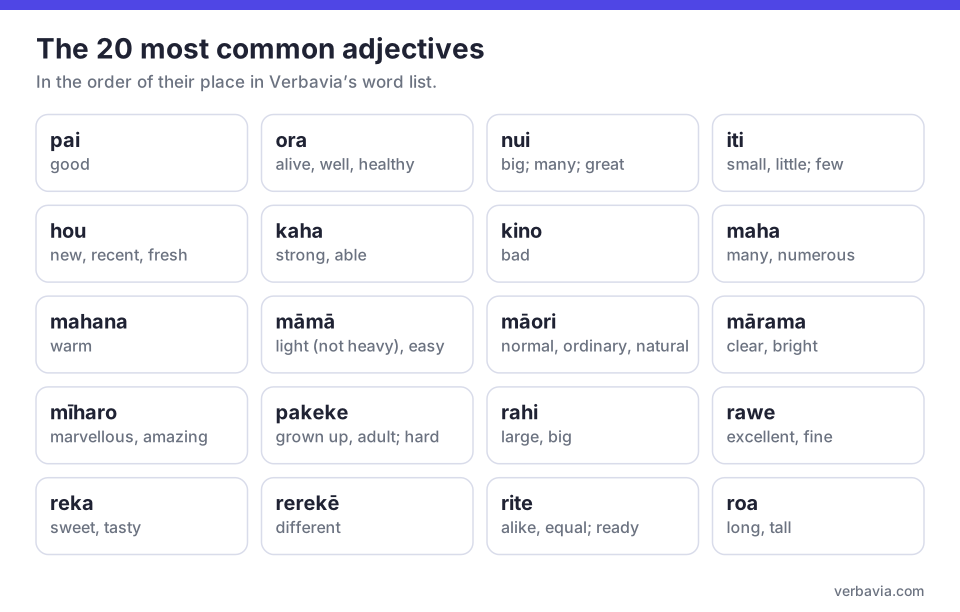
| Māori | English | Place in the word list |
|---|---|---|
| pai | good | 15 |
| ora | alive, well, healthy | 32 |
| nui | big; many; great | 33 |
| iti | small, little; few | 34 |
| hou | new, recent, fresh | 125 |
| kaha | strong, able | 142 |
| kino | bad | 155 |
| maha | many, numerous | 180 |
| mahana | warm | 181 |
| māmā | light (not heavy), easy | 207 |
| māori | normal, ordinary, natural | 209 |
| mārama | clear, bright | 210 |
| mīharo | marvellous, amazing | 215 |
| pakeke | grown up, adult; hard | 228 |
| rahi | large, big | 250 |
| rawe | excellent, fine | 257 |
| reka | sweet, tasty | 259 |
| rerekē | different | 262 |
| rite | alike, equal; ready | 265 |
| roa | long, tall | 266 |
The number is each word’s place in Verbavia’s Māori word list, the order in which the course teaches its words. It is a teaching order, not a count of how often a word is spoken, so read a low number as met early and nothing more exact than that.
What are the most common Māori adjectives?
The 60 below are the entries in the first 700 places of that list whose meaning is a describing word. The colours, the feelings and one shape are left to guides of their own, linked at the end of this section, and a handful of words like mate ‘dead; sick’ are dealt with further down. What counts as a describing word is a judgement, and it is ours. The English beside each word is Te Aka Māori Dictionary’s, shortened.
Size and amount
| Māori | English | Place |
|---|---|---|
| nui | big, large; many, plentiful; great, important | 33 |
| iti | small, little; few; unimportant | 34 |
| maha | many, numerous, abundant | 180 |
| rahi | large, big; numerous, plentiful | 250 |
| roa | long, tall; a long time | 266 |
| whānui | broad, wide, extensive | 357 |
| hōhonu | deep | 447 |
| kaitā | large, big, major | 470 |
| paku, pakupaku | small, little, tiny | 656, 657 |
| poto | short | 696 |
Nui covers three English words at once: a big thing, many things and an important thing. Te Aka notes that maha usually takes toko- in front when it is people who are many, tokomaha, the same prefix that counts people in Māori numbers. Roa is the course’s word for a tall person, as in He tangata roa ia. ‘He’s a tall person.’, while a high hill or mountain is teitei ‘high, tall, lofty’, further down the list at place 812.
Good and bad
| Māori | English | Place |
|---|---|---|
| pai | good; also pleasant, suitable, good-looking | 15 |
| kino | bad, evil; naughty, ugly, damaged | 155 |
| mīharo | marvellous, amazing | 215 |
| rawe | excellent, fine, pleasant, nice | 257 |
| ātaahua | beautiful, handsome, pretty, lovely | 366 |
| nanakia | crafty, treacherous, deceitful, cruel | 611 |
Pai is the first describing word on the list, and the course builds its first describing sentence on it: He pai te kai. ‘The food is good.’ Nanakia is less simple than it looks: after a noun Te Aka gives it as crafty or cruel, but as a verb it means to be better than expected, not too bad. The other words for good looks, and how to pay someone a compliment, are in beautiful in Māori.
True, same and different
| Māori | English | Place |
|---|---|---|
| māori | normal, usual, ordinary, natural | 209 |
| rerekē | different, unusual, changed | 262 |
| rite | alike, equal; ready | 265 |
| tika | correct, right, true, fair; straight | 298 |
| tūturu | real, true, authentic; fixed, permanent | 329 |
| hē | wrong, mistaken, incorrect | 445 |
| motuhake | separate, special, distinct, independent | 587 |
| pono | true, honest, genuine, sincere | 690 |
With a small m, māori is an everyday adjective, and how it became the name of a people is told in what does Māori mean? Both tika and pono can be translated true. Te Aka’s list for tika runs correct, right, just, fair, accurate, and the course uses it in He tika tāu. ‘You’re right.’; its list for pono runs valid, honest, genuine, sincere. The macron is doing real work in hē: without it the word is he, the little word that opens every describing sentence further down this page. How long and short vowels differ is explained in the Māori pronunciation guide.
New and old, fast and far
| Māori | English | Place |
|---|---|---|
| hou | new, recent, modern; fresh | 125 |
| pakeke | grown up, adult, mature; also hard, difficult | 228 |
| tata | near, close | 289 |
| tawhiti | distant, far away, remote | 295 |
| tere | quick, swift, fast | 296 |
| horo | quick, fast, swift | 429 |
| kaumātua | elderly, old, aged | 495 |
Te Aka lists hou under two spellings, hou and hōu, with the same meaning; the course writes it without the macron. Old, of a thing, is tawhito ‘old, ancient’ (place 810), and Te Aka adds that it was not used of people in classical Māori. Of a person, the list has kaumātua, elderly, and pakeke, grown up, as in the course’s Kua pakeke ia. ‘He’s grown up.’ Slow is pōturi (place 1605): Kōrero pōturi mai. ‘Speak slowly to me.’
Hot, cold, wet and dry
| Māori | English | Place |
|---|---|---|
| mahana | warm | 181 |
| wera | hot; burnt | 340 |
| makariri | cold | 553 |
| maroke | dry, arid | 565 |
| mākū | wet, moist, damp | 595 |
| mātao | cold | 601 |
Two lines from the course show them at work: He rā mahana tēnei. ‘This is a warm day.’ and He makariri i te ata. ‘It is cold in the morning.’ Makariri is also one of the names for winter, as the four seasons in Māori explains. Te Aka records a warmth that has nothing to do with weather: a marae is said to be mahana when old people from among the local people are present.
Taste and smell
| Māori | English | Place |
|---|---|---|
| reka | sweet, tasty; pleasant | 259 |
| haunga | stinking, smelly | 407 |
| kakara | fragrant, sweet-smelling | 473 |
| pirau | rotten, decaying | 680 |
| piro | putrid, stinking, smelly | 684 |
He reka te kai! ‘The food is delicious!’ is the line to learn here, and the rest of the table talk is in food in Māori. Piro has a second life on the field, where Te Aka gives it as a try in rugby or a goal; the words for the games themselves are in sports in Māori.
Look and feel
| Māori | English | Place |
|---|---|---|
| mārama | clear, light (not dark), bright; easy to understand | 210 |
| koi | sharp, pointed | 513 |
| mārō | stiff, hard, solid, firm | 598 |
| pakaru | broken, smashed, torn | 651 |
| paru | dirty, muddy | 668 |
| puare | open, exposed, hollow | 699 |
Mārama is clear to the mind as well as to the eye, which is why the course asks Kei te mārama koe? ‘Do you understand?’ Without its macron it is a different word, marama ‘moon, month’.
Easy and hard
| Māori | English | Place |
|---|---|---|
| māmā | light (not heavy), easy, simple | 207 |
| uaua | difficult, hard, demanding | 330 |
| ngāwari | soft, easy, flexible; kind, easygoing | 625 |
Te Aka’s meanings for māmā begin with light, not heavy, and go on to easy and simple; the borrowed word for mum is spelt the same and has an entry of its own. Heavy is taumaha (place 804). The course puts uaua in a sentence many learners will agree with: He uaua ngā kupu tawhito. ‘The old words are difficult.’
Strength, health and the body
| Māori | English | Place |
|---|---|---|
| ora | alive, well, healthy, safe | 32 |
| kaha | strong, able, capable; loud | 142 |
| toa | brave, bold, victorious, skilful | 306 |
| hapū | pregnant | 398 |
| hauora | fit, well, healthy | 408 |
| mamae | painful, sore, hurt | 556 |
| matekai | hungry | 569 |
| māia | brave, bold, capable, confident | 594 |
| pakari | mature, ripe, strong, sturdy | 650 |
Several of these have a better-known life as nouns. Toa is also a champion or a warrior (the shop is a separate, borrowed word), hapū is also the kinship group, and hauora is health itself, the subject of health words in Māori. Mamae is how you say where it hurts, Kei te mamae taku upoko. ‘My head hurts.’, with the words for the rest of you in Māori body parts.
Colours, feelings and shapes
Seven colour words sit in the same stretch of the list, from mā ‘white’ at place 51 to parauri ‘brown’ at 664, and all of them are in Māori colours. Seven feeling words do too, from mataku ‘afraid’ at 187 to ngenge ‘tired’ at 619, and they are in Māori words for feelings. Round is porowhita, which is first of all the circle in shapes in Māori.
Where does the adjective go in Māori?
After the noun. W. L. Williams’s First Lessons in Maori gives the rule in one line, “An adjective always stands after the noun which it qualifies”, and the sources agree with him:
| Māori | English | Printed in |
|---|---|---|
| He whare pai | a good house | Williams, First Lessons in Maori |
| te whare nui | the big house | Verbavia’s course |
| ngā whare nui | the big houses | Verbavia’s course |
| Te āporo whero | the red apple | NZQA’s grammar levels, under te / ngā + noun + adjective |
| He ngārara paku te namu. | The sandfly is a small insect. | Te Aka, under paku |
| He wahine tāroaroa ia. | She is a tall woman. | Te Aka, under tūāhua |
In the second and third rows nui is the same word for one house and for several: te and ngā carry the number. To say that something is big, the adjective moves to the front behind he, as in He nui te whare. ‘The house is big.’, a pattern set out with the rest of the word order in Māori sentence structure. Te Aka’s entry for he says it may be followed by a noun or an adjective, and its entry for kāore … i te calls that the negative for a he sentence with an adjective: Kāore a Hēni i te tūpuhi rawa. ‘Jane is not too thin.’
Two adjectives on one noun
Williams’s advice is to repeat the noun, or to stand mea ‘thing’ in for it the second time: He kōwhatu nui, he mea taimaha ‘a large heavy stone’, here in today’s spelling. Te Aka quotes a line from a newspaper of 1913 that simply sets two side by side with a comma: ngā rākau ātaahua, teitei ‘the beautiful, tall trees’. Both are in print; neither source calls the other wrong.
An adjective is also its own noun
Put te in front of an adjective and it names the quality. Williams gives te pai ‘the goodness’ and te roa ‘the length’, and Te Aka lists a noun meaning beside many of the words above: nui is also size, roa also length. The course uses it to compare heights: He rite tōna roa ki tōku. ‘He’s as tall as I am.’, word for word his length is like mine. The two little words for his and mine there are explained in the a and o categories.
How do you say very, too and a bit in Māori?
With a small word beside the adjective. Some stand in front of it and some behind, and for the two commonest Williams states it as a rule: “Tino always stands before the adjective, and rawa after it.”
| Māori | English | The small word |
|---|---|---|
| He tino māngere ia. | He is very lazy. | tino, very: in front. Te Aka’s example. |
| He tino pai te kai. | The food is very good. | tino again, from the course. |
| He nui rawa tērā. | That’s too big. | rawa, very or too: behind. From the course. |
| Ka nui rawa ō moni! | You’ve got too much money! | rawa as too. Te Aka’s example. |
| Te mea tino pai rawa | the very best thing | Both at once. Williams’s example. |
| Kua āhua pukuriri ia. | He is somewhat angry. | āhua, somewhat, a bit: in front. Te Aka’s example. |
| He āhua pai. | It’s fairly good. | āhua again, from the course. |
| He iti noa iho. | It’s only small. | noa iho, only, just: behind. From the course. |
Whether rawa means very or too is left to the situation: Te Aka lists both, the second as a degree that is not satisfactory, too much or too little. Te Aka also describes paku placed in front of a word as a little, slightly, a way of playing something down.
Māori opposites: big and small, good and bad
| Māori | English | Its opposite | English |
|---|---|---|---|
| nui | big | iti | small |
| pai | good | kino | bad |
| roa | long, tall | poto | short |
| hou | new | tawhito | old |
| tere | fast | pōturi | slow |
| wera | hot | makariri | cold |
| mākū | wet | maroke | dry |
| tata | near | tawhiti | far |
| tika | right | hē | wrong |
| māmā | easy | uaua | difficult |
| māmā | light | taumaha | heavy |
| whānui | wide | whāiti | narrow |
Te Aka does not mark opposites, so these pairs are made by setting its meanings side by side. Four of the words are outside the 60: tawhito, pōturi and taumaha, met above, and whāiti at place 979. The course likes to teach a pair inside one sentence:
| Māori | English |
|---|---|
| Ko tēnei he pai, ko tērā he kino. | This one is good, that one is bad. |
| He hou ōku kākahu, engari he tawhito ōna. | My clothes are new, but his are old. |
| He tawhiti? Kāo, he tata. | Is it far? No, it is near. |
Do Māori adjectives have a plural form?
A few do, made by doubling the first syllable, and none of them is compulsory. Te Aka marks six for the words on this page, and a handful more beyond it:
| Plural form | Te Aka’s meaning | Te Aka’s example |
|---|---|---|
| nunui | large, big: “mainly used as the plural form of nui” | tētehi o ngā hapū nunui o Te Arawa ‘one of the large Te Arawa sub-tribes’ |
| roroa | long, tall (plural form) | he roroa ana makawe ‘his hair was long’ |
| papai | good (plural form of pai) | ngā tarutaru papai ‘good grass’ |
| kikino | bad, evil (plural form) | ngā rangi kikino ‘bad days’ |
| rarahi | large, great (plural form) | he āhua rarahi tonu ‘it’s rather large’, of a kind of eel |
| ririki | small (plural form) | He manuao ririki rawa iho ēnei ‘These are much smaller warships’ |
Nunui has a place of its own in Verbavia’s list, at 629, and ririki one at 1666. Williams has the same rule, with He tāngata roroa ‘tall men’, and then takes the pressure off: “The simple form is, however, often used for the plural as well as the singular.” That is why ngā whare nui above is right as it stands. Te Aka’s own example for iti has both kinds in five words, a plain iti beside a doubled nunui: He iti ngā tuna nunui. ‘There were few large eels.’
How do you say bigger and biggest in Māori?
The adjective never changes. For more, put ake or atu after it, and introduce the thing it is measured against with i. For most, put rawa atu after it. Te Aka, the course, NZQA’s grammar levels and Williams print these frames:
| Māori | English | Printed in |
|---|---|---|
| He pai ake tēnei i tēnā. | This is better than that. | Te Aka, under ake |
| He roa atu te whiore o te kau i tō te poaka. | A cow’s tail is longer than that of a pig. | Te Aka, under atu |
| He roa atu ia i a au. | He’s taller than me. | Verbavia’s course |
| He iti iho tēnei i tērā. | This one is smaller than that one. | Verbavia’s course |
| Te mea pai rawa | the best thing | Williams |
| Ko ia te mea nui rawa atu. | He’s the biggest. | Verbavia’s course |
| Ko te maunga teitei rawa atu! | The highest mountain! | NZQA, which gives no English; the gloss is built from Te Aka |
| He ātaahua rawa atu tēnei wāhi. | This place is extremely beautiful. | Te Aka, under rawa |
Te Aka gives ake and atu the same note, used when comparing things, and Williams treats them as alternatives, so either is right. With iti, Te Aka says the word that follows is often iho ‘downwards’ instead, as in the fourth row. The superlative is where the sources word things differently. Te Aka says an adjective followed by rawa atu expresses the superlative, yet translates its own example extremely beautiful, while the course teaches te mea nui rawa atu ‘the biggest thing’. Williams supplies the piece that fits the two together: tino or rawa with te ‘the’ makes the superlative, and with he ‘a’ it “forms an intense comparative”. So the small word at the front of the phrase decides between extremely big and the biggest. Te Aka’s own name for a comparative adjective is kupu āhua whakataurite.
What is the Māori word for adjective?
Te Aka has three entries that all mean adjective: kupu āhua, the same term written as one word, kupuāhua, and tūāhua. Kupu is word and āhua is shape, appearance, character, so a kupu āhua is a word for what something is like. It is a grammar term, the kind met in a te reo class; the names of the classes themselves are in school subjects in Māori.
Look up the words on this page in Te Aka and each meaning carries a label in brackets. There are four to expect: (verb) with a meaning that starts to be, as for nui and pai; (stative), as for iti, mahana and makariri; (adjective), as for māmā, rerekē and pono; and (modifier), as for hou, mākū and poto. The last is explained in the entry for tūāhua: adjectives “often come after he or after a noun, in which case they are called modifiers in this dictionary”, and they are often words that can also be nouns or verbs. Te Aka does not say how it chooses among the other three, and its own term kupumahi āhua is glossed stative, adjective, so a learner can read all four labels as one message: this word can describe. One word often carries several, and uaua is listed as a verb, an adjective, a modifier and a noun.
Adjective or stative verb: mate, mutu, oti
Three common words wear the same (stative) label and are still usually taught apart: mate ‘dead; sick’, mutu ‘ended, finished’ and oti ‘finished, complete’. Te Aka’s term for these is a stative verb, “a verb expressing a state or condition rather than an activity or event”, and it adds that some grammarians call them neuter verbs. NZQA’s grammar levels use that name, list mate, mahue, whati, oti under it, and show what sets them apart, the i that marks whoever brought the state about: I oti i a au te mahi. ‘The work was completed by me.’ That pattern, with more of these words, is in Māori verbs. It is why mate, at place 188 in the list, is not among the 60.
In everyday use the line is thin, because adjectives take the same tense markers. The course has Kua nui koe! ‘You’ve grown big!’ and Kua makariri. ‘It’s got cold.’, where kua on an adjective means it has become so. And an order to be something opens with kia, which Te Aka describes as the way to give commands with adjectives and statives: Kia tūpato! ‘Be careful!’ The best-known of those has a page to itself, what does kia kaha mean?
Adjectives are also raw material for verbs. Te Aka describes whaka- as a prefix added to adjectives and statives to mean cause to be, so pai gives whakapai ‘to make good, improve’, roa gives whakaroa ‘to lengthen’ and poto gives whakapoto ‘to shorten’; the prefix is taken apart in what does whaka mean?
Learning the adjectives
Learn them in pairs and inside a sentence: a line like He tawhiti? Kāo, he tata. sticks better than two words on a card. Verbavia’s free te reo Māori course teaches the describing sentence early and brings in tino, rawa and the comparisons after it; describing things is week three of the plan in learn Māori for beginners. How far a few hundred words of any kind will carry you is worked out in how many Māori words do you need to know?
Learn te reo Māori with Verbavia
Verbavia’s free te reo Māori course starts with the most common words, explains the grammar properly, and plays every example in Papa Reo’s native te reo voice. One lesson a day, from your first word to B1.
Quick questions
What is big in Maori?
Nui, which also means many and important. Rahi and kaitā mean big as well, and nunui is the form for several big things.
What is good in Māori?
Pai. He pai te kai. is the food is good, and the course gives Ka pai. on its own as Good.
Does the adjective come before or after the noun in Māori?
After it: te whare nui is the big house. The small words tino ‘very’ and āhua ‘somewhat’ go in front of the adjective.
How do you say very good in Māori?
Tino pai, with tino in front. Pai rawa, with rawa behind, is the course’s really good.
What is the Māori word for adjective?
Kupu āhua, also written kupuāhua; Te Aka lists tūāhua with the same meaning.
Sources
- Te Aka Māori Dictionary: kupu āhua (adjective)
- Te Aka Māori Dictionary: kupuāhua (adjective; the note on modifiers)
- Te Aka Māori Dictionary: tūāhua (adjective; He wahine tāroaroa ia)
- Te Aka Māori Dictionary: kupu āhua whakataurite (comparative adjective)
- Te Aka Māori Dictionary: kupumahi āhua (stative, adjective)
- Te Aka Māori Dictionary: tūmahi oti (stative verb)
- Te Aka Māori Dictionary: he (may be followed by a noun or an adjective)
- Te Aka Māori Dictionary: kāore ... i te (the negative for he with an adjective)
- Te Aka Māori Dictionary: tino (very, before an adjective or verb)
- Te Aka Māori Dictionary: rawa (very; too; with atu, the superlative)
- Te Aka Māori Dictionary: āhua (somewhat, a little; stands before the word)
- Te Aka Māori Dictionary: āhua (shape, appearance, character)
- Te Aka Māori Dictionary: noa iho (only, just, merely)
- Te Aka Māori Dictionary: ake (sense 7, used when comparing things)
- Te Aka Māori Dictionary: atu (sense 4, used when comparing things)
- Te Aka Māori Dictionary: kia (sense 3, commands with adjectives and statives)
- Te Aka Māori Dictionary: whaka- (prefixed to adjectives and statives)
- Te Aka Māori Dictionary: whakapai
- Te Aka Māori Dictionary: whakaroa
- Te Aka Māori Dictionary: whakapoto
- Te Aka Māori Dictionary: mate (stative)
- Te Aka Māori Dictionary: mutu (stative)
- Te Aka Māori Dictionary: oti (stative)
- Te Aka Māori Dictionary: nunui (mainly the plural form of nui)
- Te Aka Māori Dictionary: roroa (plural form)
- Te Aka Māori Dictionary: papai (plural form of pai)
- Te Aka Māori Dictionary: kikino (plural form)
- Te Aka Māori Dictionary: ririki (plural form)
- Te Aka Māori Dictionary: rarahi (plural form)
- Te Aka Māori Dictionary: pai
- Te Aka Māori Dictionary: ora
- Te Aka Māori Dictionary: nui
- Te Aka Māori Dictionary: iti
- Te Aka Māori Dictionary: hou
- Te Aka Māori Dictionary: hōu
- Te Aka Māori Dictionary: kaha
- Te Aka Māori Dictionary: kino
- Te Aka Māori Dictionary: maha
- Te Aka Māori Dictionary: tokomaha
- Te Aka Māori Dictionary: mahana
- Te Aka Māori Dictionary: māmā (light, easy)
- Te Aka Māori Dictionary: māori (normal, ordinary)
- Te Aka Māori Dictionary: mārama
- Te Aka Māori Dictionary: mīharo
- Te Aka Māori Dictionary: pakeke
- Te Aka Māori Dictionary: rahi
- Te Aka Māori Dictionary: rawe
- Te Aka Māori Dictionary: reka
- Te Aka Māori Dictionary: rerekē
- Te Aka Māori Dictionary: rite
- Te Aka Māori Dictionary: roa
- Te Aka Māori Dictionary: tata
- Te Aka Māori Dictionary: tawhiti
- Te Aka Māori Dictionary: tere
- Te Aka Māori Dictionary: tika
- Te Aka Māori Dictionary: toa (brave; champion)
- Te Aka Māori Dictionary: tūturu
- Te Aka Māori Dictionary: uaua
- Te Aka Māori Dictionary: wera
- Te Aka Māori Dictionary: whānui
- Te Aka Māori Dictionary: ātaahua
- Te Aka Māori Dictionary: hapū
- Te Aka Māori Dictionary: haunga
- Te Aka Māori Dictionary: hauora
- Te Aka Māori Dictionary: horo (quick, fast)
- Te Aka Māori Dictionary: hē
- Te Aka Māori Dictionary: hōhonu
- Te Aka Māori Dictionary: kaitā
- Te Aka Māori Dictionary: kakara
- Te Aka Māori Dictionary: kaumātua
- Te Aka Māori Dictionary: koi
- Te Aka Māori Dictionary: makariri
- Te Aka Māori Dictionary: mamae
- Te Aka Māori Dictionary: maroke
- Te Aka Māori Dictionary: matekai
- Te Aka Māori Dictionary: motuhake
- Te Aka Māori Dictionary: māia
- Te Aka Māori Dictionary: mākū
- Te Aka Māori Dictionary: mārō
- Te Aka Māori Dictionary: mātao
- Te Aka Māori Dictionary: nanakia
- Te Aka Māori Dictionary: ngāwari
- Te Aka Māori Dictionary: pakari
- Te Aka Māori Dictionary: pakaru
- Te Aka Māori Dictionary: paku (He ngārara paku te namu)
- Te Aka Māori Dictionary: pakupaku
- Te Aka Māori Dictionary: paru
- Te Aka Māori Dictionary: pirau
- Te Aka Māori Dictionary: piro
- Te Aka Māori Dictionary: pono
- Te Aka Māori Dictionary: poto
- Te Aka Māori Dictionary: puare
- Te Aka Māori Dictionary: porowhita
- Te Aka Māori Dictionary: tawhito (not used for people in classical Māori)
- Te Aka Māori Dictionary: pōturi
- Te Aka Māori Dictionary: taumaha
- Te Aka Māori Dictionary: taimaha
- Te Aka Māori Dictionary: teitei
- Te Aka Māori Dictionary: whāiti
- Te Aka Māori Dictionary: tāroaroa
- Te Aka Māori Dictionary: māngere
- Te Aka Māori Dictionary: tūpuhi
- Te Aka Māori Dictionary: tūpato
- Te Aka Māori Dictionary: kōwhatu
- W. L. Williams, First Lessons in Maori (Whitcombe and Tombs, 1930), V. Adjectives, sections 23 to 27, New Zealand Electronic Text Collection, Victoria University of Wellington
- NZQA: Clarification of grammar levels, te reo Māori (PDF)