School subjects in Māori: pāngarau, pūtaiao and more
The school subjects in Māori are pāngarau ‘mathematics’, pūtaiao ‘science’, te reo Pākehā ‘English’, te reo Māori, hangarau ‘technology’, tikanga ā-iwi ‘social sciences’, ngā toi ‘the arts’, hauora ‘health and physical education’ and ngā reo ‘languages’: the nine learning areas of Te Marautanga o Aotearoa, the Māori-medium national curriculum, as the Ministry of Education has printed them since 2008. Below are those names and the single subjects inside them, from biology to PE, each with the dictionary or official page that prints it; what pāngarau, pūtaiao and hangarau mean; the learning areas that were renamed in the curriculum statement of November 2026; and the words for a timetable, a report and saying what you study.
Tap 🔊 to hear an example. Māori examples play Papa Reo, the te reo Māori voice made by Te Hiku Media from recordings of native speakers. Every sentence in the free course is spoken like this.
On this page
- What are maths, science and English in Māori?
- What do pāngarau, pūtaiao and hangarau mean?
- What are the learning areas called in the Māori-medium curriculum?
- Biology, chemistry and physics in Māori
- History, geography, economics and business
- Art, music, drama and dance in Māori
- What are health and PE in Māori?
- Te reo Māori, te reo Rangatira and other languages
- How do you say what you study in Māori?
- Māori words for a school timetable or report
- Going further
- Quick questions
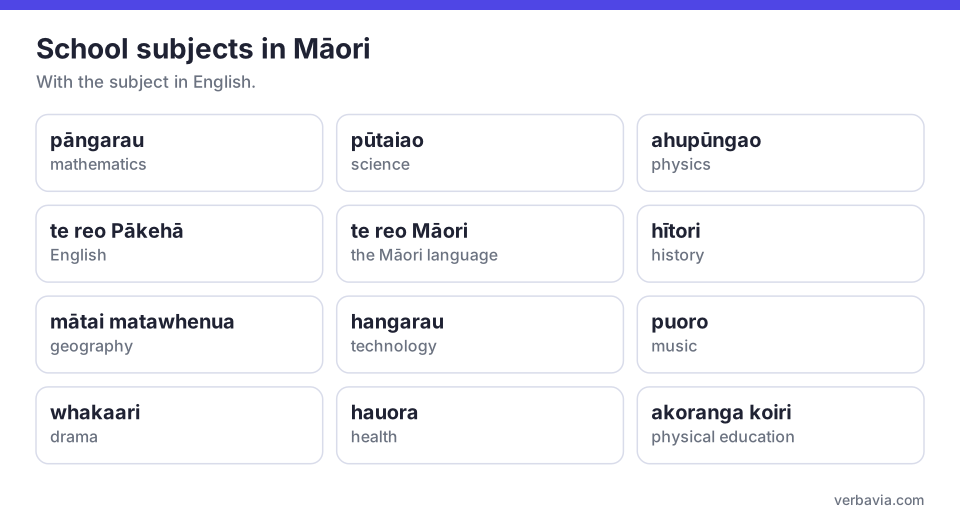
| Māori | English | Who prints it |
|---|---|---|
| pāngarau | mathematics | Te Aka Māori Dictionary; a learning area of the curriculum. |
| tauanga | statistics | Te Aka, which also gives tatauranga. |
| pūtaiao | science | Te Aka; a learning area of the curriculum. |
| mātai koiora | biology | Te Aka, which also gives mātauranga koiora. |
| mātai matū | chemistry | Te Aka, which also gives mātauranga matū. |
| ahupūngao | physics | Te Aka, which also gives mātai ahupūngao; the University of Auckland’s glossary. |
| te reo Pākehā | English | The curriculum’s name for the learning area. |
| te reo Māori | the Māori language | The subject’s name in English-medium schools and at NZQA. |
| ngā reo | languages | The curriculum’s name for learning other languages. |
| tikanga ā-iwi | social sciences | The curriculum of 2008. Te Aka: cultural practice, social science, tribal custom. |
| akoranga hapori | social studies | Te Aka, which also gives mātauranga noho hapori. |
| hītori | history | Te Aka, a loan; also hītōria and tāhuhu kōrero. |
| mātai matawhenua | geography | Te Aka; Auckland’s glossary has matawhenua alone. |
| mātauranga ōhanga | economics | Te Aka and Auckland’s glossary. |
| pakihi | business | Te Aka: business, enterprise. |
| hangarau | technology | Te Aka; a learning area of the curriculum. |
| hangarau matihiko | digital technology | Word for word, with Te Aka’s matihiko ‘digital’; a proposed Māori-medium subject is Te Hangarau Matihiko. |
| toi | art | Te Aka. The learning area of 2008 is ngā toi, the arts. |
| toi ataata | visual art | Te Aka; an NCEA subject at NZQA. |
| puoro | music | Te Aka and Auckland’s glossary; NZQA’s subject is toi puoro. |
| whakaari | drama | Te Aka: drama, play, acting. |
| kanikani | dance | Te Aka: dance, dancing. |
| hauora | health | Te Aka; the curriculum of 2008 uses it for health and physical education. |
| akoranga koiri | physical education | Te Aka; a proposed Māori-medium subject is Te Akoranga Koiri. |
What are maths, science and English in Māori?
Maths is pāngarau, science is pūtaiao and English is te reo Pākehā. Te Aka Māori Dictionary defines the first two in one word each, mathematics and science, and illustrates both with the same sentence from 1992, about people sought out by topic: pēnei i te hākinakina, i te pūtaiao, i te pāngarau me te hauora ‘such as sport, science, mathematics and health’. Notice the te in front of each one: in that sentence every subject takes the.
Georgina Tuari Stewart of AUT, who began teaching the subject in 1993, notes that pūtaiao is the Māori word for science and is written with a capital, Pūtaiao, when it means the school subject in Māori-medium schools. The Ministry’s pages capitalise the other learning areas in the same way.
English as a subject is te reo Pākehā, literally the Pākehā language: Te Aka gives Pākehā, used as a describing word, as English, foreign, European, and where the word comes from is in what does Pākehā mean? The dictionary also has the loan Ingarihi ‘English’, and one of its examples, from the newspaper Te Toa Takitini in 1925, is a list of what a school taught: Ko ngā mātauranga e akoria ana ko te reo Ingarihi, kōrero pukapuka, tuhituhi me te mapi ‘The subjects being taught are English, reading, writing and geography’. In that list geography is simply te mapi; mapi is the loan for map.
What do pāngarau, pūtaiao and hangarau mean?
Each means its subject and nothing smaller. Te Aka gives pāngarau as mathematics, pūtaiao as science and hangarau as technology, and for none of the three does it split the word into parts or say how it was formed, so this page does not guess.
- Pāngarau. Its synonym in Te Aka is the loan whika, which the dictionary glosses as to do sums, calculate, a figure or number and arithmetic, mathematics, with examples from a newspaper of 1878; mahi whika is arithmetic. Inside the subject, tauanga is statistics (and statistical), tuanaki is calculus and mahi taurangi is algebra. The geometry words are in shapes in Māori.
- Pūtaiao. Te Aka also lists mātauranga pūtaiao, science, scientific technique, built with mātauranga ‘knowledge’, the word at the centre of the three baskets of knowledge.
- Hangarau. Te Aka has two separate entries spelt the same way. One is an old verb and noun, to deceive, fool, jest and trickery, with examples from 1900 and 1929. The other is the modern word: technological and technology. Around the second, matihiko is digital, rorohiko is computer and hangarau whakaaturanga is information technology.
Several subject words are marked in Te Aka as loans from English; how borrowed words such as hītori and whika are reshaped is explained in English words in Māori.
What are the learning areas called in the Māori-medium curriculum?
Aotearoa New Zealand has one national curriculum with two pathways: The New Zealand Curriculum, written mainly in English, and Te Marautanga o Aotearoa, written in te reo Māori. The first has learning areas; the second has wāhanga ako, which the 2026 statement defines as the “Te Marautanga o Aotearoa equivalent to learning areas”. The University of Auckland’s glossary gives the same meaning, with the example Ko te pāngarau tētahi wāhanga ako nui i te kura. ‘Mathematics is a major learning area at school.’
| Te Marautanga o Aotearoa, 2008 | National Curriculum Statement 2026 | The New Zealand Curriculum |
|---|---|---|
| Te Reo Māori | Te Reo Rangatira | No separate area: Te Reo Māori is listed under Learning Languages |
| Pāngarau | Te Pāngarau | Mathematics and Statistics |
| Pūtaiao | Te Pūtaiao | Science |
| Tikanga ā-Iwi | Te Pūmanawa Tangata | Social Sciences |
| Hauora | Te Waiora | Health and Physical Education |
| Hangarau | Te Hangarau | Technology |
| Ngā Toi | Te Toi Ihiihi | The Arts |
| Te Reo Pākehā | Te Reo Pākehā | English |
| Ngā Reo | Ngā Reo | Learning Languages |
The facts and dates, from the Ministry of Education’s own pages:
- The Education (The New Zealand Curriculum and Te Marautanga o Aotearoa) National Curriculum Statement 2026 was made on 3 November 2026, published on 5 November 2026 and comes into force on 1 January 2027. It covers Years 0 to 10; the earlier statements stay in force for Years 11 to 13 for now.
- Te Reo Rangatira began earlier: the Ministry says it replaced Te Reo Māori for Years 0 to 6 on 1 January 2025.
- Te Pūmanawa Tangata “replaces Tikanga ā‑Iwi”, in the Ministry’s words, and was known while it was being drafted as Te Ao Māori.
- The Ministry’s Māori-language pages for Te Waiora and Te Toi Ihiihi name Hauora and Ngā Toi as the statements they replace.
- Schools on this pathway must teach Te Reo Rangatira and Te Pāngarau from 1 January 2027; the other areas are phased in, and the last date the statement sets for full use is 31 December 2030.
- The eight learning areas of The New Zealand Curriculum keep their English names. The statement gives them no Māori names, though the Ministry’s senior arts page does write “The Arts | Toi Ihiihi”.
So a timetable that says Tikanga ā-Iwi or Hauora is using the curriculum’s names of 2008, and they remain the names of the Māori-medium NCEA subjects NZQA lists today: Hangarau, Hauora, Pāngarau, Pūtaiao, Te Reo Rangatira, Tikanga ā-Iwi, Toi Ataata, Toi Puoro and Ngā Mahi a te Rēhia. The ministry itself is Te Tāhuhu o te Mātauranga, a name taken apart in Māori names of government agencies.
Where the names differ
| Name | The Ministry’s use | Te Aka Māori Dictionary |
|---|---|---|
| tikanga ā-iwi | the social sciences learning area of 2008, and an NCEA subject | cultural practice, social science, tribal custom; social studies is akoranga hapori |
| pūmanawa tangata | the learning area that replaces it from 2027 | only human resources; pūmanawa alone is natural talent, and a beating heart |
| waiora | the learning area that replaces Hauora | health, soundness; hauora is to be fit, well, healthy, and health, vigour |
| toi ihiihi | the arts learning area from 2027 | no entry for the pair; toi is art, knowledge, and ihiihi is thrill, excitement, and expression in performance |
| Te Pāngarau | the statement writes Te before four names; the glossary of its own framework page prints Pāngarau, Pūtaiao, Hangarau and Toi Ihiihi without it | pāngarau, with no article |
None of these is a mistake. A dictionary records how a word has been used; a curriculum chooses a name. Tikanga on its own, the right way of doing things, has a guide of its own: what does tikanga mean?
Biology, chemistry and physics in Māori
The sciences are named with mātai. As a verb it is to inspect, examine, investigate; as a noun Te Aka glosses it field of study, -ology, “used with names of fields of science”. What follows it says what is studied:
| Māori | English | Built from (Te Aka) |
|---|---|---|
| mātai koiora | biology | mātai + koiora ‘life’ |
| mātai matū | chemistry | mātai + matū ‘matter, substance, chemical’ |
| mātai ahupūngao | physics | ahupūngao alone is also physics |
| pūtaiao ā-nuku | Earth science | Te Aka lists the phrase whole |
| tātai arorangi | astronomy | knowledge of celestial bodies |
The Ministry’s proposed senior subjects for Māori-medium schools use the same words with te in front: Te Mātai Koiora, Te Mātai Matū, Te Mātai Ahupūngao and Te Tātai Arorangi. They are drafts, planned for Year 11 in 2028, Year 12 in 2029 and Year 13 in 2030, and not yet part of a curriculum statement. NZQA’s list of today’s NCEA subjects gives Biology, Chemistry and Physics in English only. For a sentence, the University of Auckland’s glossary has Kei te ako au i te ahupūngao i te whare wānanga. ‘I am studying physics at the university.’
History, geography, economics and business
- History. Te Aka gives the loans hītori and hītōria, and tāhuhu kōrero. The Ministry pairs the senior subject as “History | Te Takanga o te Wā”; takanga o te wā is Te Aka’s passage of time.
- Geography. Te Aka has mātai matawhenua, and also takotoranga papa and the loan Tiokarewhi. Its example, from a biography, is a sentence a school report could borrow: I tino mātau anō hoki ia ki ngā akoranga pāngarau, me te mātai matawhenua ‘She was also good at mathematics and geography’. The Ministry’s proposed Māori-medium subject is Te Matawhenua.
- Economics. Ōhanga is economics and the economy, and mātauranga ōhanga is economics as a study. The first sense of ōhanga in Te Aka is nest, with a pointer to the kōhanga of kōhanga reo. Auckland’s example: Kei te ako ia i te mātauranga ōhanga i te whare wānanga. ‘He is studying economics at university.’ The proposed subject is Te Mātai Ōhanga.
- Business studies. Pakihi is business, enterprise; the proposed subject is Te Mātai Pakihi.
- Social studies. Te Aka gives akoranga hapori and mātauranga noho hapori; hapori is society, community.
Two subjects have no Māori name in any source reached for this page: accounting and religious studies. Te Aka has the loan kaute, to count, to account for; an account or tally, and kaikaute ‘accountant’, but no word for the subject, and for religion only words such as hāhi ‘church, sect, religion’. NZQA and the Ministry list both subjects in English alone, so no Māori name is offered here.
Art, music, drama and dance in Māori
Toi is art (Te Aka adds knowledge), and mahi toi is art, craft. From there: toi ataata ‘visual art’, puoro ‘song, music, a musical instrument’, whakaari ‘drama, a play, acting’, kanikani ‘dance, dancing’ and toi whakaari ‘performing arts’. Whakaari is also the verb to show, present, act; words that begin this way are the subject of what does whaka- mean?
At NZQA the Māori-medium arts subjects are Toi Ataata, Toi Puoro and Ngā Mahi a te Rēhia, all filed under Ngā Toi. NZQA gives no English for the third; Te Aka glosses ngā mahi a te rēhia as pursuit of pleasure, recreational activities, entertainment. Under The New Zealand Curriculum there is also Te Ao Haka, which NZQA describes as “a performance-based subject that combines traditional and contemporary culture”; what a group performs is in kapa haka, and the instruments are in taonga puoro. The carving subject became Te Ao Whakairo in 2023, when the Ministry changed its name from Toi Whakairo.
What are health and PE in Māori?
Health is hauora, and PE is akoranga koiri. Hauora is both to be fit, well, healthy and health, vigour, and in the curriculum of 2008 the one word names the whole area of health and physical education; how the health curriculum uses it is in Te Whare Tapa Whā. Akoranga koiri is Te Aka’s entry for physical education: akoranga is learning, a subject or a lesson, and koiri is to bend the body, sway, move to and fro, and to warm up for exercise. The Ministry’s proposed Māori-medium subject is Te Akoranga Koiri, and it pairs outdoor education as “Outdoor Education | Ngā Akoranga tū-ā-nuku”; Te Aka lists akoranga tū-ā-nuku with the same meaning.
Sport itself is hākinakina. The names of the codes are in sports in Māori, and games for a PE lesson, with the words used while playing, are in traditional Māori games.
Te reo Māori, te reo Rangatira and other languages
The language has two subject names. In English-medium schools it is Te Reo Māori, which NZQA describes as “the study of listening, speaking, reading, and writing in Māori”, and the 2026 statement places it among the languages a school may teach. In Māori-medium schools, where it is the language of the classroom, the learning area is Te Reo Rangatira: reo is language and rangatira, as a describing word, is chiefly, noble. Te Aka translates te reo rangatira in a 1921 newspaper as the noble language.
Other languages are ngā reo, simply the languages. The Ministry pairs one of them in both languages, “New Zealand Sign Language | Te Reo Rotarota o Aotearoa”; reo rotarota is Te Aka’s sign language. NZQA lists French, German, Spanish, Japanese, Korean and Chinese under their English names.
How do you say what you study in Māori?
The verb is ako, which Te Aka gives as to learn, study, teach: one word for both sides of the classroom. The frame is Kei te ako au i te and then the subject. Two sources print it with a subject in it, and the rest of the table swaps in subjects from the list above:
| Māori | English | Where it is from |
|---|---|---|
| Kei te ako au i te reo Māori. | I’m learning te reo Māori. | Verbavia’s course, word for word. |
| Kei te ako au i te ahupūngao i te whare wānanga. | I am studying physics at the university. | The University of Auckland’s glossary, word for word. |
| Kei te ako au i te pāngarau. | I’m studying maths. | Built on that frame. |
| Kei te ako au i te pūtaiao i te kura. | I’m studying science at school. | Built on that frame; i te kura is the course’s. |
| He pai ki a au te pāngarau. | I like maths. | Built from the course’s He pai ki a au te kai. ‘I like the food.’ |
Au is I or me; it is also written ahau, with the same meaning. The words for asking a question are set out in Māori question words.
My favourite subject
No dictionary or official source reached for this page prints a sentence for my favourite subject is … or what is your favourite subject?, so none is offered. Te Aka does list favourite among the senses of tino before a noun, beside main and best, with the example Koia nei te tino kai a taua iwi. ‘This is the staple food of that people.’ The attested way to say which subject you enjoy is He pai ki a au and the subject, as above; tino pai ‘very good’ and the other describing words are in Māori adjectives.
Māori words for a school timetable or report
| Māori | English | Note |
|---|---|---|
| wātaka | timetable | Te Aka: timetable, calendar. Auckland: timetable, schedule. |
| pūrongo | report | Te Aka and Auckland’s glossary. |
| marau | subject | Te Aka: subject of talk, subject, topic. NZQA’s Māori pages use it for an NCEA subject. |
| wāhanga ako | learning area | The curriculum’s own term. |
| akoranga | lesson | Te Aka: learning, subject, class, lesson. |
| marautanga | curriculum | Te Aka: curriculum, syllabus. |
| wāhanga | term | Auckland’s glossary: a school term. The Ministry heads its term dates ngā wāhanga ā-kura. |
| Tau | Year | The Ministry writes “Years | Tau 11-13”; tau is year. |
| Kaupae | Level (of NCEA) | The NCEA site’s word in its Māori-medium menu; Te Aka: rung, level. |
| whakamātautau | exam, test | Te Aka; also the verb to test. |
| kura waenga | intermediate school | Te Aka. |
| māhita | teacher | A loan; Te Aka: teacher, master. It also has pouako, teacher. |
Three sentences that use them. The University of Auckland’s glossary has Kei te wātaka ngā mahi mō te wiki e tū mai nei. ‘The schedule for the upcoming week is on the timetable.’ and Hei te wāhanga e tū mai nei, haere ai te akomanga ki te marae o Matua. ‘Next term, the class is going to Matua’s marae.’ Te Aka’s example for an exam begins Ka puta au i taku whakamātautau ‘I passed my test’. No official page reached for this guide prints a Māori label for a numbered term or a numbered period, so the table stops at the words themselves.
The rest of a timetable is already on this site. The days of the week, in both sets of names, and the numbers for periods and year levels are in Māori numbers, days and months. The everyday school words, kura, kaiako, tumuaki, ākonga, akomanga and mahi kāinga ‘homework’, and the kinds of school from kura tuatahi to wharekura, are in kōhanga reo, kura kaupapa and wharekura explained. What to say in the room, from the roll to praise, is in te reo Māori for teachers, and what comes after school is in Māori names of universities.
Going further
Subject names are nouns; using them takes sentences. Our free te reo Māori course teaches Kei te ako au, He pai ki a au and the questions around them one lesson a day. For children learning at home, the first words a family uses are in te reo Māori for kids, and the proverb about the bird that feeds on knowledge, which the Ministry itself quotes above its notice on subject names, is in whakataukī: Māori proverbs.
Learn te reo Māori with Verbavia
Verbavia’s free te reo Māori course starts with the most common words, explains the grammar properly, and plays every example in Papa Reo’s native te reo voice. One lesson a day, from your first word to B1.
Quick questions
How do you say school subjects in Maori?
The main ones are pāngarau ‘maths’, pūtaiao ‘science’, te reo Pākehā ‘English’, hangarau ‘technology’, ngā toi ‘the arts’ and hauora ‘health’. A subject in general is a marau, and a learning area is a wāhanga ako.
What is maths in Māori?
Pāngarau. Te Aka defines it as mathematics, and it is the name of the learning area in the Māori-medium curriculum; statistics is tauanga.
What does pūtaiao mean?
Science. Te Aka gives that one meaning and does not break the word into parts. With a capital, Pūtaiao is the school subject.
What is PE in Māori?
Akoranga koiri is Te Aka’s entry for physical education. The curriculum of 2008 covers health and PE together under Hauora, and the 2026 statement renames that area Te Waiora.
What is English in Māori?
As a school subject it is te reo Pākehā, the name of the learning area in Te Marautanga o Aotearoa. Te Aka also has the loan Ingarihi.
Sources
- Ministry of Education: Education (The New Zealand Curriculum and Te Marautanga o Aotearoa) National Curriculum Statement 2026 (made 3 November 2026; in force 1 January 2027)
- Ministry of Education, Tāhūrangi: The New Zealand Curriculum | Te Mātaiaho (framework and glossary)
- Ministry of Education, Tāhūrangi: The New Zealand Curriculum, learning areas
- Ministry of Education, Kauwhata Reo: Te Marautanga o Aotearoa 2008 (the nine wāhanga ako, with English glosses)
- Ministry of Education, Kauwhata Reo: Te Marautanga o Aotearoa Whakapākehātanga (Te Reo Rangatira replaces Te Reo Māori, 1 January 2025)
- Ministry of Education: Consultation on Pūmanawa Tangata wāhanga ako (published 4 February 2026)
- Ministry of Education, Kauwhata Reo: Te Pūmanawa Tangata, Ngā Tau 0–10
- Ministry of Education, Kauwhata Reo: Te Waiora, Ngā Tau 0–10
- Ministry of Education, Kauwhata Reo: Te Toi Ihiihi, Ngā Tau 0–10
- Ministry of Education, Kauwhata Reo: Te Pūtaiao, proposed subjects for Tau 11–13
- Ministry of Education, Kauwhata Reo: Te Pūmanawa Tangata, proposed subjects for Tau 11–13
- Ministry of Education, Kauwhata Reo: Te Waiora, proposed subjects for Tau 11–13
- Ministry of Education, Kauwhata Reo: Te Toi Ihiihi, proposed subjects for Tau 11–13
- Ministry of Education, Kauwhata Reo: Te Hangarau, proposed subjects for Tau 11–13
- Ministry of Education, Tāhūrangi: NZC Science, Phase 5 (Years 11–13), proposed
- Ministry of Education, Tāhūrangi: NZC The Arts, Phase 5 (Years 11–13), proposed (“The Arts | Toi Ihiihi”)
- Ministry of Education, Tāhūrangi: Consultation for Tūārere 5 (Outdoor Education | Ngā Akoranga tū-ā-nuku; New Zealand Sign Language | Te Reo Rotarota o Aotearoa)
- Ministry of Education, NCEA: Additional senior secondary subjects open for feedback (History | Te Takanga o te Wā), 21 August 2026
- Ministry of Education, NCEA: Name changes of Kaupapa Ako Māori (Toi Whakairo to Te Ao Whakairo), 6 September 2023
- Ministry of Education, NCEA: subjects of both curricula (Level and Kaupae)
- Ministry of Education: School terms and holidays dates (Ngā rā o ngā wāhanga ā-kura me ngā hararei)
- NZQA: Subjects (Ngā wāhanga ako), the official NCEA subject names
- NZQA: Te Reo Māori
- NZQA: Te Reo Rangatira
- NZQA: Te Ao Haka
- NZQA: Ngā Mahi a te Rēhia
- NZQA: Hauora
- University of Auckland, He Kuputaka nā Waipapa Taumata Rau: wāhanga ako (learning area)
- University of Auckland, He Kuputaka: ahupūngao (physics)
- University of Auckland, He Kuputaka: mātauranga ōhanga (economics)
- University of Auckland, He Kuputaka: matawhenua (geography)
- University of Auckland, He Kuputaka: puoro (music)
- University of Auckland, He Kuputaka: wātaka (timetable)
- University of Auckland, He Kuputaka: wāhanga (kura), a school term
- University of Auckland, He Kuputaka: pūrongo (report)
- Georgina Tuari Stewart, AUT: Is there such a thing as Māori science?
- Te Aka Māori Dictionary: pāngarau
- Te Aka Māori Dictionary: whika (loan; arithmetic, mathematics)
- Te Aka Māori Dictionary: mahi whika
- Te Aka Māori Dictionary: tauanga
- Te Aka Māori Dictionary: tatauranga
- Te Aka Māori Dictionary: tuanaki
- Te Aka Māori Dictionary: mahi taurangi
- Te Aka Māori Dictionary: pūtaiao
- Te Aka Māori Dictionary: mātauranga pūtaiao
- Te Aka Māori Dictionary: mātai (field of study, -ology)
- Te Aka Māori Dictionary: mātai koiora
- Te Aka Māori Dictionary: mātauranga koiora
- Te Aka Māori Dictionary: koiora
- Te Aka Māori Dictionary: mātai matū
- Te Aka Māori Dictionary: mātauranga matū
- Te Aka Māori Dictionary: matū
- Te Aka Māori Dictionary: ahupūngao
- Te Aka Māori Dictionary: mātai ahupūngao
- Te Aka Māori Dictionary: pūtaiao ā-nuku
- Te Aka Māori Dictionary: tātai arorangi
- Te Aka Māori Dictionary: hangarau (to deceive, jest; trickery)
- Te Aka Māori Dictionary: hangarau (technology)
- Te Aka Māori Dictionary: matihiko
- Te Aka Māori Dictionary: rorohiko
- Te Aka Māori Dictionary: hangarau whakaaturanga
- Te Aka Māori Dictionary: tikanga ā-iwi
- Te Aka Māori Dictionary: akoranga hapori
- Te Aka Māori Dictionary: mātauranga noho hapori
- Te Aka Māori Dictionary: hapori
- Te Aka Māori Dictionary: hītori
- Te Aka Māori Dictionary: hītōria
- Te Aka Māori Dictionary: tāhuhu kōrero
- Te Aka Māori Dictionary: takanga o te wā
- Te Aka Māori Dictionary: mātai matawhenua
- Te Aka Māori Dictionary: takotoranga papa
- Te Aka Māori Dictionary: Tiokarewhi
- Te Aka Māori Dictionary: ōhanga
- Te Aka Māori Dictionary: mātauranga ōhanga
- Te Aka Māori Dictionary: pakihi
- Te Aka Māori Dictionary: kaute
- Te Aka Māori Dictionary: kaikaute
- Te Aka Māori Dictionary: hāhi
- Te Aka Māori Dictionary: toi (sense 5, art, knowledge)
- Te Aka Māori Dictionary: mahi toi
- Te Aka Māori Dictionary: toi ataata
- Te Aka Māori Dictionary: toi whakaari
- Te Aka Māori Dictionary: puoro
- Te Aka Māori Dictionary: whakaari
- Te Aka Māori Dictionary: kanikani
- Te Aka Māori Dictionary: ngā mahi a te rēhia
- Te Aka Māori Dictionary: hauora
- Te Aka Māori Dictionary: waiora
- Te Aka Māori Dictionary: akoranga koiri
- Te Aka Māori Dictionary: koiri
- Te Aka Māori Dictionary: akoranga tū-ā-nuku
- Te Aka Māori Dictionary: hākinakina
- Te Aka Māori Dictionary: pūmanawa
- Te Aka Māori Dictionary: pūmanawa tangata
- Te Aka Māori Dictionary: ihiihi
- Te Aka Māori Dictionary: reo (with the 1921 example, te reo rangatira)
- Te Aka Māori Dictionary: rangatira
- Te Aka Māori Dictionary: reo rotarota
- Te Aka Māori Dictionary: Pākehā
- Te Aka Māori Dictionary: Ingarihi
- Te Aka Māori Dictionary: ako (with the 1925 list of subjects)
- Te Aka Māori Dictionary: mapi
- Te Aka Māori Dictionary: marau (subject, topic)
- Te Aka Māori Dictionary: marautanga
- Te Aka Māori Dictionary: akoranga
- Te Aka Māori Dictionary: wātaka
- Te Aka Māori Dictionary: whakamātautau
- Te Aka Māori Dictionary: pūrongo
- Te Aka Māori Dictionary: kaupae
- Te Aka Māori Dictionary: wāhanga
- Te Aka Māori Dictionary: tau (year)
- Te Aka Māori Dictionary: kura waenga
- Te Aka Māori Dictionary: māhita
- Te Aka Māori Dictionary: pouako
- Te Aka Māori Dictionary: tino (sense 1, with favourite)